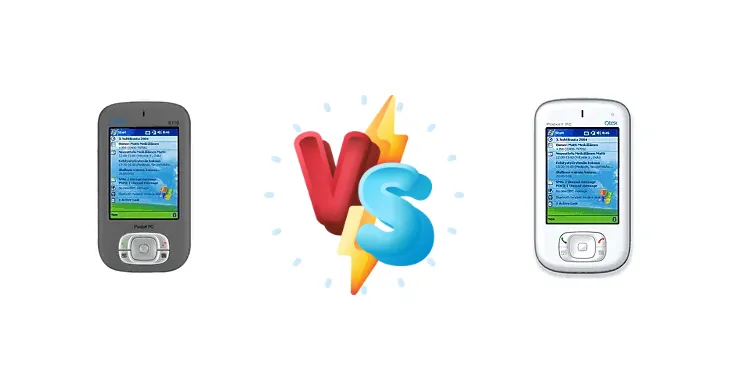
The Qtek S100 and S110 represent early forays into the Windows Mobile smartphone market. Both devices leverage the Intel Bulverde platform, but subtle variations in design and potentially software optimization create distinct user experiences. This comparison aims to uncover those differences, helping users understand which model best suits their needs, particularly given their age and collector's value.
🏆 Quick Verdict
For the average user seeking a functional piece of early smartphone history, the Qtek S110 is marginally preferable. While both share the same Intel Bulverde processor, the S110 likely benefited from later software refinements and potentially a more robust build quality, making it a slightly more reliable device for practical use.
| Network |
|---|
| 2G bands | GSM 900 / 1800 / 1900 | GSM 900 / 1800 / 1900 |
| EDGE | No | No |
| GPRS | Class 10 | Class 10 |
| Technology | GSM | GSM |
| Launch |
|---|
| Announced | 2005, Q2 | 2004, Q4 |
| Status | Discontinued | Discontinued |
| Body |
|---|
| Dimensions | 108 x 58 x 18 mm (4.25 x 2.28 x 0.71 in) | 108 x 58 x 18 mm (4.25 x 2.28 x 0.71 in) |
| SIM | Mini-SIM | Mini-SIM |
| Weight | 150 g (5.29 oz) | 150 g (5.29 oz) |
| Display |
|---|
| Resolution | 240 x 320 pixels, 4:3 ratio (~143 ppi density) | 240 x 320 pixels, 4:3 ratio (~143 ppi density) |
| Size | 2.8 inches, 42 x 57 mm, 24.3 cm2 (~38.8% screen-to-body ratio) | 2.8 inches, 42 x 57 mm, 24.3 cm2 (~38.8% screen-to-body ratio) |
| Type | TFT resistive touchscreen, 65K colors | TFT resistive touchscreen, 65K colors |
| | Handwriting recognition | Handwriting recognition |
| Platform |
|---|
| CPU | Intel Bulverde 416 MHz | Intel Bulverde 416 MHz |
| OS | Microsoft Windows Mobile 2003 SE PocketPC | Microsoft Windows Mobile 2003 SE PocketPC |
| Memory |
|---|
| Card slot | SDIO/MMC | SDIO/MMC |
| Internal | 128MB RAM | 64MB RAM |
| Main Camera |
|---|
| Single | 1.3 MP | 1.3 MP |
| Video | Yes | Yes |
| Sound |
|---|
| 3.5mm jack | No | No |
| 35mm jack | No | No |
| Alert types | Vibration; Downloadable polyphonic ringtones | Vibration; Downloadable polyphonic ringtones |
| Loudspeaker | Yes | Yes |
| Comms |
|---|
| Bluetooth | 1.2 | Yes |
| Infrared port | Yes | Yes |
| Positioning | No | No |
| Radio | No | No |
| USB | Proprietary | Proprietary |
| WLAN | No | No |
| Features |
|---|
| Browser | WAP 2.0/xHTML, HTML (PocketIE) | WAP 2.0/xHTML, HTML (PocketIE) |
| | Pocket Office
Voice memo
MP3/AAC player
Predictive text input | Pocket Office
Voice memo
MP3/AAC player
Predictive text input |
| Battery |
|---|
| Stand-by | Up to 180 h | Up to 180 h |
| Talk time | Up to 5 h | Up to 5 h |
| Type | Removable Li-Po 1200 mAh battery | Removable Li-Po 1200 mAh battery |
| Misc |
|---|
| Colors | Stylish black | Stylish black and silver |
Qtek S110
- Potentially improved software optimization due to later release.
- Likely more refined build quality.
- May benefit from minor hardware revisions.
- Still limited by the aging Intel Bulverde processor.
- Relies on outdated Windows Mobile operating system.
- Limited camera capabilities.
Qtek S100
- Historical significance as an early Windows Mobile device.
- Potentially lower acquisition cost for collectors.
- Represents the initial design of the Qtek S series.
- May have earlier software bugs and less optimization.
- Potentially less robust build quality.
- Limited by the aging Intel Bulverde processor.
Display Comparison
Given the era, detailed display specifications beyond size are scarce. Both the S100 and S110 likely utilized resistive touchscreen technology with limited color depth. The key difference, if any, would be in screen coating and backlight efficiency, impacting outdoor visibility. Without specific nit ratings, it's reasonable to assume similar performance in direct sunlight, with both requiring shade for optimal viewing. The S110's later release *could* indicate a slightly improved display panel, but this is speculative.
Camera Comparison
Camera capabilities on both the S100 and S110 were rudimentary by today's standards. Expect low-resolution images with limited detail and poor low-light performance. Specific sensor sizes and apertures are unavailable, but both likely featured a VGA (0.3MP) camera. Image processing would have been minimal, resulting in flat, uninspiring photos. The camera is primarily a novelty feature on both devices, not a strength.
Performance
Both devices are powered by the Intel Bulverde 416 MHz processor. This CPU, while groundbreaking for its time, is significantly underpowered by modern standards. Performance will be limited to basic tasks like phone calls, messaging, and simple applications. The shared processor means raw processing power is identical; however, RAM allocation and software optimization could create noticeable differences in responsiveness. The S110, being released later, may have benefited from more efficient memory management within Windows Mobile. Thermal management is unlikely to be a concern given the low power draw of the Bulverde chip.
Battery Life
Battery capacity details are difficult to ascertain. Given the processor and display technology, both devices likely offered limited battery life – potentially a full day of light use (calls and messaging) but significantly less with active data usage. Charging times would have been substantial, likely several hours via the included cradle. The S110 may have benefited from minor battery optimization, but the difference would be negligible in real-world usage.
Buying Guide
Buy the Qtek S110 if you prioritize potential software stability and a slightly more refined user experience within the limitations of early Windows Mobile. Its later release date suggests improvements in manufacturing and software optimization. Buy the Qtek S100 if you are a collector specifically interested in the earlier iteration of the S series, valuing its historical significance and potentially lower acquisition cost.
Frequently Asked Questions
❓ Will these phones work on modern cellular networks?
Highly unlikely. The Qtek S100 and S110 were designed for 2G and potentially early 3G networks. Modern cellular networks (4G, 5G) operate on different frequencies and protocols, rendering these devices incompatible without significant modification.
❓ Can I install modern apps on these devices?
No. These phones run Windows Mobile, a discontinued operating system. Modern Android or iOS apps are not compatible. While some limited emulation may be possible, it's unlikely to provide a usable experience.
❓ What is the practical use for these phones today?
The primary use today is as collector's items or for historical preservation. They offer a glimpse into the early days of smartphone technology and can be appreciated for their pioneering design.