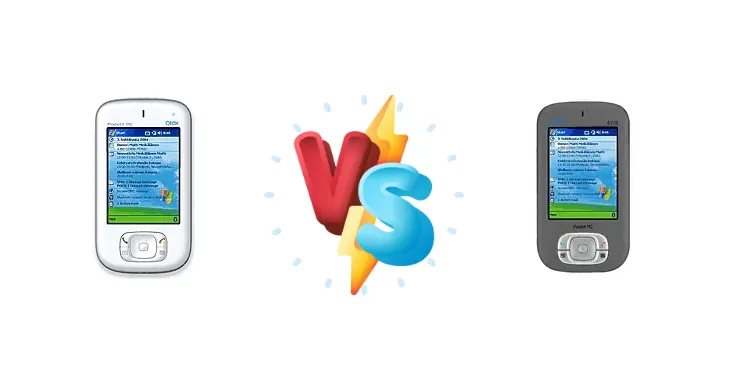
The Qtek S100 and S110 represent early forays into the Windows Mobile smartphone space, both leveraging Intel’s Bulverde platform. While seemingly similar on paper, subtle design and software choices differentiate these devices, impacting their usability for the modern collector or retro-tech enthusiast. This comparison dissects these nuances to determine which device offers the better experience.
🏆 Quick Verdict
For the user prioritizing potential software compatibility and a slightly more refined experience, the Qtek S110 emerges as the better choice. Both devices offer identical core performance due to the shared Intel Bulverde processor, but the S110’s later release likely benefited from software optimizations and bug fixes.
| Network |
|---|
| 2G bands | GSM 900 / 1800 / 1900 | GSM 900 / 1800 / 1900 |
| EDGE | No | No |
| GPRS | Class 10 | Class 10 |
| Technology | GSM | GSM |
| Launch |
|---|
| Announced | 2004, Q4 | 2005, Q2 |
| Status | Discontinued | Discontinued |
| Body |
|---|
| Dimensions | 108 x 58 x 18 mm (4.25 x 2.28 x 0.71 in) | 108 x 58 x 18 mm (4.25 x 2.28 x 0.71 in) |
| SIM | Mini-SIM | Mini-SIM |
| Weight | 150 g (5.29 oz) | 150 g (5.29 oz) |
| Display |
|---|
| Resolution | 240 x 320 pixels, 4:3 ratio (~143 ppi density) | 240 x 320 pixels, 4:3 ratio (~143 ppi density) |
| Size | 2.8 inches, 42 x 57 mm, 24.3 cm2 (~38.8% screen-to-body ratio) | 2.8 inches, 42 x 57 mm, 24.3 cm2 (~38.8% screen-to-body ratio) |
| Type | TFT resistive touchscreen, 65K colors | TFT resistive touchscreen, 65K colors |
| | Handwriting recognition | Handwriting recognition |
| Platform |
|---|
| CPU | Intel Bulverde 416 MHz | Intel Bulverde 416 MHz |
| OS | Microsoft Windows Mobile 2003 SE PocketPC | Microsoft Windows Mobile 2003 SE PocketPC |
| Memory |
|---|
| Card slot | SDIO/MMC | SDIO/MMC |
| Internal | 64MB RAM | 128MB RAM |
| Main Camera |
|---|
| Single | 1.3 MP | 1.3 MP |
| Video | Yes | Yes |
| Sound |
|---|
| 3.5mm jack | No | No |
| 35mm jack | No | No |
| Alert types | Vibration; Downloadable polyphonic ringtones | Vibration; Downloadable polyphonic ringtones |
| Loudspeaker | Yes | Yes |
| Comms |
|---|
| Bluetooth | Yes | 1.2 |
| Infrared port | Yes | Yes |
| Positioning | No | No |
| Radio | No | No |
| USB | Proprietary | Proprietary |
| WLAN | No | No |
| Features |
|---|
| Browser | WAP 2.0/xHTML, HTML (PocketIE) | WAP 2.0/xHTML, HTML (PocketIE) |
| | Pocket Office
Voice memo
MP3/AAC player
Predictive text input | Pocket Office
Voice memo
MP3/AAC player
Predictive text input |
| Battery |
|---|
| Stand-by | Up to 180 h | Up to 180 h |
| Talk time | Up to 5 h | Up to 5 h |
| Type | Removable Li-Po 1200 mAh battery | Removable Li-Po 1200 mAh battery |
| Misc |
|---|
| Colors | Stylish black and silver | Stylish black |
Qtek S100
- First-to-market appeal for collectors.
- Represents the original design iteration.
- Potential for lower acquisition cost due to age.
- Likely to have more software bugs and compatibility issues.
- May lack driver optimizations present in the S110.
- Potentially lower battery life due to less refined power management.
Qtek S110
- Likely benefits from software optimizations and bug fixes.
- Potentially smoother user experience.
- May have slightly improved battery life.
- Less desirable for collectors seeking the original model.
- May command a slightly higher price.
- Still limited by the underlying Bulverde hardware.
Display Comparison
Given the era, detailed display specifications beyond size are scarce. Both devices likely utilized resistive touchscreen technology common at the time. The absence of information regarding panel type (TFT, LCD) or resolution prevents a meaningful comparison. However, the S110’s later release *may* have benefited from minor improvements in screen calibration or backlight uniformity, though this is speculative. The user experience will be largely defined by the resistive touchscreen's accuracy and responsiveness, a factor likely consistent between both models.
Camera Comparison
Information regarding camera specifications is absent. Given the era, both devices likely featured low-resolution cameras (likely VGA or 1.3MP) primarily intended for basic photo capture and video calls. Image quality would be poor by modern standards, and features like optical image stabilization (OIS) were non-existent. The camera experience will be largely defined by the software interface and the quality of the lens, factors unlikely to differ significantly between the S100 and S110.
Performance
Both the Qtek S100 and S110 are powered by the Intel Bulverde 416 MHz processor. This means raw CPU performance will be virtually identical. The Bulverde platform, while innovative for its time, was limited by its clock speed and architecture. Performance bottlenecks would likely stem from RAM capacity (unspecified in the provided data) and the efficiency of the Windows Mobile operating system. The S110, released later, may have benefited from driver optimizations or minor firmware tweaks that could translate to slightly snappier application loading times, but the difference would be negligible in real-world use.
Battery Life
Battery capacity is not specified for either device. Given the power consumption of the Intel Bulverde processor and the resistive touchscreen technology, battery life would have been limited. The S110 *might* have incorporated minor battery optimizations or a slightly more efficient power management IC, potentially extending runtime by a small margin. However, real-world battery life would heavily depend on usage patterns (e.g., Wi-Fi usage, screen brightness).
Buying Guide
Buy the Qtek S100 if you are a collector seeking the earliest iteration of this design and are comfortable with potentially encountering more software quirks. Buy the Qtek S110 if you prefer a device with a higher probability of smoother operation and broader software support within the Windows Mobile ecosystem, even if it means sacrificing the 'first-to-market' appeal of the S100.
Frequently Asked Questions
❓ Will these devices work with modern cellular networks?
No. The Qtek S100 and S110 support 2G and potentially early 3G networks. Modern cellular networks (4G, 5G) are incompatible. These devices are primarily suitable for collectors or for use with legacy network infrastructure.
❓ Can I install modern apps on these devices?
Installing modern apps is extremely difficult, if not impossible. These devices run Windows Mobile, a discontinued operating system. While some legacy apps may still be available, compatibility is limited. Emulation is a potential option, but performance will be severely constrained by the Bulverde processor.
❓ What kind of storage does the Qtek S110 offer compared to the S100?
Storage details are not provided. However, both devices likely utilized either internal ROM or SD card expansion for storage. The S110 *may* have offered a slightly larger internal storage capacity, but this is speculative. SD card support would have been the primary method for expanding storage on both models.