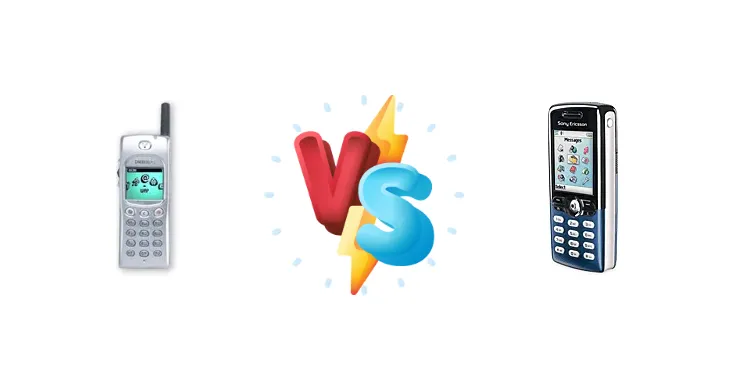
Before smartphones dominated our pockets, Philips and Sony Ericsson battled for feature phone supremacy. The Philips Xenium 9@9 and Sony Ericsson T610 represent peak design and functionality from the early 2000s. This comparison revisits these titans, analyzing their strengths and weaknesses in a modern context, understanding their impact on the mobile landscape.
🏆 Quick Verdict
For the average user seeking a nostalgic trip or a durable, long-lasting feature phone, the Sony Ericsson T610 emerges as the slightly stronger choice. Its iconic design, coupled with a more established brand reputation and likely wider availability of accessories, gives it a slight edge over the Philips Xenium 9@9.
| Network |
|---|
| 2G bands | GSM 900 / 1800 | GSM 900 / 1800 / 1900 |
| EDGE | No | No |
| GPRS | No | Class 8 |
| Technology | GSM | GSM |
| Launch |
|---|
| Announced | 2000 | 2003, Q2 |
| Status | Discontinued | Discontinued |
| Body |
|---|
| Dimensions | 109 x 41 x 22 mm, 85 cc (4.29 x 1.61 x 0.87 in) | 102 x 44 x 19 mm (4.02 x 1.73 x 0.75 in) |
| SIM | Mini-SIM | Mini-SIM |
| Weight | 95 g (3.35 oz) | 95 g (3.35 oz) |
| Display |
|---|
| Resolution | 5 lines | 128 x 160 pixels (~114 ppi density) |
| Size | - | 1.8 inches, 10.2 cm2 (~22.7% screen-to-body ratio) |
| Type | Monochrome graphic | STN, 65K colors |
| | - | Wallpapers |
| Memory |
|---|
| Call records | 10 dialed, 10 received, 10 missed calls | 30 received, dialed and missed calls |
| Card slot | No | No |
| Internal | - | 2MB |
| Phonebook | - | 8 fields, 510 items, Photo call |
| | - | 300 organizer entries |
| Main Camera |
|---|
| Single | - | CIF |
| Video | - | No |
| Sound |
|---|
| 3.5mm jack | - | No |
| 35mm jack | No | No |
| Alert types | Vibration; Monophonic ringtones, composer | Vibration; Downloadable polyphonic ringtones, composer |
| Loudspeaker | No | No |
| | - | Ringtones can be assigned to phonebook entries |
| Comms |
|---|
| Bluetooth | No | 1.0b |
| Infrared port | - | Yes |
| Positioning | No | No |
| Radio | No | No |
| WLAN | No | No |
| Features |
|---|
| Alarm | Yes | Yes |
| Browser | WAP | WAP 2.0/xHTML |
| Clock | Yes | Yes |
| Games | Bricks | Deep Abyss, Five Stones, Minigolf and downloadable |
| Java | No | Yes |
| Messaging | SMS | SMS, EMS, MMS, Email |
| | - | Predictive text input
Organizer
Voice memo |
| Battery |
|---|
| Stand-by | up to 600 h | Up to 310 h |
| Talk time | 3 - 7 h | Up to 14 h |
| Type | Removable Li-Ion battery | Removable Li-Ion 770 mAh battery (BST-25) |
| Misc |
|---|
| Colors | 4 | 3 |
| SAR | - | 1.21 W/kg (head) 0.97 W/kg (body) |
| SAR EU | - | 0.89 W/kg (head) |
Philips Xenium 9@9
- Potentially superior build quality and durability
- Extended battery life (Xenium branding)
- Rarity and collector's appeal
- Less recognizable brand
- Potentially less refined software experience
- Limited accessory availability
Sony Ericsson T610
- Iconic and recognizable design
- Established brand reputation
- Wider availability of accessories and repair options
- Potentially shorter battery life
- Less rugged build quality
- May lack the 'Xenium' battery optimization
Display Comparison
Given the era, both phones likely featured monochrome LCD screens with limited resolution. The Sony Ericsson T610, however, benefited from Sony's display expertise, potentially offering slightly better contrast and viewing angles. The T610’s screen size was likely optimized for text readability, a key feature for messaging, while the Xenium 9@9 may have prioritized maximizing battery life by using a smaller display. Bezels were substantial on both, dictated by the technology of the time.
Camera Comparison
Both phones likely featured rudimentary cameras, if any. The T610 may have included a VGA camera, a significant selling point at the time, allowing for basic photo capture. The Xenium 9@9 may have omitted a camera entirely to focus on battery life and durability. Image quality would be extremely low by today’s standards, limited by sensor size and processing power. The primary use case was novelty, not serious photography.
Performance
Performance in these devices is dictated by the processor architecture and available memory, both of which were limited. The Sony Ericsson T610 likely benefited from a more optimized software stack, given Sony Ericsson’s experience in mobile phone software development. The Philips Xenium 9@9, while potentially utilizing a similar processor, may have suffered from less refined software, impacting responsiveness. Neither phone would be capable of multitasking in the modern sense.
Battery Life
The Philips Xenium line was renowned for its exceptional battery life. The 9@9 likely featured a larger battery capacity than the T610, prioritizing talk time and standby duration. However, the Sony Ericsson T610 may have employed more efficient power management techniques, partially offsetting the battery capacity difference. Both phones would offer significantly longer battery life than modern smartphones, lasting several days on a single charge with moderate use.
Buying Guide
Buy the Philips Xenium 9@9 if you prioritize a potentially more rugged build quality and a less common, collector's item status. Its focus on extended battery life, implied by the 'Xenium' branding, would appeal to users needing reliable communication without frequent charging. Buy the Sony Ericsson T610 if you value a sleek, recognizable design, a more intuitive user interface (based on Sony Ericsson's established software), and a broader ecosystem of accessories and potential repair options.
Frequently Asked Questions
❓ Is the Sony Ericsson T610 still compatible with modern networks?
No. The Sony Ericsson T610 operates on 2G networks, which are being phased out globally. It will likely not function on modern 3G, 4G, or 5G networks.
❓ Can I find replacement batteries for the Philips Xenium 9@9?
Finding replacement batteries for the Philips Xenium 9@9 will be extremely difficult. Due to its age and relative rarity, aftermarket support is limited. Sourcing a battery may require searching specialized vintage electronics retailers or online auction sites.
❓ What kind of data transfer options did these phones offer?
Both phones primarily relied on SMS messaging and WAP browsing for data transfer. Connectivity options were limited to proprietary data cables for connecting to a computer, primarily for syncing contacts and transferring ringtones.