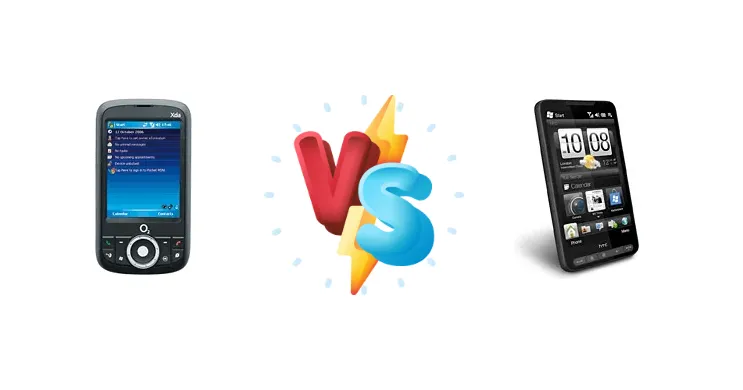
Comparing the O2 XDA Orbit and the HTC HD2 isn't just a spec sheet exercise; it's a journey through a pivotal era of smartphone development. The Orbit represents the tail end of Windows Mobile's early dominance, while the HD2 foreshadows the modern smartphone experience with its significantly more powerful processor and larger display. This comparison highlights the dramatic leap in mobile processing power within a relatively short timeframe.
🏆 Quick Verdict
For the average user today, the HTC HD2 is the clear winner. Its 1.0 GHz Snapdragon S1 processor provides a vastly superior experience to the O2 XDA Orbit’s 200 MHz OMAP 850, enabling smoother multitasking and a more responsive user interface. While both are relics, the HD2 is the more functional and enjoyable device in 2024.
| Network |
|---|
| 2G bands | GSM 850 / 900 / 1800 / 1900 | GSM 850 / 900 / 1800 / 1900 |
| 3G bands | - | HSDPA 900 / 2100 |
| EDGE | Class 10 | - |
| GPRS | Class 10 | - |
| Speed | - | HSPA 7.2/2 Mbps |
| Technology | GSM | GSM / HSPA |
| | - | HSDPA 850 / 2100 - Australian Version |
| Launch |
|---|
| Announced | 2006, September | 2009, October. Released 2009, November |
| Status | Discontinued | Discontinued |
| Body |
|---|
| Dimensions | 108 x 58 x 16.8 mm (4.25 x 2.28 x 0.66 in) | 120.5 x 67 x 11 mm (4.74 x 2.64 x 0.43 in) |
| SIM | Mini-SIM | Mini-SIM |
| Weight | 129 g (4.55 oz) | 157 g (5.54 oz) |
| Display |
|---|
| Resolution | 240 x 320 pixels, 4:3 ratio (~143 ppi density) | 480 x 800 pixels, 5:3 ratio (~217 ppi density) |
| Size | 2.8 inches, 24.3 cm2 (~38.8% screen-to-body ratio) | 4.3 inches, 52.6 cm2 (~65.2% screen-to-body ratio) |
| Type | TFT resistive touchscreen, 65K colors | TFT, 65K colors |
| | Handwriting recognition | - |
| Platform |
|---|
| CPU | 200 MHz ARM926EJ-S | 1.0 GHz Scorpion |
| Chipset | TI OMAP 850 | Qualcomm QSD8250 Snapdragon S1 |
| GPU | - | Adreno 200 |
| OS | Microsoft Windows Mobile 5.0 PocketPC | Microsoft Windows Mobile 6.5 Professional, Sense UI |
| Memory |
|---|
| Card slot | microSD (dedicated slot) | microSDHC (dedicated slot) |
| Internal | 64MB RAM, 128MB ROM | 448MB RAM, 512MB ROM |
| Main Camera |
|---|
| Features | - | Dual-LED flash |
| Single | 2 MP | 5 MP, AF |
| Video | QCIF | 480p@30fps |
| Sound |
|---|
| 3.5mm jack | No | Yes |
| 35mm jack | No | Yes |
| Alert types | Vibration; Downloadable polyphonic, MP3 ringtones | - |
| Loudspeaker | Yes | Yes |
| Comms |
|---|
| Bluetooth | 2.0 | 2.1, A2DP |
| Positioning | GPS, CoPilot Live Navigator | GPS, A-GPS; NaviPanel |
| Radio | FM radio | Stereo FM radio, RDS |
| USB | Proprietary | microUSB |
| WLAN | Wi-Fi 802.11b/g | Wi-Fi 802.11 b/g, Wi-Fi router |
| Features |
|---|
| Browser | WAP 2.0/xHTML, HTML (PocketIE) | WAP 2.0/xHTML, HTML |
| Sensors | - | Accelerometer, proximity, compass |
| | Pocket Office
Voice memo
MP3/AAC player | MP3/WAV/WMA/eAAC+ player
MP4/WMV/H.264 player
Facebook and Twitter integration
YouTube client
Pocket Office
HTC Peep, HTC Footprints
Voice memo
Predictive text input |
| Battery |
|---|
| Music play | - | Up to 12 h |
| Stand-by | Up to 200 h | Up to 490 h (2G) / Up to 390 h (3G) |
| Talk time | Up to 5 h | Up to 6 h 20 min (2G) / Up to 5 h 40 min (3G) |
| Type | Removable Li-Ion battery | Removable Li-Ion 1230 mAh battery |
| Misc |
|---|
| Colors | Silver, Black | Black |
| Price | - | About 140 EUR |
| SAR | - | 0.63 W/kg (head) 0.72 W/kg (body) |
| Tests |
|---|
| Audio quality | - |
Noise -89.0dB / Crosstalk -87.5dB |
| Camera | - |
Photo |
| Loudspeaker | - |
Voice 75dB / Noise 72dB / Ring 78dB |
O2 XDA Orbit
- Compact size and form factor
- Nostalgic value for Windows Mobile enthusiasts
- Simpler user interface (potentially)
- Extremely slow processor
- Limited functionality by modern standards
- Poor multitasking capabilities
HTC HD2
- Significantly faster processor
- Larger display for better usability
- More responsive user interface
- Larger size and weight
- Battery life likely shorter than the Orbit
- Still limited by outdated technology
Display Comparison
The O2 XDA Orbit’s display specifications are not provided, but given its era, it likely featured a small, resistive touchscreen with a low resolution. In contrast, the HTC HD2 boasted a significantly larger display, though the exact specifications (resolution, panel type) are not provided. The HD2’s larger screen size alone provides a substantial advantage for media viewing and general usability. The resistive touchscreen of the Orbit requires more pressure and is less responsive than the capacitive technology that was becoming prevalent around the HD2’s release.
Camera Comparison
Both devices feature a 'Photo' camera, but the specifics are missing. Given the era, both cameras likely offered low resolution and limited functionality. The HD2, being a later model, likely had a slightly more advanced camera module, potentially with autofocus or a higher megapixel count, but neither device is expected to deliver high-quality images by today’s standards. The lack of detailed camera specifications makes a direct comparison difficult, but the HD2’s more modern chipset likely allowed for better image processing.
Performance
The performance gap between these two devices is immense. The O2 XDA Orbit’s 200 MHz ARM926EJ-S processor, coupled with the TI OMAP 850 chipset, was adequate for basic tasks in its time, but struggles with even simple modern operations. The HTC HD2’s 1.0 GHz Qualcomm QSD8250 Snapdragon S1 represents a generational leap. The Snapdragon’s Scorpion architecture and higher clock speed deliver significantly faster processing, enabling smoother multitasking, quicker application loading times, and a more responsive user experience. The HD2’s chipset also benefits from a more advanced manufacturing process, leading to improved power efficiency.
Battery Life
Battery capacity details are unavailable for both devices. However, the HD2’s more powerful processor and larger display likely resulted in shorter battery life compared to the Orbit, despite potentially having a larger battery. The HD2’s Snapdragon S1, while more efficient per clock cycle, consumed more power overall due to its higher performance. Charging times would have been significantly longer for both devices compared to modern smartphones, relying on slower charging standards.
Buying Guide
Buy the O2 XDA Orbit if you're a collector focused on experiencing the historical roots of Windows Mobile and appreciate a more compact form factor. Its appeal lies in its nostalgic value and simplicity. Buy the HTC HD2 if you want a taste of early smartphone power, a larger screen for media consumption, and a device that, while still dated, offers a more usable experience with modern apps (through emulation or limited compatibility).
Frequently Asked Questions
❓ Can the HTC HD2 run modern apps?
Directly, no. The HD2 runs Windows Mobile 6.5, which is incompatible with modern Android or iOS apps. However, enthusiasts have successfully ported Android to the HD2, allowing for limited access to a wider range of applications, though performance will vary significantly.
❓ Is the O2 XDA Orbit still usable as a daily driver in 2024?
Highly unlikely. The O2 XDA Orbit’s slow processor and limited functionality make it impractical for modern use. Basic tasks like web browsing and email are sluggish, and the lack of app support severely restricts its capabilities. It's best suited for collectors or those interested in experiencing early Windows Mobile.
❓ What kind of connectivity does the HTC HD2 offer?
The HTC HD2 supports 3G connectivity, Wi-Fi, and Bluetooth. However, it lacks support for modern standards like 4G or 5G. Data speeds will be significantly slower compared to contemporary smartphones.
❓ Are replacement batteries readily available for either device?
Finding replacement batteries for both the O2 XDA Orbit and the HTC HD2 can be challenging. They are older devices, and battery availability is limited. Third-party batteries may be available, but their quality and reliability can vary.