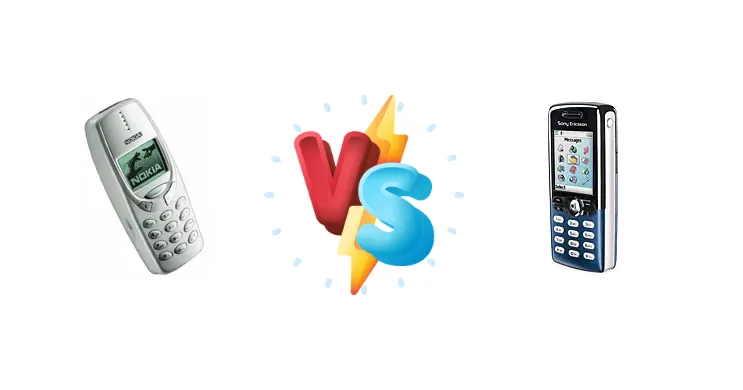
The early 2000s saw a pivotal shift in mobile technology. The Nokia 3310, a bastion of reliability and simplicity, represented the peak of feature phone design. Simultaneously, Sony Ericsson’s T610 attempted to bridge the gap between feature phones and the burgeoning smartphone market, introducing features previously unseen in mass-market devices. This comparison examines how these two iconic phones defined their respective eras and which holds up better in retrospect.
🏆 Quick Verdict
For the user prioritizing unbreakable reliability and exceptional battery life, the Nokia 3310 remains the clear winner. However, the Sony Ericsson T610’s early adoption of smartphone-like features – a color screen, limited internet access, and basic applications – makes it the more interesting device for tech enthusiasts and collectors.
| Network |
|---|
| 2G bands | GSM 900 / 1800 | GSM 900 / 1800 / 1900 |
| EDGE | No | No |
| GPRS | No | Class 8 |
| Technology | GSM | GSM |
| Launch |
|---|
| Announced | 2000 | 2003, Q2 |
| Status | Discontinued | Discontinued |
| Body |
|---|
| Dimensions | 113 x 48 x 22 mm, 97 cc (4.45 x 1.89 x 0.87 in) | 102 x 44 x 19 mm (4.02 x 1.73 x 0.75 in) |
| SIM | Mini-SIM | Mini-SIM |
| Weight | 133 g (4.69 oz) | 95 g (3.35 oz) |
| Display |
|---|
| Resolution | 5 lines | 128 x 160 pixels (~114 ppi density) |
| Size | - | 1.8 inches, 10.2 cm2 (~22.7% screen-to-body ratio) |
| Type | Monochrome graphic | STN, 65K colors |
| | - | Wallpapers |
| Memory |
|---|
| Call records | 8 dialed, 8 received, 8 missed calls | 30 received, dialed and missed calls |
| Card slot | No | No |
| Internal | - | 2MB |
| Phonebook | SIM only | 8 fields, 510 items, Photo call |
| | - | 300 organizer entries |
| Main Camera |
|---|
| Single | - | CIF |
| Video | - | No |
| Sound |
|---|
| 3.5mm jack | - | No |
| 35mm jack | No | No |
| Alert types | Vibration; Downloadable monophonic ringtones | Vibration; Downloadable polyphonic ringtones, composer |
| Loudspeaker | No | No |
| | - | Ringtones can be assigned to phonebook entries |
| Comms |
|---|
| Bluetooth | No | 1.0b |
| Infrared port | - | Yes |
| Positioning | No | No |
| Radio | No | No |
| WLAN | No | No |
| Features |
|---|
| Alarm | Yes | Yes |
| Browser | - | WAP 2.0/xHTML |
| Clock | Yes | Yes |
| Games | 4 ( Snake II, Pairs II, Space Impact, Bantumi ) | Deep Abyss, Five Stones, Minigolf and downloadable |
| Java | No | Yes |
| Languages | 17 for menu, 11 for T9 | - |
| Messaging | SMS | SMS, EMS, MMS, Email |
| | - | Predictive text input
Organizer
Voice memo |
| Battery |
|---|
| Stand-by | 55 h to 245 h | Up to 310 h |
| Talk time | 2 h 30 min to 4 h 30 | Up to 14 h |
| Type | Removable NiMH 900 mAh battery (BMC-3) | Removable Li-Ion 770 mAh battery (BST-25) |
| Misc |
|---|
| Colors | User exchangeable front and back covers | 3 |
| SAR | - | 1.21 W/kg (head) 0.97 W/kg (body) |
| SAR EU | 0.96 W/kg (head) | 0.89 W/kg (head) |
Nokia 3310
- Unmatched durability and build quality
- Exceptional battery life (weeks on standby)
- Simple and intuitive user interface
- Monochrome display
- Lack of advanced features (no camera, limited internet)
Sony Ericsson T610
- Color display for a more engaging experience
- Early adoption of Java applications
- Basic internet connectivity (WAP)
- Significantly shorter battery life
- Less durable build quality
- Sluggish performance compared to the Nokia 3310
Display Comparison
The Nokia 3310 featured a monochrome LCD, prioritizing legibility and battery conservation. In contrast, the Sony Ericsson T610 boasted a color STN LCD. While the T610’s color display offered a more visually engaging experience, it came at the cost of battery life and outdoor visibility. The Nokia’s simpler display technology, while less aesthetically pleasing, was demonstrably more energy-efficient and readable in direct sunlight. The T610’s attempt at color was a significant step, but the technology wasn’t mature enough to compete with the Nokia’s clarity.
Camera Comparison
Neither device featured a camera. The inclusion of cameras was still nascent in the early 2000s and reserved for higher-end devices. The Nokia 3310’s focus was entirely on core communication, while the Sony Ericsson T610 prioritized other features like internet connectivity and applications over image capture. The absence of a camera on both devices reflects the market priorities of the time.
Performance
Analyzing performance is challenging given the limited processing power of both devices. The Nokia 3310 relied on a single-chip solution optimized for basic functions like calls and SMS. The Sony Ericsson T610, while also utilizing a single-chip solution, included a more powerful processor to handle the demands of its color display, Java applications, and rudimentary web browsing. This processing power, however, came at the expense of battery life. The T610’s architecture represented an early attempt at multitasking, but its limited RAM and processing speed resulted in sluggish performance compared to the Nokia’s streamlined operation.
Battery Life
The Nokia 3310 is legendary for its battery life, often lasting days or even weeks on a single charge due to its low-power monochrome display and efficient chipset. The Sony Ericsson T610, with its color screen and more demanding processor, offered significantly shorter battery life, typically lasting only a day or two with moderate use. The Nokia’s battery capacity, combined with its power-saving design, made it a standout feature and a key selling point.
Buying Guide
Buy the Nokia 3310 if you need a phone that can withstand extreme conditions, offers weeks of standby time, and prioritizes core communication functions above all else. It’s the ultimate ‘dumbphone’ for minimalists and those seeking a digital detox. Buy the Sony Ericsson T610 if you appreciate early mobile innovation, desire a color display and basic internet capabilities, and are willing to trade some robustness for a glimpse into the future of mobile computing.
Frequently Asked Questions
❓ Is the Sony Ericsson T610's WAP browser usable today?
No, the WAP browser on the T610 is largely unusable today. WAP protocols are outdated and most modern websites are not optimized for them. Furthermore, data networks have evolved significantly, rendering the T610’s connectivity extremely slow and unreliable.
❓ Can I still find replacement batteries for the Nokia 3310?
Yes, replacement batteries for the Nokia 3310 are readily available online from various retailers. Due to the phone’s enduring popularity, a robust aftermarket for accessories and spare parts exists. However, quality can vary, so it’s advisable to purchase from reputable sources.
❓ Which phone is better for playing retro games?
The Nokia 3310 is the superior choice for playing retro games, specifically *Snake*. Its simple interface and long battery life make it ideal for extended gaming sessions. While the T610 could run Java games, the experience was often hampered by slow performance and limited game selection.