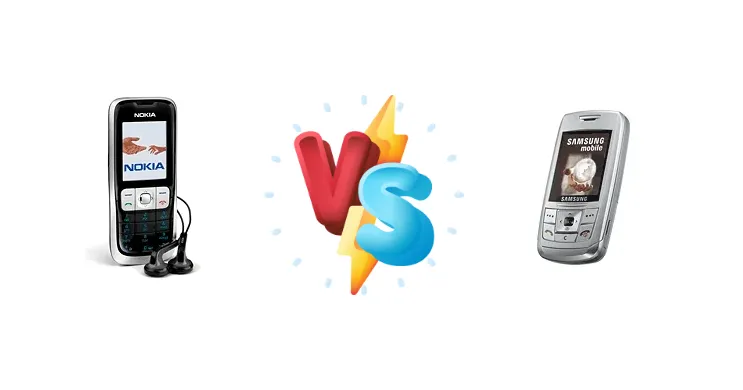
In a world dominated by smartphones, the humble feature phone continues to hold appeal for those seeking simplicity, durability, and extended battery life. The Nokia 2630 and Samsung E250 represent this segment, offering core communication features without the complexities of modern operating systems. This comparison dissects their strengths and weaknesses, helping you determine which best suits your needs.
🏆 Quick Verdict
For users prioritizing robust build quality and a potentially wider service network, the Nokia 2630 is the better choice. However, the Samsung E250’s compact form factor and potentially lower price point make it a viable option for those needing an ultra-portable, basic communication device.
| Network |
|---|
| 2G bands | GSM 900 / 1800 | GSM 900 / 1800 / 1900 |
| EDGE | Class 6 | Yes |
| GPRS | Class 10 | Class 10 |
| Technology | GSM | GSM |
| | GSM 850 / 1900 - US version | - |
| Launch |
|---|
| Announced | 2007, May | 2006, October |
| Status | Discontinued | Discontinued |
| Body |
|---|
| Dimensions | 105 x 45 x 9.9 mm, 45 cc (4.13 x 1.77 x 0.39 in) | 99.5 x 49.5 x 14.1 mm (3.92 x 1.95 x 0.56 in) |
| SIM | Mini-SIM | Mini-SIM |
| Weight | 66 g (2.33 oz) | 80 g (2.82 oz) |
| Display |
|---|
| Resolution | 128 x 160 pixels (~114 ppi density) | 128 x 160 pixels (~102 ppi density) |
| Size | 1.8 inches, 10.2 cm2 (~21.6% screen-to-body ratio) | 2.0 inches, 32 x 40 mm, 12.6 cm2 (~25.6% screen-to-body ratio) |
| Type | TFT, 65K colors | TFT, 65K colors |
| | 4-way scrolling
Screensavers, themes and wallpapers | - |
| Memory |
|---|
| Call records | 20 dialed, 20 received, 20 missed calls | 30 dialed, 30 received, 30 missed calls |
| Card slot | No | microSD (dedicated slot) |
| Internal | 11MB | 10MB |
| Phonebook | 1000 entries, Photocall | 1000 entries, Photocall |
| Main Camera |
|---|
| Single | VGA | VGA |
| Video | SQCIF | QCIF |
| Sound |
|---|
| 3.5mm jack | No | No |
| 35mm jack | No | No |
| Alert types | Vibration; Downloadable polyphonic, MP3 ringtones | Vibration; Downloadable polyphonic, MP3 ringtones |
| Loudspeaker | Yes | Yes |
| Comms |
|---|
| Bluetooth | 2.0 | 2.0, A2DP |
| Positioning | No | No |
| Radio | FM radio | FM radio |
| USB | No | 1.1 |
| WLAN | No | No |
| Features |
|---|
| Browser | WAP 2.0/xHTML | WAP 2.0/xHTML |
| Games | Yes + downloadable | Yes + downloadable |
| Java | Yes, MIDP 2.0 | Yes, MIDP 2.0 |
| Messaging | SMS, MMS, Email, Instant Messaging | SMS, EMS, MMS, Email |
| | Predictive text input
Organizer
Voice memo | MP3/AAC/AAC+ player
Predictive text input
Organizer
Voice memo |
| Battery |
|---|
| Stand-by | Up to 310 h | Up to 250 h |
| Talk time | Up to 6 h | Up to 5 h |
| Type | Removable Li-Ion 700 mAh battery (BL-4B) | Removable Li-Ion 750 mAh battery |
| Misc |
|---|
| Colors | Black | Silver, Black |
| Price | About 60 EUR | About 90 EUR |
| SAR | 1.04 W/kg (head) 0.60 W/kg (body) | 0.48 W/kg (head) 0.54 W/kg (body) |
| SAR EU | 0.63 W/kg (head) | 0.70 W/kg (head) |
Nokia 2630
- Potentially more durable build quality (Nokia reputation)
- Likely longer software support for basic features
- Potentially larger battery capacity
- May be larger and less pocketable
- Potentially higher price point
Samsung E250
- Ultra-compact and lightweight design
- Potentially lower price point
- Simple and easy to use interface
- Potentially less durable build quality
- May have a smaller battery capacity
Display Comparison
Given both phones target the budget segment, display technology is likely basic TFT LCD. The Nokia 2630, historically, has focused on readability in outdoor conditions, suggesting a potentially brighter display than the Samsung E250. However, without specific nit ratings, it's reasonable to assume both offer similar viewing experiences – adequate for basic text and call information, but lacking the vibrancy of smartphone displays. The E250’s smaller size may translate to a slightly higher pixel density, but the impact will be minimal.
Camera Comparison
Both the Nokia 2630 and Samsung E250 likely feature a basic VGA camera (0.3MP). Image quality will be extremely limited, suitable only for very basic snapshots in good lighting conditions. The primary function of these cameras is likely for visual caller ID or simple documentation, not photography. Any differences in sensor size or lens aperture will be minimal and unlikely to significantly impact image quality. Focusing on camera capabilities for these devices is largely irrelevant.
Performance
Performance is dictated by the underlying chipset, which in both cases will be a basic 2G-focused processor. Neither phone is designed for multitasking or demanding applications. The Nokia brand historically emphasizes optimized software for its feature phones, potentially leading to a slightly smoother user experience compared to the Samsung E250. However, the difference will be negligible for typical feature phone usage – making and receiving calls and sending SMS messages. RAM capacity is likely limited on both, further restricting any potential for performance gains.
Battery Life
Feature phones excel in battery life, and both the Nokia 2630 and Samsung E250 are expected to offer days, if not weeks, of standby time on a single charge. The Nokia 2630, given its larger physical size, may accommodate a slightly larger battery capacity. However, the Samsung E250’s smaller display and potentially less power-hungry chipset could offset this difference. Charging is likely via a proprietary connector, and charging speeds will be slow compared to modern smartphones.
Buying Guide
Buy the Nokia 2630 if you need a phone built to withstand daily wear and tear, and value a brand known for reliability and potentially longer software support for basic features. Buy the Samsung E250 if you prioritize extreme portability and a minimalist design, and are looking for the most affordable option for essential calling and texting.
Frequently Asked Questions
❓ Which phone is better for areas with limited network coverage?
Both phones support 2G networks, which generally have wider coverage than 3G or 4G. However, Nokia historically has a stronger presence in emerging markets and may have optimized its phones for better performance in challenging network conditions. Checking local network compatibility is crucial regardless.
❓ Can either of these phones be used with a modern SIM card?
Yes, both the Nokia 2630 and Samsung E250 support standard SIM cards. However, they are limited to 2G connectivity, so features requiring 3G or 4G (like mobile data) will not be available. Ensure your SIM card is activated for 2G voice and SMS services.
❓ Is it possible to transfer contacts from a smartphone to either of these phones?
Transferring contacts is possible, but requires a workaround. You can save contacts as vCard (.vcf) files on your smartphone and then transfer them to the feature phone via Bluetooth (if supported) or by sending them as SMS attachments. The process is manual and may be limited by the phone's memory.