
India's smartphone production was on the rise in 2025, but strong headwinds await
- Posted on April 25, 2026, 3 a.m.
India's Smartphone Manufacturing Soars in 2025: Exports Drive Robust Growth Amidst Future Challenges
India's journey as a global smartphone manufacturing hub gained significant momentum in 2025, with production experiencing a robust 8% year-over-year growth. This impressive expansion, tracked by Counterpoint's "Make in India" initiative, was predominantly fueled by a staggering 28% surge in exports, cementing India's position on the international electronics stage. While domestic shipments saw a more modest 1% increase, exports emerged as a critical growth engine, accounting for a full one-third of all smartphones produced within the country.
A key driver of this export success can be attributed to major players like Foxconn Hon Hai, a primary assembler for tech giant Apple. Foxconn reported an exceptional 48% year-over-year growth, showcasing the strength of its operations in India. Similarly, Tata Electronics, another significant Apple assembler, made substantial contributions to the export volume. In contrast, Samsung's export figures saw a more moderate 4% growth compared to the previous year, highlighting the diverse performances within the sector.
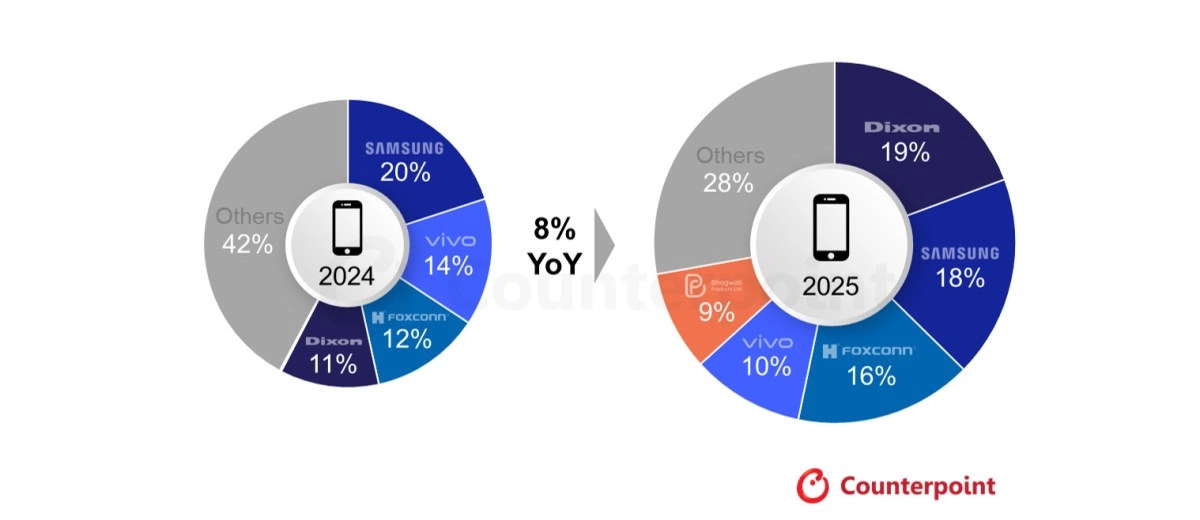
The burgeoning electronics manufacturing sector, powered significantly by smartphone production, ascended to become India's third-largest export category in fiscal year 2025. Industry analysts project an even more prominent role, anticipating it will secure the second position by FY2026, underscoring its growing economic importance and potential for further growth.
Beyond the top-tier assemblers, other manufacturers also played crucial roles in this growth story. Dixon Technologies, known for producing smartphones for popular brands like Motorola, Realme, and Xiaomi, achieved an outstanding 89% growth in orders. Furthermore, Bhagwati Products Limited strategically benefited from vivo's decision to outsource a portion of its production, with additional orders from Oppo and Realme further bolstering the company's success.
Despite the current upward trajectory, the Indian smartphone manufacturing industry faces potential hurdles on the horizon. Analysts point to several significant challenges, including a projected rise in memory chip prices, the global implications of the US-Iran geopolitical situation, and an anticipated decline in the domestic smartphone market. To mitigate these risks and ensure sustained economic success, experts advocate for strategic diversification. They suggest that India should broaden its production capabilities to include other high-demand segments such as laptops and tablets, believing these markets offer a pathway to longer-term stability and growth for the country's electronics manufacturing ecosystem.
Source
0 Responses Write a Response