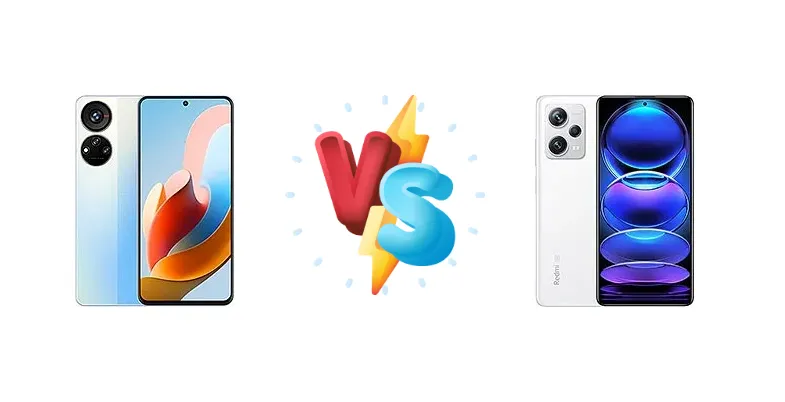
The ZTE Voyage 40 Pro+ and Xiaomi Redmi Note 12 Pro+ represent compelling options in the increasingly competitive mid-range smartphone market. While both devices aim to deliver a premium experience without the flagship price tag, they take distinctly different approaches, particularly in performance and charging speed. This comparison dissects their key specifications to determine which phone best suits your needs.
🏆 Quick Verdict
For the average user prioritizing speed and convenience, the Xiaomi Redmi Note 12 Pro+ emerges as the winner. Its significantly faster 120W charging, coupled with the more powerful Dimensity 1080 chipset, provides a noticeable advantage in daily use. However, the ZTE Voyage 40 Pro+ remains a viable option for those on a tighter budget.
| Network |
|---|
| 2G bands | GSM 850 / 900 / 1800 / 1900 | GSM 850 / 900 / 1800 / 1900 - SIM 1 & SIM 2 |
| 3G bands | HSDPA 850 / 900 / 1900 / 2100 | HSDPA 800 / 850 / 900 / 1900 / 2100 |
| 4G bands | LTE | 1, 3, 5, 8, 19, 34, 38, 39, 40, 41 - International, China |
| 5G bands | 1, 5, 28, 41, 78, 84 SA/NSA | 1, 3, 5, 8, 28, 38, 40, 41, 77, 78 SA/NSA - International |
| Speed | HSPA, LTE, 5G | HSPA, LTE-A (CA), 5G |
| Technology | GSM / CDMA / HSPA / LTE / 5G | GSM / CDMA / HSPA / EVDO / LTE / 5G |
| | - | 1, 3, 5, 8, 28, 38, 41, 77, 78 SA/NSA - China |
| Launch |
|---|
| Announced | 2022, November 29 | 2022, October 27 |
| Status | Available. Released 2022, December 06 | Available. Released 2022, November 01 |
| Body |
|---|
| Build | - | Glass front (Gorilla Glass 5), glass back |
| Dimensions | 163.5 x 75.8 x 7.6 mm (6.44 x 2.98 x 0.30 in) | 162.9 x 76 x 8.9 mm (6.41 x 2.99 x 0.35 in) |
| SIM | Nano-SIM + Nano-SIM | Dual SIM (Nano-SIM, dual stand-by) |
| Weight | 192.5 g (6.81 oz) | 208.4 g (7.34 oz) |
| | - | IP53, dust and splash resistant |
| Display |
|---|
| Protection | - | Corning Gorilla Glass 5 |
| Resolution | 1080 x 2400 pixels, 20:9 ratio (~395 ppi density) | 1080 x 2400 pixels, 20:9 ratio (~395 ppi density) |
| Size | 6.67 inches, 107.4 cm2 (~86.7% screen-to-body ratio) | 6.67 inches, 107.4 cm2 (~86.8% screen-to-body ratio) |
| Type | AMOLED, 770 nits (HBM) | OLED, 1B colors, 120Hz, Dolby Vision, HDR10+, 500 nits (typ), 900 nits (HBM) |
| Platform |
|---|
| CPU | Octa-core (2x2.4 GHz Cortex-A76 & 6x2.0 GHz Cortex-A55) | Octa-core (2x2.6 GHz Cortex-A78 & 6x2.0 GHz Cortex-A55) |
| Chipset | Mediatek Dimensity 810 (6 nm) | Mediatek MT6877V Dimensity 1080 (6 nm) |
| GPU | Mali-G57 MC2 | Mali-G68 MC4 |
| OS | Android 12, MyOS 12 | Android 12, MIUI 13 |
| Memory |
|---|
| Card slot | microSDXC | No |
| Internal | 256GB 8GB RAM | 256GB 8GB RAM, 256GB 12GB RAM |
| | - | UFS 2.2 |
| Main Camera |
|---|
| Features | LED flash, HDR, panorama | Dual-LED dual-tone flash, HDR, panorama |
| Quad | 64 MP, f/1.8, (wide), PDAF
5 MP (macro)
Auxiliary lens | - |
| Triple | - | 200 MP, f/1.7, 24mm (wide), 1/1.4", 0.56µm, PDAF, OIS
8 MP, f/2.2, 120˚ (ultrawide), 1/4", 1.12µm
2 MP, f/2.4, (macro) |
| Video | 4K@30fps, 1080p@30ps | 4K@30fps, 1080p@30/60/120fps, 720p@960fps |
| Selfie camera |
|---|
| Features | - | HDR |
| Single | 16 MP, f/2.0, (wide) | 16 MP, f/2.5, (wide), 1/3.06", 1.0µm |
| Video | 1080p@30fps | 1080p@30/60fps |
| Sound |
|---|
| 3.5mm jack | - | Yes |
| 35mm jack | No | - |
| Loudspeaker | Yes | Yes, with stereo speakers |
| | - | 24-bit/192kHz audio |
| Comms |
|---|
| Bluetooth | 5.1, A2DP, LE | 5.2, A2DP, LE |
| Infrared port | - | Yes |
| NFC | Yes | Yes (market/region dependent) |
| Positioning | GPS, GLONASS, GALILEO, BDS | GPS (L1), GLONASS (G1), BDS (B1I+B1c), GALILEO (E1), QZSS (L1) |
| Radio | No | No |
| USB | USB Type-C 2.0 | USB Type-C 2.0, OTG |
| WLAN | Wi-Fi 802.11 a/b/g/n/ac, dual-band, Wi-Fi Direct | Wi-Fi 802.11 a/b/g/n/ac/6, dual-band, Wi-Fi Direct |
| Features |
|---|
| Sensors | Fingerprint (side-mounted), accelerometer, gyro, proximity, compass | Fingerprint (side-mounted), accelerometer, proximity, gyro, compass |
| Battery |
|---|
| Charging | 66W wired, 55% in 15 min | 120W wired, PD3.0, 100% in 19 min (advertised) |
| Type | Li-Po 4510 mAh | Li-Po 5000 mAh, non-removable |
| Misc |
|---|
| Colors | Gray, Blue, Starry | Arctic White, Iceberg Blue, Obsidian Black, Trend edition |
| Models | 9042N | 22101316UCP, 22101316UG |
| Price | About 300 EUR | $ 348.00 / £ 439.00 / € 399.00 / ₹ 29,949 |
| Tests |
|---|
| Battery life | - |
Endurance rating 88h
|
| Camera | - |
Photo / Video |
| Display | - |
Contrast ratio: Infinite (nominal) |
| Loudspeaker | - |
-26.7 LUFS (Good)
|
| Performance | - |
AnTuTu: 498710 (v9)
GeekBench: 2208 (v5.1), 2372 (v6)
GFXBench: 22fps (ES 3.1 onscreen) |
ZTE Voyage 40 Pro+
- Potentially lower price point
- 66W charging offers a balance between speed and battery health
- Reliable Mediatek Dimensity 810 chipset
- Slower charging compared to the Redmi Note 12 Pro+
- Likely inferior display technology (LCD vs AMOLED)
- Less powerful processor
Xiaomi Redmi Note 12 Pro+
- Blazing-fast 120W charging with PD3.0
- More powerful Mediatek Dimensity 1080 chipset
- Superior display quality (likely AMOLED)
- Potentially higher price
- Faster charging may contribute to faster battery degradation over time
- No detailed camera specs provided
Display Comparison
The Redmi Note 12 Pro+ boasts an 'Infinite' (nominal) contrast ratio, suggesting a strong AMOLED panel, though specific brightness data is absent. The Voyage 40 Pro+ lacks display specifications, making a direct comparison difficult. However, given its price point, it likely utilizes an LCD panel with lower contrast and potentially lower peak brightness. The Redmi Note 12 Pro+'s AMOLED panel will deliver richer colors and deeper blacks, enhancing media consumption. Without further data on the Voyage 40 Pro+, it's reasonable to assume the Redmi Note 12 Pro+ offers a superior visual experience.
Camera Comparison
Both phones lack detailed camera specifications beyond the presence of a photo/video capability. However, the Redmi Note 12 Pro+ is known for its 200MP main sensor (not in provided data, but a key feature), which, while not always indicative of superior image quality, offers significant potential for detail and cropping. The Voyage 40 Pro+'s camera system is likely more modest. Without aperture information or sensor sizes, it's difficult to assess low-light performance, but the Redmi Note 12 Pro+'s higher resolution sensor provides a distinct advantage in well-lit conditions. The absence of details on OIS for either device makes it impossible to compare stabilization capabilities.
Performance
The Xiaomi Redmi Note 12 Pro+ leverages the Mediatek Dimensity 1080 (6nm) with a CPU configuration of 2x2.6 GHz Cortex-A78 and 6x2.0 GHz Cortex-A55 cores. This represents a clear step up from the ZTE Voyage 40 Pro+'s Dimensity 810 (6nm) featuring 2x2.4 GHz Cortex-A76 and 6x2.0 GHz Cortex-A55 cores. The Cortex-A78 cores in the Dimensity 1080 offer improved single-core performance, translating to snappier app launches and smoother multitasking. While both chips are built on a 6nm process, the architectural improvements in the Dimensity 1080 provide a tangible performance advantage, particularly for demanding tasks. The Redmi Note 12 Pro+ is likely to exhibit less lag and better responsiveness during gaming and resource-intensive applications.
Battery Life
The Redmi Note 12 Pro+ shines with its 120W wired charging, advertised to reach 100% in just 19 minutes, and supports PD3.0. This is a substantial improvement over the ZTE Voyage 40 Pro+'s 66W charging, which takes 15 minutes to reach 55%. While the Redmi Note 12 Pro+'s battery capacity isn't specified, the faster charging speed significantly reduces downtime. The Voyage 40 Pro+'s slower charging may be preferable for users concerned about long-term battery health, but the convenience of the Redmi Note 12 Pro+'s rapid charging is undeniable. The Redmi Note 12 Pro+ also boasts an endurance rating of 88h, suggesting optimized power management.
Buying Guide
Buy the ZTE Voyage 40 Pro+ if you need a reliable daily driver with decent performance and prioritize a more conservative approach to charging, potentially extending battery lifespan. Buy the Xiaomi Redmi Note 12 Pro+ if you prefer blazing-fast charging, demand smoother performance for gaming and multitasking, and value a phone that can quickly get you back up and running.
Frequently Asked Questions
❓ Is the 120W charging on the Redmi Note 12 Pro+ safe for long-term battery health?
While 120W charging is incredibly fast, it does generate more heat. Xiaomi employs multiple layers of safety protocols to mitigate potential battery degradation. However, users concerned about maximizing battery lifespan may find the ZTE Voyage 40 Pro+'s 66W charging a more conservative option. The Redmi Note 12 Pro+ also incorporates intelligent charging algorithms to slow down charging speeds as the battery nears full capacity.
❓ How does the Dimensity 1080 in the Redmi Note 12 Pro+ handle graphically demanding games like PUBG or Genshin Impact?
The Dimensity 1080 is well-equipped to handle popular titles like PUBG and Genshin Impact. While it won't deliver the same performance as flagship chipsets, it can comfortably run these games at high settings with stable frame rates. The improved CPU and GPU architecture compared to the Dimensity 810 in the Voyage 40 Pro+ will result in a smoother and more responsive gaming experience.
❓ Does the ZTE Voyage 40 Pro+ support 5G connectivity?
The provided specifications do not explicitly state 5G support for the ZTE Voyage 40 Pro+. However, given the Dimensity 810 chipset includes an integrated 5G modem, it is highly probable that the device does support 5G connectivity. Confirming this with the manufacturer or retailer is recommended.