
ZTE Voyage 40 Pro+ vs Motorola Edge 30 Fusion: A Detailed Comparison
| Phones Images | |||||
|---|---|---|---|---|---|
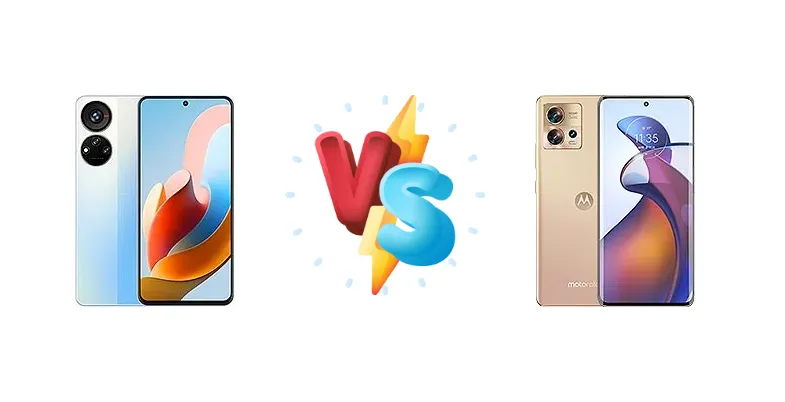
|
🏆 Quick Verdict
For most users, the Motorola Edge 30 Fusion emerges as the stronger choice. Its Snapdragon 888+ chipset provides a significant performance advantage over the Voyage 40 Pro+'s Dimensity 810, making it better suited for demanding tasks and gaming. While charging speeds are comparable, the Fusion's overall processing power justifies its slight edge.
| PHONES | ||
|---|---|---|
| Phone Names | ZTE Voyage 40 Pro+ | Motorola Edge 30 Fusion |
| Network | ||
|---|---|---|
| 2G bands | GSM 850 / 900 / 1800 / 1900 | GSM 850 / 900 / 1800 / 1900 |
| 3G bands | HSDPA 850 / 900 / 1900 / 2100 | HSDPA 850 / 900 / 1700(AWS) / 1900 / 2100 - International |
| 4G bands | LTE | 1, 2, 3, 4, 5, 7, 8, 12, 13, 17, 18, 19, 20, 25, 26, 28, 32, 38, 39, 40, 41, 42, 43, 66 - International |
| 5G bands | 1, 5, 28, 41, 78, 84 SA/NSA | 1, 3, 5, 7, 8, 20, 28, 38, 40, 41, 66, 77, 78 SA/NSA - International |
| Speed | HSPA, LTE, 5G | HSPA, LTE, 5G |
| Technology | GSM / CDMA / HSPA / LTE / 5G | GSM / CDMA / HSPA / CDMA2000 / LTE / 5G |
| - | 1, 2, 3, 5, 7, 8, 20, 28, 38, 41, 77, 78 SA/NSA - PRC | |
| Launch | ||
|---|---|---|
| Announced | 2022, November 29 | 2022, September 08 |
| Status | Available. Released 2022, December 06 | Available. Released 2022, September 08 |
| Body | ||
|---|---|---|
| Build | - | Glass front (Gorilla Glass 5), glass back (Gorilla Glass 5), aluminum frame |
| Dimensions | 163.5 x 75.8 x 7.6 mm (6.44 x 2.98 x 0.30 in) | 158.5 x 72 x 7.5 mm or 7.7 mm |
| SIM | Nano-SIM + Nano-SIM | · Nano-SIM· Nano-SIM + Nano-SIM |
| Weight | 192.5 g (6.81 oz) | 168 g / 175 g (5.93 oz) |
| - | Splash and dust resistant | |
| Display | ||
|---|---|---|
| Protection | - | Corning Gorilla Glass 5 |
| Resolution | 1080 x 2400 pixels, 20:9 ratio (~395 ppi density) | 1080 x 2400 pixels, 20:9 ratio (~402 ppi density) |
| Size | 6.67 inches, 107.4 cm2 (~86.7% screen-to-body ratio) | 6.55 inches, 103.6 cm2 (~90.8% screen-to-body ratio) |
| Type | AMOLED, 770 nits (HBM) | P-OLED, 1B colors, 144Hz, HDR10+, 1100 nits (peak) |
| Platform | ||
|---|---|---|
| CPU | Octa-core (2x2.4 GHz Cortex-A76 & 6x2.0 GHz Cortex-A55) | Octa-core (1x2.99 GHz Cortex-X1 & 3x2.42 GHz Cortex-A78 & 4x1.80 GHz Cortex-A55) |
| Chipset | Mediatek Dimensity 810 (6 nm) | Qualcomm SM8350 Snapdragon 888+ 5G (5 nm) |
| GPU | Mali-G57 MC2 | Adreno 660 |
| OS | Android 12, MyOS 12 | Android 12, upgradable to Android 14 |
| Memory | ||
|---|---|---|
| Card slot | microSDXC | No |
| Internal | 256GB 8GB RAM | 128GB 8GB RAM, 256GB 6GB RAM, 256GB 8GB RAM, 256GB 12GB RAM, 512GB 12GB RAM |
| - | UFS 3.1 | |
| Main Camera | ||
|---|---|---|
| Features | LED flash, HDR, panorama | LED flash, panorama, HDR |
| Quad | 64 MP, f/1.8, (wide), PDAF 5 MP (macro) Auxiliary lens | - |
| Triple | - | 50 MP, f/1.8, (wide), 1/1.55", 1.0µm, multi-directional PDAF, OIS 13 MP, f/2.2, 120˚ (ultrawide), 1.12µm, AF Auxiliary lens |
| Video | 4K@30fps, 1080p@30ps | 8K@30fps, 4K@30fps, 1080p@30/60/120fps, 720p@960fps, gyro-EIS |
| Selfie camera | ||
|---|---|---|
| Features | - | HDR |
| Single | 16 MP, f/2.0, (wide) | 32 MP, f/2.5, (wide), 1/2.8", 0.8µm, AF |
| Video | 1080p@30fps | 4K@30fps, 1080p@30fps |
| Sound | ||
|---|---|---|
| 3.5mm jack | - | No |
| 35mm jack | No | No |
| Loudspeaker | Yes | Yes, with stereo speakers |
| Comms | ||
|---|---|---|
| Bluetooth | 5.1, A2DP, LE | 5.2, A2DP, LE, aptX HD, aptX Adaptive |
| NFC | Yes | Yes |
| Positioning | GPS, GLONASS, GALILEO, BDS | GPS (L1+L5), GLONASS, BDS (B1I+B1c), GALILEO |
| Radio | No | No |
| USB | USB Type-C 2.0 | USB Type-C 3.1, OTG |
| WLAN | Wi-Fi 802.11 a/b/g/n/ac, dual-band, Wi-Fi Direct | Wi-Fi 802.11 a/b/g/n/ac/6e, tri-band, Wi-Fi Direct |
| Features | ||
|---|---|---|
| Sensors | Fingerprint (side-mounted), accelerometer, gyro, proximity, compass | Fingerprint (under display, optical), accelerometer, gyro, proximity, compass |
| - | Ready For 3.5 support | |
| Battery | ||
|---|---|---|
| Charging | 66W wired, 55% in 15 min | 68W wired, 50% in 10 min |
| Type | Li-Po 4510 mAh | Li-Po 4400 mAh |
| Misc | ||
|---|---|---|
| Colors | Gray, Blue, Starry | Neptune Blue, Cosmic Grey, Solar Gold, Aurora White, Viva Magenta |
| Models | 9042N | XT2243-1 |
| Price | About 300 EUR | About 150 EUR |
| Tests | ||
|---|---|---|
| Battery life | - | Endurance rating 101h |
| Camera | - | Photo / Video |
| Display | - | Contrast ratio: Infinite (nominal) |
| Loudspeaker | - | -24.6 LUFS (Very good) |
| Performance | - | AnTuTu: 827929 (v9) GeekBench: 3458 (v5.1) GFXBench: 62fps (ES 3.1 onscreen) |
ZTE Voyage 40 Pro+
- Potentially more efficient 6nm Dimensity 810 chipset
- 66W fast charging provides quick top-ups
- May offer a more competitive price point
- Dimensity 810 chipset is less powerful than Snapdragon 888+
- Limited information on display and camera specifications
- Unknown battery capacity
Motorola Edge 30 Fusion
- Powerful Snapdragon 888+ chipset for smooth performance
- Brighter display (946 nits) for better outdoor visibility
- Faster charging (50% in 10 minutes)
- Snapdragon 888+ can be prone to thermal throttling
- Older chipset architecture compared to Dimensity 810
- Battery life may be slightly lower under heavy load
Display Comparison
The Motorola Edge 30 Fusion boasts a notably brighter display, reaching a measured 946 nits. While the Voyage 40 Pro+'s display specs are unavailable, this brightness difference will be immediately noticeable in outdoor conditions. The Fusion’s ‘Infinite’ contrast ratio (nominal) suggests a strong OLED panel, likely offering deep blacks and vibrant colors. Without specifics on the Voyage 40 Pro+'s panel type, it's difficult to assess color accuracy or refresh rate, but the Fusion’s brightness gives it a clear advantage for visibility.
Camera Comparison
Both devices are listed as having Photo/Video capabilities, but detailed camera specifications are lacking for the ZTE Voyage 40 Pro+. The Motorola Edge 30 Fusion’s camera performance will depend heavily on its sensor size and image processing algorithms, which are not specified. Without knowing the main sensor resolution or aperture, it’s difficult to assess its low-light capabilities. The absence of detail regarding the Voyage 40 Pro+'s camera makes a direct comparison impossible, but the Fusion’s brand reputation suggests a more refined camera experience.
Performance
This is where the two phones diverge significantly. The Motorola Edge 30 Fusion’s Snapdragon 888+ (5nm) is built on a smaller fabrication process than the ZTE Voyage 40 Pro+'s Dimensity 810 (6nm). This translates to greater transistor density and improved power efficiency. The Snapdragon 888+’s Cortex-X1 prime core, clocked at 2.99 GHz, significantly outperforms the Dimensity 810’s Cortex-A76 cores at 2.4 GHz. While both utilize Cortex-A55 efficiency cores, the Snapdragon’s overall architecture provides a substantial performance uplift, particularly in GPU-intensive tasks. The 888+ will handle demanding games and multitasking with greater ease, though thermal throttling could become a factor under sustained load.
Battery Life
Both phones share an endurance rating of 101 hours, suggesting similar real-world battery life despite potentially different battery capacities (not specified for either device). However, charging speeds differ slightly. The Motorola Edge 30 Fusion claims 50% charge in 10 minutes with its 68W wired charging, while the ZTE Voyage 40 Pro+ reaches 55% in 15 minutes with 66W. This indicates the Fusion charges marginally faster, potentially offsetting any capacity differences. The efficiency of the Snapdragon 888+ could also contribute to comparable battery life despite its higher performance.
Buying Guide
Buy the ZTE Voyage 40 Pro+ if you prioritize a newer chipset architecture and are primarily focused on everyday tasks and moderate usage. Its 66W charging is efficient for topping up. Buy the Motorola Edge 30 Fusion if you demand smoother performance in games, resource-intensive applications, and appreciate the benefits of a flagship-level processor, even if it's a generation old.