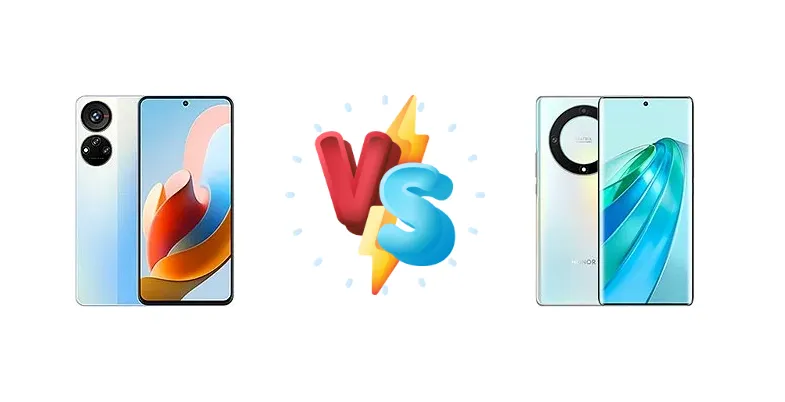
The ZTE Voyage 40 Pro+ and Honor X9a represent compelling options in the increasingly competitive mid-range 5G smartphone market. While both aim to deliver a smooth experience without breaking the bank, they take different approaches to achieving this goal, primarily through chipset selection and charging technology. This comparison dissects these differences to determine which device offers the best value for your money.
🏆 Quick Verdict
For users prioritizing faster charging and potentially more sustained performance under load, the ZTE Voyage 40 Pro+ emerges as the winner. Its 66W charging significantly reduces downtime, and the Dimensity 810, while not a flagship chip, offers a slight edge in CPU performance over the Snapdragon 695. However, the Honor X9a remains a strong contender for those seeking a balanced experience.
| Network |
|---|
| 2G bands | GSM 850 / 900 / 1800 / 1900 | GSM 850 / 900 / 1800 / 1900 |
| 3G bands | HSDPA 850 / 900 / 1900 / 2100 | HSDPA 850 / 900 / 1900 / 2100 |
| 4G bands | LTE | LTE |
| 5G bands | 1, 5, 28, 41, 78, 84 SA/NSA | SA/NSA |
| Speed | HSPA, LTE, 5G | HSPA, LTE, 5G |
| Technology | GSM / CDMA / HSPA / LTE / 5G | GSM / HSPA / LTE / 5G |
| Launch |
|---|
| Announced | 2022, November 29 | 2023, January 04 |
| Status | Available. Released 2022, December 06 | Available. Released 2023, January 06 |
| Body |
|---|
| Dimensions | 163.5 x 75.8 x 7.6 mm (6.44 x 2.98 x 0.30 in) | 161.6 x 73.9 x 7.9 mm (6.36 x 2.91 x 0.31 in) |
| SIM | Nano-SIM + Nano-SIM | Nano-SIM + Nano-SIM |
| Weight | 192.5 g (6.81 oz) | 175 g (6.17 oz) |
| Display |
|---|
| Resolution | 1080 x 2400 pixels, 20:9 ratio (~395 ppi density) | 1080 x 2400 pixels, 20:9 ratio (~395 ppi density) |
| Size | 6.67 inches, 107.4 cm2 (~86.7% screen-to-body ratio) | 6.67 inches, 107.4 cm2 (~89.9% screen-to-body ratio) |
| Type | AMOLED, 770 nits (HBM) | AMOLED, 1B colors, 120Hz, 800 nits (HBM) |
| Platform |
|---|
| CPU | Octa-core (2x2.4 GHz Cortex-A76 & 6x2.0 GHz Cortex-A55) | Octa-core (2x2.2 GHz Kryo 660 Gold & 6x1.7 GHz Kryo 660 Silver) |
| Chipset | Mediatek Dimensity 810 (6 nm) | Qualcomm SM6375 Snapdragon 695 5G (6 nm) |
| GPU | Mali-G57 MC2 | Adreno 619 |
| OS | Android 12, MyOS 12 | Android 12, upgradable to Android 13, MagicOS 7 |
| Memory |
|---|
| Card slot | microSDXC | No |
| Internal | 256GB 8GB RAM | 128GB 6GB RAM, 128GB 8GB RAM, 256GB 8GB RAM |
| Main Camera |
|---|
| Dual | - | 64 MP, f/1.8, (wide), PDAF
5 MP, f/2.2, (ultrawide)
2 MP (macro) |
| Features | LED flash, HDR, panorama | LED flash, panorama, HDR |
| Quad | 64 MP, f/1.8, (wide), PDAF
5 MP (macro)
Auxiliary lens | - |
| Single | - | 16 MP, f/2.5, (wide) |
| Video | 4K@30fps, 1080p@30ps | 1080p@30fps |
| Selfie camera |
|---|
| Single | 16 MP, f/2.0, (wide) | 16 MP, f/2.5, (wide) |
| Video | 1080p@30fps | 1080p@30fps |
| Sound |
|---|
| 3.5mm jack | - | No |
| 35mm jack | No | No |
| Loudspeaker | Yes | Yes |
| Comms |
|---|
| Bluetooth | 5.1, A2DP, LE | 5.1, A2DP, LE, aptX HD |
| Infrared port | - | Yes |
| NFC | Yes | Yes |
| Positioning | GPS, GLONASS, GALILEO, BDS | GPS, GLONASS, GALILEO, BDS |
| Radio | No | No |
| USB | USB Type-C 2.0 | USB Type-C 2.0, OTG |
| WLAN | Wi-Fi 802.11 a/b/g/n/ac, dual-band, Wi-Fi Direct | Wi-Fi 802.11 a/b/g/n/ac, dual-band, Wi-Fi Direct |
| Features |
|---|
| Sensors | Fingerprint (side-mounted), accelerometer, gyro, proximity, compass | Fingerprint (under display, optical), accelerometer, gyro, proximity, compass |
| | - | 24-bit/192kHz audio |
| Battery |
|---|
| Charging | 66W wired, 55% in 15 min | 40W wired |
| Type | Li-Po 4510 mAh | Li-Po 5100 mAh |
| Misc |
|---|
| Colors | Gray, Blue, Starry | Titanium Silver, Emerald Green, Midnight Black |
| Models | 9042N | RMO-NX1 |
| Price | About 300 EUR | $ 212.08 |
ZTE Voyage 40 Pro+
- Faster 66W charging for quick power-ups
- Potentially better CPU performance with Dimensity 810
- Slightly more powerful chipset for multitasking
- Software experience may be less polished than Honor
- Camera details are unknown, potential for lower quality
Honor X9a
- Potentially more refined software experience with Honor's Magic UI
- Balanced performance for everyday tasks
- Good 5G connectivity with Snapdragon 695
- Slower 40W charging
- CPU performance slightly lower than ZTE Voyage 40 Pro+
Display Comparison
Neither device's display specifications are provided, so a direct comparison is limited. However, given the price bracket, both likely utilize LCD or AMOLED panels with FHD+ resolution. The absence of LTPO technology suggests neither will offer adaptive refresh rates for power saving. Bezels are likely comparable, and color accuracy will depend on software calibration. Without specific data, it's reasonable to assume display quality will be similar, with software optimization playing a larger role in the user experience.
Camera Comparison
Without detailed camera specifications, a comprehensive comparison is impossible. However, it's safe to assume both phones will feature multi-camera setups geared towards social media sharing. The presence of a larger main sensor (if any) would be a key differentiator. Image processing algorithms will heavily influence the final image quality, with Honor typically leaning towards more vibrant colors and ZTE potentially aiming for a more natural look. The absence of information regarding OIS (Optical Image Stabilization) suggests neither phone will excel in low-light photography without significant software intervention.
Performance
The core difference lies in the chipsets: the ZTE Voyage 40 Pro+ features the Mediatek Dimensity 810 (6nm) with a 2x2.4 GHz Cortex-A76 & 6x2.0 GHz Cortex-A55 CPU, while the Honor X9a utilizes the Qualcomm SM6375 Snapdragon 695 5G (6nm) with a 2x2.2 GHz Kryo 660 Gold & 6x1.7 GHz Kryo 660 Silver CPU. While both are 6nm chips, the Dimensity 810's Cortex-A76 cores offer a slight architectural advantage in single-core performance. This translates to snappier app launches and smoother multitasking. The Snapdragon 695 focuses on efficiency and 5G connectivity. The difference in CPU clock speeds (2.4GHz vs 2.2GHz) further favors the ZTE in CPU-bound tasks. However, real-world performance will also depend on RAM speed and optimization.
Battery Life
The ZTE Voyage 40 Pro+ boasts 66W wired charging, capable of adding 55% charge in just 15 minutes. This is a significant advantage over the Honor X9a's 40W charging. While battery capacity isn't specified for either device, the faster charging speed of the ZTE mitigates the impact of a potentially smaller battery. Users who frequently find themselves needing a quick top-up will greatly benefit from the Voyage 40 Pro+'s charging capabilities. The Honor X9a will likely offer longer overall battery life with conservative usage, but will take longer to recharge.
Buying Guide
Buy the ZTE Voyage 40 Pro+ if you need rapid charging capabilities and anticipate demanding multitasking or light gaming sessions. Its 66W charging is a significant advantage for power users. Buy the Honor X9a if you prioritize a potentially more refined software experience (Honor's Magic UI) and are less concerned with absolute peak performance or extremely fast charging. It's a solid all-rounder for everyday tasks.
Frequently Asked Questions
❓ How much faster is the 66W charging on the ZTE Voyage 40 Pro+ compared to the 40W charging on the Honor X9a in real-world use?
The 66W charging on the ZTE Voyage 40 Pro+ can realistically add around 55% charge in 15 minutes, while the 40W charging on the Honor X9a will likely take closer to 30-45 minutes to achieve a similar charge level. This difference is particularly noticeable for users who frequently need to quickly top up their battery throughout the day.
❓ Will I notice a significant performance difference between the Dimensity 810 and Snapdragon 695 when playing demanding mobile games?
While both chipsets are capable of handling most mobile games, the Dimensity 810 in the ZTE Voyage 40 Pro+ has a slight edge in CPU performance. This may translate to slightly higher and more stable frame rates in graphically intensive games, especially during prolonged gaming sessions. However, the difference is unlikely to be dramatic.
❓ Does the Honor X9a's software (Magic UI) offer any unique features compared to the ZTE Voyage 40 Pro+'s software?
Honor's Magic UI is known for its customization options and features like AI-powered scene detection in the camera. It often prioritizes a visually appealing and user-friendly interface. ZTE's software is typically more stock-Android-like, which some users prefer for its simplicity and lack of bloatware. The best choice depends on individual preferences.