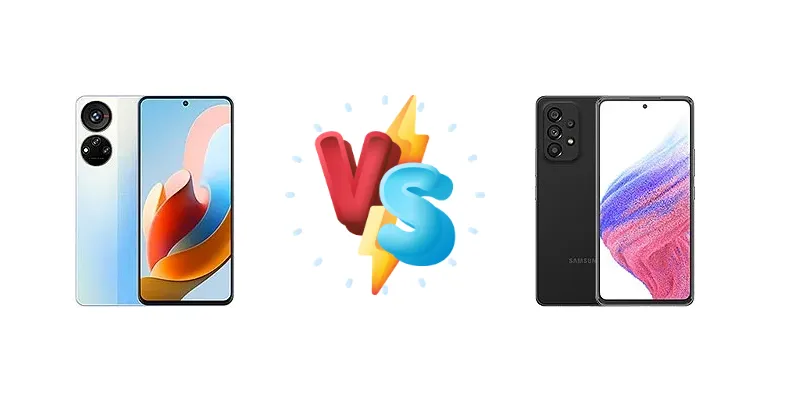
The mid-range 5G smartphone market is fiercely competitive. The ZTE Voyage 40 Pro+ aims to disrupt with its aggressive charging speed and Mediatek Dimensity 810 chipset, while the Samsung Galaxy A53 5G leverages Samsung’s brand recognition and a well-rounded feature set. This comparison dissects their key differences to help you choose the right device.
🏆 Quick Verdict
For the average user prioritizing consistent performance and a proven software experience, the Samsung Galaxy A53 5G is the safer bet. However, the ZTE Voyage 40 Pro+’s significantly faster 66W charging offers a compelling advantage for those who frequently need to top up their battery quickly.
| Network |
|---|
| 2G bands | GSM 850 / 900 / 1800 / 1900 - SIM 1 & SIM 2 | GSM 850 / 900 / 1800 / 1900 |
| 3G bands | HSDPA 850 / 900 / 1900 / 2100 | HSDPA 850 / 900 / 1700(AWS) / 1900 / 2100 |
| 4G bands | LTE | 1, 2, 3, 4, 5, 7, 12, 14, 20, 29, 30, 38, 39, 40, 41, 46, 48, 66 - SM-A536U |
| 5G bands | 1, 5, 28, 41, 78, 84 SA/NSA | 2, 5, 41, 66, 77, 78 SA/NSA/Sub6/mmWave - SM-A536U |
| Speed | HSPA, LTE-A (CA), 5G | HSPA, LTE, 5G |
| Technology | GSM / CDMA / HSPA / LTE / 5G | GSM / HSPA / LTE / 5G |
| | CDMA 800 | 2, 5, 48, 66, 77, 78, 260, 261 SA/NSA/Sub6/mmWave - SM-A536V |
| Launch |
|---|
| Announced | 2022, November 29 | 2022, March 17 |
| Status | Available. Released 2022, December 06 | Available. Released 2022, March 24 |
| Body |
|---|
| Build | - | Glass front (Gorilla Glass 5), plastic frame, plastic back |
| Dimensions | 163.5 x 75.8 x 7.6 mm (6.44 x 2.98 x 0.30 in) | 159.6 x 74.8 x 8.1 mm (6.28 x 2.94 x 0.32 in) |
| SIM | Dual SIM (Nano-SIM, dual stand-by) | · Nano-SIM· Nano-SIM + Nano-SIM |
| Weight | 192.5 g (6.81 oz) | 189 g (6.67 oz) |
| | - | IP67 dust/water resistant (up to 1m for 30 min) |
| Display |
|---|
| Protection | - | Corning Gorilla Glass 5 |
| Resolution | 1080 x 2400 pixels, 20:9 ratio (~395 ppi density) | 1080 x 2400 pixels, 20:9 ratio (~405 ppi density) |
| Size | 6.67 inches, 107.4 cm2 (~86.7% screen-to-body ratio) | 6.5 inches, 102.0 cm2 (~85.4% screen-to-body ratio) |
| Type | AMOLED, 770 nits (HBM) | Super AMOLED, 120Hz, 800 nits (HBM) |
| Platform |
|---|
| CPU | Octa-core (2x2.4 GHz Cortex-A76 & 6x2.0 GHz Cortex-A55) | Octa-core (2x2.4 GHz Cortex-A78 & 6x2.0 GHz Cortex-A55) |
| Chipset | Mediatek MT6833P Dimensity 810 (6 nm) | Exynos 1280 (5 nm) |
| GPU | Mali-G57 MC2 | Mali-G68 |
| OS | Android 12, MyOS 12 | Android 12, up to 4 major Android upgrades, One UI 8 |
| Memory |
|---|
| Card slot | microSDXC | microSDXC (uses shared SIM slot) |
| Internal | 256GB 8GB RAM | 128GB 4GB RAM, 128GB 6GB RAM, 128GB 8GB RAM, 256GB 6GB RAM, 256GB 8GB RAM |
| Main Camera |
|---|
| Features | LED flash, HDR, panorama | LED flash, panorama, HDR |
| Quad | 64 MP, f/1.8, (wide), PDAF
5 MP, f/2.4, (macro)
2 MP, f/2.4, (depth) | 64 MP, f/1.8, 26mm (wide), 1/1.7X", 0.8µm, PDAF, OIS
12 MP, f/2.2, 123˚ (ultrawide), 1.12µm
5 MP (macro)
Auxiliary lens |
| Single | 16 MP, f/2.0, (wide) | 32 MP, f/2.2, 26mm (wide), 1/2.8", 0.8µm |
| Video | 4K@30fps, 1080p@30ps | 4K@30fps, 1080p@30/60fps; gyro-EIS |
| Selfie camera |
|---|
| Features | - | HDR |
| Single | 16 MP, f/2.0, (wide) | 32 MP, f/2.2, 26mm (wide), 1/2.8", 0.8µm |
| Video | 1080p@30fps | 4K@30fps, 1080p@30fps |
| Sound |
|---|
| 3.5mm jack | No | No |
| 35mm jack | - | No |
| Loudspeaker | Yes | Yes, with stereo speakers |
| Comms |
|---|
| Bluetooth | 5.1, A2DP, LE | 5.1, A2DP, LE |
| NFC | Yes | Yes (market/region dependent) |
| Positioning | GPS, GLONASS, GALILEO, BDS | GPS, GLONASS, GALILEO, BDS |
| Radio | No | No |
| USB | USB Type-C 2.0 | USB Type-C 2.0, OTG |
| WLAN | Wi-Fi 802.11 a/b/g/n/ac, dual-band, Wi-Fi Direct | Wi-Fi 802.11 a/b/g/n/ac, dual-band, Wi-Fi Direct |
| Features |
|---|
| Sensors | Fingerprint (side-mounted), accelerometer, gyro, proximity, compass | Fingerprint (under display, optical), accelerometer, gyro, compass, barometer (market/region dependent) |
| | - | Virtual proximity sensing |
| Battery |
|---|
| Charging | 66W wired, 55% in 15 min (advertised) | 25W wired |
| Type | Li-Po 4510 mAh, non-removable | Li-Po 5000 mAh |
| Misc |
|---|
| Colors | Gray, Blue, Starry | Black, White, Blue, Peach |
| Models | 9042N | SM-A536B, SM-A536B/DS, SM-A536U, SM-A536U1, SM-A5360, SM-A536E, SM-A536E/DS, SM-A536V, SM-A536W, SM-A536N, SM-S536DL |
| Price | About 300 EUR | $ 151.42 / £ 185.00 / € 169.14 |
| SAR | - | 0.75 W/kg (head) 1.58 W/kg (body) |
| SAR EU | - | 0.89 W/kg (head) 1.60 W/kg (body) |
| Tests |
|---|
| Battery life | - |
Endurance rating 113h
|
| Camera | - |
Photo / Video |
| Display | - |
Contrast ratio: Infinite (nominal) |
| Loudspeaker | - |
-26.5 LUFS (Good)
|
| Performance | - |
AnTuTu: 329802 (v8), 379313 (v9)
GeekBench: 1891 (v5.1)
GFXBench: 19fps (ES 3.1 onscreen) |
ZTE Voyage 40 Pro+
- Significantly faster 66W charging
- Potentially more affordable price point
- Mediatek Dimensity 810 offers solid performance
- Less established brand reputation
- Limited information on camera specs
- Potentially less efficient chipset (6nm vs 5nm)
Samsung Galaxy A53 5G
- Brighter and more vibrant display (830 nits)
- More efficient Exynos 1280 chipset (5nm)
- Established brand and software support
- Slower 25W charging
- Potentially higher price
- LPDDR4X RAM is slower than newer standards
Display Comparison
The Samsung Galaxy A53 5G boasts a notably brighter display, reaching a measured 830 nits, which translates to superior visibility outdoors. While the Voyage 40 Pro+’s display specs are unavailable, Samsung’s Super AMOLED technology typically delivers vibrant colors and excellent contrast, with an 'Infinite' contrast ratio. The A53’s brightness advantage is crucial for users who spend significant time outdoors or in brightly lit environments. The lack of LTPO on either device suggests neither offers adaptive refresh rate technology for power saving.
Camera Comparison
Both devices offer photo and video capabilities, but detailed sensor information for the Voyage 40 Pro+ is missing. The Galaxy A53 5G likely benefits from Samsung’s established image processing algorithms, known for producing vibrant and shareable photos. Without knowing the Voyage 40 Pro+'s main sensor size and aperture, it’s difficult to assess its low-light performance. The inclusion of OIS (Optical Image Stabilization) on the A53 would be a significant advantage for video recording and reducing blur in low-light photos. It's safe to assume both phones include a suite of software features to enhance image quality.
Performance
Both phones utilize octa-core CPUs with a similar core configuration (2x high-performance Cortex-A cores and 6x efficiency cores). However, the Galaxy A53 5G’s Exynos 1280, built on a 5nm process, has a theoretical efficiency advantage over the Voyage 40 Pro+’s Mediatek Dimensity 810 (6nm). This means the Exynos chip is likely to run cooler and sustain peak performance for longer periods. The Cortex-A78 cores in the Exynos 1280 also offer a slight architectural advantage over the A76 cores in the Dimensity 810, potentially leading to better single-core performance. The A53's LPDDR4X RAM is slower than the LPDDR5 RAM commonly found in competing devices, potentially creating a bottleneck.
Battery Life
Both the ZTE Voyage 40 Pro+ and Samsung Galaxy A53 5G achieve an endurance rating of 113 hours, suggesting similar overall battery life. However, the Voyage 40 Pro+’s 66W wired charging is a game-changer, promising a 55% charge in just 15 minutes. In contrast, the Galaxy A53 5G is limited to 25W charging, resulting in a significantly longer charge time. This difference is critical for users who prioritize quick top-ups over absolute battery capacity. While both have similar endurance, the charging speed drastically alters the user experience.
Buying Guide
Buy the ZTE Voyage 40 Pro+ if you need exceptionally fast charging and are comfortable with a less established brand. Its 66W charging is a standout feature for power users. Buy the Samsung Galaxy A53 5G if you prefer a polished software experience, a brighter display, and the peace of mind that comes with Samsung’s extensive support network and established ecosystem.
Frequently Asked Questions
❓ Does the Exynos 1280 in the Galaxy A53 5G tend to overheat during prolonged gaming sessions?
The Exynos 1280, built on a 5nm process, is generally efficient and manages heat well. While some throttling may occur during extended, graphically demanding games, it's unlikely to cause significant performance drops or discomfort. Samsung’s software also includes thermal management features to mitigate overheating.
❓ Is the 2MP macro camera on the Galaxy A53 5G actually useful for taking detailed close-up photos?
Typically, 2MP macro cameras on phones in this price range offer limited detail and image quality. While they can capture close-up shots, the low resolution often results in soft, grainy images. It's best to manage expectations and consider it a novelty feature rather than a primary camera for macro photography.
❓ Can the ZTE Voyage 40 Pro+ reliably achieve a 55% charge in 15 minutes with the 66W charger?
ZTE advertises a 55% charge in 15 minutes with the 66W charger. However, real-world charging speeds can vary depending on battery temperature, background processes, and the charger's efficiency. It's likely to achieve close to this figure under optimal conditions, making it significantly faster than the A53's 25W charging.
❓ How does the software experience differ between the ZTE Voyage 40 Pro+ and the Samsung Galaxy A53 5G?
Samsung’s One UI offers a polished and feature-rich software experience with a strong emphasis on customization and usability. ZTE’s software is generally less refined and may include more pre-installed bloatware. Samsung also provides longer software support with more frequent updates, offering greater long-term value.