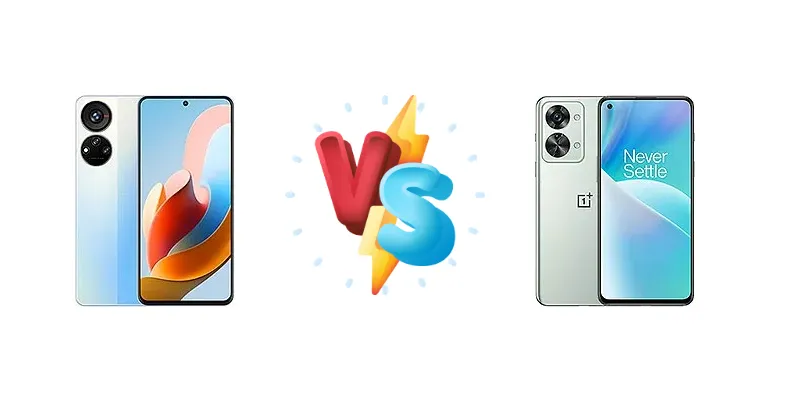
The mid-range smartphone market is fiercely competitive, and the ZTE Voyage 40 Pro+ and OnePlus Nord 2T represent compelling options. While both leverage MediaTek's Dimensity series, they target slightly different priorities – the Voyage 40 Pro+ appears to focus on rapid charging, while the Nord 2T boasts a more powerful chipset. This comparison will dissect their key differences to help you choose the right device.
🏆 Quick Verdict
For most users, the OnePlus Nord 2T emerges as the stronger choice. Its Dimensity 1300 chipset delivers noticeably better CPU and GPU performance, translating to a smoother experience in demanding tasks and gaming. While the Voyage 40 Pro+ offers competitive 66W charging, the Nord 2T’s 80W charging with PD support and comparable battery life make it the more practical all-rounder.
| Network |
|---|
| 2G bands | GSM 850 / 900 / 1800 / 1900 - SIM 1 & SIM 2 | GSM 850 / 900 / 1800 / 1900 |
| 3G bands | HSDPA 850 / 900 / 1900 / 2100 | HSDPA 800 / 850 / 900 / 1700(AWS) / 1800 / 1900 / 2100 |
| 4G bands | LTE | 1, 2, 3, 4, 5, 7, 8, 12, 17, 18, 19, 20, 26, 28, 32, 34, 38, 39, 40, 41, 66 |
| 5G bands | 1, 5, 28, 41, 78, 84 SA/NSA | 1, 3, 7, 8, 20, 28, 38, 41, 78 SA/NSA |
| Speed | HSPA, LTE-A (CA), 5G | HSPA 42.2/5.76 Mbps, LTE Cat18 1200/150 Mbps, 5G |
| Technology | GSM / CDMA / HSPA / LTE / 5G | GSM / HSPA / LTE / 5G |
| | CDMA 800 | - |
| Launch |
|---|
| Announced | 2022, November 29 | 2022, May 19 |
| Status | Available. Released 2022, December 06 | Available. Released 2022, May 21 |
| Body |
|---|
| Build | - | Glass front (Gorilla Glass 5), plastic frame |
| Dimensions | 163.5 x 75.8 x 7.6 mm (6.44 x 2.98 x 0.30 in) | 159.1 x 73.2 x 8.2 mm (6.26 x 2.88 x 0.32 in) |
| SIM | Dual SIM (Nano-SIM, dual stand-by) | Nano-SIM + Nano-SIM |
| Weight | 192.5 g (6.81 oz) | 190 g (6.70 oz) |
| Display |
|---|
| Protection | - | Corning Gorilla Glass 5 |
| Resolution | 1080 x 2400 pixels, 20:9 ratio (~395 ppi density) | 1080 x 2400 pixels, 20:9 ratio (~409 ppi density) |
| Size | 6.67 inches, 107.4 cm2 (~86.7% screen-to-body ratio) | 6.43 inches, 99.8 cm2 (~85.7% screen-to-body ratio) |
| Type | AMOLED, 770 nits (HBM) | AMOLED, 90Hz, HDR10+ |
| Platform |
|---|
| CPU | Octa-core (2x2.4 GHz Cortex-A76 & 6x2.0 GHz Cortex-A55) | Octa-core (1x3.0 GHz Cortex-A78 & 3x2.6 GHz Cortex-A78 & 4x2.0 GHz Cortex-A55) |
| Chipset | Mediatek MT6833P Dimensity 810 (6 nm) | Mediatek Dimensity 1300 (6 nm) |
| GPU | Mali-G57 MC2 | Mali-G77 MC9 |
| OS | Android 12, MyOS 12 | Android 12, upgradable to Android 14, OxygenOS 14 |
| Memory |
|---|
| Card slot | microSDXC | No |
| Internal | 256GB 8GB RAM | 128GB 8GB RAM, 256GB 12GB RAM |
| | - | UFS 3.1 |
| Main Camera |
|---|
| Features | LED flash, HDR, panorama | Dual-LED flash, HDR, panorama |
| Quad | 64 MP, f/1.8, (wide), PDAF
5 MP, f/2.4, (macro)
2 MP, f/2.4, (depth) | - |
| Single | 16 MP, f/2.0, (wide) | 32 MP, f/2.4, (wide), 1/2.8", 0.8µm |
| Triple | - | 50 MP, f/1.9, 24mm (wide), 1/1.56", 1.0µm, PDAF, OIS
8 MP, f/2.2, 120˚ (ultrawide)
Auxiliary lens |
| Video | 4K@30fps, 1080p@30ps | 4K@30fps, 1080p@30/60/120/480fps, gyro-EIS |
| Selfie camera |
|---|
| Features | - | Auto HDR |
| Single | 16 MP, f/2.0, (wide) | 32 MP, f/2.4, (wide), 1/2.8", 0.8µm |
| Video | 1080p@30fps | 1080p@30fps, gyro-EIS |
| Sound |
|---|
| 3.5mm jack | No | No |
| 35mm jack | - | No |
| Loudspeaker | Yes | Yes, with stereo speakers |
| Comms |
|---|
| Bluetooth | 5.1, A2DP, LE | 5.2, A2DP, LE, aptX HD |
| NFC | Yes | Yes |
| Positioning | GPS, GLONASS, GALILEO, BDS | GPS, GLONASS, GALILEO, BDS, NavIC |
| Radio | No | No |
| USB | USB Type-C 2.0 | USB Type-C 2.0, OTG |
| WLAN | Wi-Fi 802.11 a/b/g/n/ac, dual-band, Wi-Fi Direct | Wi-Fi 802.11 a/b/g/n/ac/6, dual-band, Wi-Fi Direct |
| Features |
|---|
| Sensors | Fingerprint (side-mounted), accelerometer, gyro, proximity, compass | Fingerprint (under display, optical), accelerometer, gyro, proximity, compass |
| Battery |
|---|
| Charging | 66W wired, 55% in 15 min (advertised) | 80W wired, PD |
| Type | Li-Po 4510 mAh, non-removable | Li-Po 4500 mAh |
| Misc |
|---|
| Colors | Gray, Blue, Starry | Gray Shadow, Jade Fog |
| Models | 9042N | CPH2399, CPH2401 |
| Price | About 300 EUR | € 144.39 / $ 169.99 / ₹ 31,490 |
| Tests |
|---|
| Battery life | - |
Endurance rating 100h
|
| Camera | - |
Photo / Video |
| Display | - |
Contrast ratio: Infinite (nominal) |
| Loudspeaker | - |
-25.6 LUFS (Very good)
|
| Performance | - |
AnTuTu: 490545 (v8) | 604467 (v9)
GeekBench: 2790 (v5.1)
GFXBench: 40fps (ES 3.1 onscreen) |
ZTE Voyage 40 Pro+
- Potentially faster charging (66W)
- May offer a more affordable price point
- MediaTek Dimensity 810 is still a capable chipset
- Less powerful chipset than the Nord 2T
- Limited information on display quality
- Camera performance is unknown
OnePlus Nord 2T
- More powerful Dimensity 1300 chipset
- Brighter display with excellent contrast
- Faster 80W charging with PD support
- May be slightly more expensive
- Battery life is comparable, not superior
- Software experience can be divisive (OxygenOS)
Display Comparison
The OnePlus Nord 2T has a clear advantage in display quality, boasting a measured peak brightness of 636 nits. While the Voyage 40 Pro+'s display specs are unavailable, the Nord 2T’s brightness ensures excellent visibility even in direct sunlight. The Nord 2T’s ‘Infinite’ contrast ratio (nominal) suggests a strong AMOLED panel, likely offering vibrant colors and deep blacks. Without comparable data for the Voyage 40 Pro+, it’s difficult to assess its color accuracy or panel technology, but the Nord 2T sets a high bar.
Camera Comparison
Both phones feature photo and video capabilities, but detailed sensor information is lacking for the Voyage 40 Pro+. The Nord 2T likely benefits from MediaTek’s Imagiq 760 ISP, offering advanced image processing. Without knowing the main sensor size or aperture of the Voyage 40 Pro+, it’s difficult to assess its low-light performance. It’s reasonable to assume the Nord 2T, given its overall positioning, will deliver more consistent and detailed images, especially in challenging conditions. We'd caution against relying heavily on any 2MP macro sensors present on either device.
Performance
The core difference lies in the chipsets. The OnePlus Nord 2T’s Dimensity 1300, with its 1x3.0 GHz Cortex-A78 core and three additional 2.6 GHz Cortex-A78 cores, significantly outperforms the ZTE Voyage 40 Pro+'s Dimensity 810 (2x2.4 GHz Cortex-A76 & 6x2.0 GHz Cortex-A55). The Nord 2T’s higher clock speeds and more powerful core configuration will result in faster app loading times, smoother multitasking, and a more enjoyable gaming experience. While both are built on a 6nm process, the architectural improvements in the Dimensity 1300 are substantial.
Battery Life
Both devices achieve an endurance rating of 100 hours, suggesting similar real-world battery life despite potentially different battery capacities (unspecified for the Voyage 40 Pro+). However, the OnePlus Nord 2T’s 80W wired charging with Power Delivery (PD) is a significant advantage. Advertised to deliver a 55% charge in 15 minutes on the Voyage 40 Pro+ versus a similar timeframe for the Nord 2T, the Nord 2T’s PD support offers broader compatibility with chargers and accessories. The faster charging speed minimizes downtime and provides greater convenience.
Buying Guide
Buy the ZTE Voyage 40 Pro+ if you prioritize extremely fast charging and are willing to trade some raw processing power. This phone is ideal for users who frequently find themselves needing to top up their battery quickly. Buy the OnePlus Nord 2T if you value overall performance, a brighter display, and a more refined software experience. It’s the better choice for gamers, power users, and those who want a phone that feels consistently responsive.
Frequently Asked Questions
❓ Is the Dimensity 1300 in the OnePlus Nord 2T powerful enough for demanding games like Genshin Impact?
Yes, the Dimensity 1300 is well-equipped to handle Genshin Impact and other graphically intensive games. While you may need to adjust settings for optimal frame rates, the chipset’s CPU and GPU provide a significantly smoother experience compared to the Dimensity 810 in the Voyage 40 Pro+.
❓ Does the 80W SuperVOOC charging on the OnePlus Nord 2T generate a lot of heat during charging?
While 80W charging is fast, OnePlus has implemented thermal management systems to mitigate heat generation. The Nord 2T’s charging process is designed to balance speed and temperature, preventing excessive heat buildup that could damage the battery. However, some warmth is normal during rapid charging.
❓ How does the software experience differ between the ZTE Voyage 40 Pro+ and the OnePlus Nord 2T?
The OnePlus Nord 2T runs OxygenOS, which is based on Android but offers a more customized experience with features like Zen Mode and customizable gestures. ZTE’s MyOS is less well-known and generally offers a more stock Android-like experience, potentially with more pre-installed bloatware. OxygenOS is generally preferred for its polish and feature set.
❓ What type of charger does the OnePlus Nord 2T include in the box, and is it compatible with other devices?
The OnePlus Nord 2T includes an 80W SuperVOOC charger in the box. While it supports the PD standard, it's optimized for OnePlus devices. Using it with other devices may not deliver the full 80W charging speed, but it will still provide a standard charging rate.