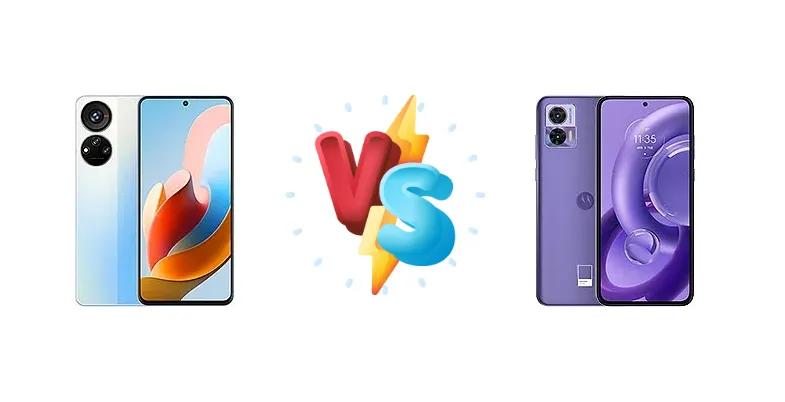
The mid-range 5G smartphone market is fiercely competitive. The ZTE Voyage 40 Pro+ and Motorola Edge 30 Neo both aim to deliver a compelling experience without breaking the bank, but they take different approaches. The Voyage 40 Pro+ leans on MediaTek's Dimensity 810, while the Edge 30 Neo opts for Qualcomm's Snapdragon 695. This comparison dissects their key differences to determine which device offers the best value.
🏆 Quick Verdict
For the average user prioritizing consistent performance and potentially longer software support, the Motorola Edge 30 Neo emerges as the slightly better choice. While the ZTE Voyage 40 Pro+ boasts faster wired charging, the Edge 30 Neo’s Snapdragon 695 offers a more refined experience and a proven track record within the Motorola ecosystem.
| Network |
|---|
| 2G bands | GSM 850 / 900 / 1800 / 1900 - SIM 1 & SIM 2 | GSM 850 / 900 / 1800 / 1900 |
| 3G bands | HSDPA 850 / 900 / 1900 / 2100 | HSDPA 850 / 900 / 1700(AWS) / 1900 / 2100 |
| 4G bands | LTE | 1, 2, 3, 4, 5, 7, 8, 12, 17, 20, 25, 26, 28, 32, 38, 40, 41, 42, 43 |
| 5G bands | 1, 5, 28, 41, 78, 84 SA/NSA | 1, 3, 5, 7, 8, 20, 28, 38, 40, 41, 66, 78 SA/NSA |
| Speed | HSPA, LTE-A (CA), 5G | HSPA, LTE, 5G |
| Technology | GSM / CDMA / HSPA / LTE / 5G | GSM / HSPA / LTE / 5G |
| | CDMA 800 | - |
| Launch |
|---|
| Announced | 2022, November 29 | 2022, September 08 |
| Status | Available. Released 2022, December 06 | Available. Released 2022, October 07 |
| Body |
|---|
| Build | - | Glass front, plastic frame, plastic back |
| Dimensions | 163.5 x 75.8 x 7.6 mm (6.44 x 2.98 x 0.30 in) | 152.9 x 71.2 x 7.8 mm (6.02 x 2.80 x 0.31 in) |
| SIM | Dual SIM (Nano-SIM, dual stand-by) | · Nano-SIM· Nano-SIM + Nano-SIM |
| Weight | 192.5 g (6.81 oz) | 155 g (5.47 oz) |
| | - | Splash and dust resistant |
| Display |
|---|
| Resolution | 1080 x 2400 pixels, 20:9 ratio (~395 ppi density) | 1080 x 2400 pixels, 20:9 ratio (~419 ppi density) |
| Size | 6.67 inches, 107.4 cm2 (~86.7% screen-to-body ratio) | 6.28 inches, 95.2 cm2 (~87.5% screen-to-body ratio) |
| Type | AMOLED, 770 nits (HBM) | P-OLED, 120Hz |
| Platform |
|---|
| CPU | Octa-core (2x2.4 GHz Cortex-A76 & 6x2.0 GHz Cortex-A55) | Octa-core (2x2.2 GHz Kryo 660 Gold & 6x1.7 GHz Kryo 660 Silver) |
| Chipset | Mediatek MT6833P Dimensity 810 (6 nm) | Qualcomm SM6375 Snapdragon 695 5G (6 nm) |
| GPU | Mali-G57 MC2 | Adreno 619 |
| OS | Android 12, MyOS 12 | Android 12, planned upgrade to Android 15 |
| Memory |
|---|
| Card slot | microSDXC | No |
| Internal | 256GB 8GB RAM | 128GB 6GB RAM, 128GB 8GB RAM, 256GB 8GB RAM |
| Main Camera |
|---|
| Dual | - | 64 MP, f/1.8, (wide), 1/1.97", 0.7µm, PDAF, OIS
13 MP, f/2.2, 120˚ (ultrawide), 1/3.0", 1.12µm, AF |
| Features | LED flash, HDR, panorama | Dual-LED flash, HDR, panorama |
| Quad | 64 MP, f/1.8, (wide), PDAF
5 MP, f/2.4, (macro)
2 MP, f/2.4, (depth) | - |
| Single | 16 MP, f/2.0, (wide) | - |
| Video | 4K@30fps, 1080p@30ps | 1080p@30/60/120fps |
| Selfie camera |
|---|
| Features | - | HDR |
| Single | 16 MP, f/2.0, (wide) | 32 MP, f/2.4, (wide), 1/3.0", 0.7µm |
| Video | 1080p@30fps | 1080p@30fps |
| Sound |
|---|
| 3.5mm jack | No | No |
| 35mm jack | - | No |
| Loudspeaker | Yes | Yes, with stereo speakers |
| Comms |
|---|
| Bluetooth | 5.1, A2DP, LE | 5.1, A2DP, LE, aptX HD, aptX Adaptive |
| NFC | Yes | Yes |
| Positioning | GPS, GLONASS, GALILEO, BDS | GPS, GLONASS, GALILEO |
| Radio | No | No |
| USB | USB Type-C 2.0 | USB Type-C 3.1, OTG |
| WLAN | Wi-Fi 802.11 a/b/g/n/ac, dual-band, Wi-Fi Direct | Wi-Fi 802.11 a/b/g/n/ac, dual-band, Wi-Fi Direct |
| Features |
|---|
| Sensors | Fingerprint (side-mounted), accelerometer, gyro, proximity, compass | Fingerprint (under display, optical), accelerometer, proximity, compass |
| Battery |
|---|
| Charging | 66W wired, 55% in 15 min (advertised) | 68W wired
5W wireless |
| Type | Li-Po 4510 mAh, non-removable | Li-Po 4020 mAh |
| Misc |
|---|
| Colors | Gray, Blue, Starry | Very Peri, Black Onyx, Ice Palace, Aqua Foam |
| Models | 9042N | XT2245-1 |
| Price | About 300 EUR | € 156.44 / $ 185.00 / £ 229.00 |
| Tests |
|---|
| Battery life | - |
Endurance rating 104h
|
| Camera | - |
Photo / Video |
| Display | - |
Contrast ratio: Infinite (nominal) |
| Loudspeaker | - |
-26.4 LUFS (Good)
|
| Performance | - |
AnTuTu: 380818 (v9)
GeekBench: 1964 (v5.1)
GFXBench: 16fps (ES 3.1 onscreen) |
ZTE Voyage 40 Pro+
- Faster 66W wired charging
- Potentially lower price point (depending on market)
- Dimensity 810 offers decent performance for the price
- Limited information on display quality
- Uncertainty regarding camera performance
- Software support may be less consistent than Motorola
Motorola Edge 30 Neo
- Brighter 1004 nit display
- Snapdragon 695 offers efficient performance
- 104-hour endurance rating suggests excellent battery life
- Wireless charging support
- Wired charging speed is comparable, not faster
- May be slightly more expensive than the ZTE Voyage 40 Pro+
- Camera details are limited
Display Comparison
The Motorola Edge 30 Neo boasts a significantly brighter display, reaching a measured 1004 nits. This is a crucial advantage for outdoor visibility, a scenario where the Voyage 40 Pro+'s display specifications are currently unknown. The Edge 30 Neo’s ‘Infinite’ contrast ratio (nominal) suggests a typical OLED panel, offering deep blacks. Without comparable data for the Voyage 40 Pro+, it’s difficult to assess its color accuracy or viewing angles, but the Edge 30 Neo’s brightness alone gives it a clear edge for users who spend significant time outdoors.
Camera Comparison
Both devices offer photo and video capabilities, but detailed sensor information is lacking for the Voyage 40 Pro+. The Edge 30 Neo’s camera system, while not specified in detail, likely benefits from Motorola’s image processing algorithms. Without knowing the main sensor resolution or aperture on the Voyage 40 Pro+, it’s difficult to assess its low-light performance. The absence of details regarding OIS on either device suggests a reliance on software stabilization. It's reasonable to assume both phones will include standard features like portrait mode and HDR, but the Edge 30 Neo’s established brand reputation in camera performance gives it a slight advantage.
Performance
The ZTE Voyage 40 Pro+ utilizes the Mediatek Dimensity 810, built on a 6nm process, featuring an octa-core CPU with two Cortex-A76 cores clocked at 2.4 GHz. The Motorola Edge 30 Neo counters with the Qualcomm Snapdragon 695 5G, also 6nm, but with a different core configuration: two Kryo 660 Gold cores at 2.2 GHz and six Kryo 660 Silver cores at 1.7 GHz. While clock speeds are slightly higher on the Dimensity 810, the Snapdragon 695 benefits from Qualcomm’s optimized software and generally more efficient core design. This translates to smoother multitasking and potentially better sustained performance under load, especially considering the Edge 30 Neo’s reported 104-hour endurance rating suggests efficient power management.
Battery Life
The Motorola Edge 30 Neo boasts an endurance rating of 104 hours, indicating solid battery life. While the exact battery capacity isn’t specified, this rating suggests efficient power consumption. The ZTE Voyage 40 Pro+ compensates with 66W wired charging, advertised to deliver 55% charge in 15 minutes. The Edge 30 Neo matches this with 68W wired charging and adds the convenience of 5W wireless charging. The faster charging on the Voyage 40 Pro+ is appealing, but the Edge 30 Neo’s longer endurance and wireless charging option provide greater flexibility.
Buying Guide
Buy the ZTE Voyage 40 Pro+ if you absolutely prioritize the fastest possible wired charging speeds and frequently find yourself needing to top up quickly. Buy the Motorola Edge 30 Neo if you value a more balanced experience with a brighter display, potentially better software support, and a chipset known for its efficiency and stable performance in everyday tasks.
Frequently Asked Questions
❓ Does the Snapdragon 695 in the Motorola Edge 30 Neo struggle with demanding games like Genshin Impact?
While the Snapdragon 695 isn't a flagship chipset, it can handle many popular games at medium settings. Genshin Impact may require lower graphics settings and frame rate caps to maintain a smooth experience. The efficient thermal design of the Edge 30 Neo should help prevent significant throttling during extended gaming sessions.
❓ How reliable is ZTE's software update schedule for the Voyage 40 Pro+ compared to Motorola?
Motorola generally offers a more consistent and predictable software update schedule than ZTE, particularly for security patches and Android version upgrades. While ZTE has improved in recent years, Motorola’s commitment to software support is a key advantage for users who prioritize long-term usability.
❓ Is the 5W wireless charging on the Motorola Edge 30 Neo fast enough for overnight charging?
5W wireless charging is relatively slow and best suited for overnight or occasional top-ups. It won't provide a rapid charge, but it offers a convenient way to replenish the battery while you sleep. The 68W wired charging remains the fastest option.