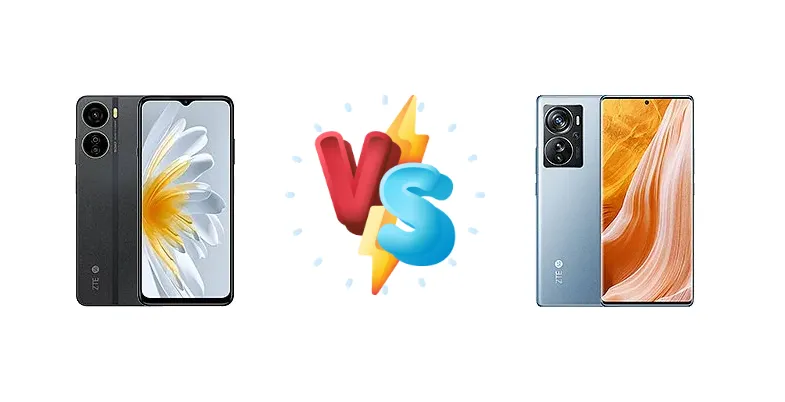
ZTE is targeting different segments with the Voyage 3D and Axon 40 Pro. The Voyage 3D attempts to stand out with its integrated 3D display, powered by a Unisoc chipset, while the Axon 40 Pro focuses on delivering flagship-adjacent performance with the Snapdragon 870 at a competitive price. This comparison dissects the key differences to determine which device offers the best value.
🏆 Quick Verdict
For most users, the ZTE Axon 40 Pro is the superior choice. Its Snapdragon 870 chipset provides significantly better performance and efficiency than the Unisoc T760, coupled with faster 65W charging. While the Voyage 3D’s 3D capabilities are unique, they don’t justify the performance compromise for the average user.
| Network |
|---|
| 2G bands | GSM 850 / 900 / 1800 / 1900 | GSM 850 / 900 / 1800 / 1900 |
| 3G bands | HSDPA 850 / 900 / 1900 / 2100 | HSDPA 850 / 900 / 1900 / 2100 - Europe |
| 4G bands | 1, 3, 5, 7, 8, 34, 38, 39, 40, 41 | 1, 3, 5, 7, 8, 20, 28, 38, 40, 41 - Europe |
| 5G bands | 1, 5, 8, 28, 41, 78 SA/NSA | 1, 3, 5, 7, 28, 38, 40, 41, 78 SA/NSA - Europe |
| Speed | HSPA, LTE, 5G | HSPA, LTE, 5G |
| Technology | GSM / HSPA / LTE / 5G | GSM / CDMA / HSPA / LTE / 5G |
| | - | 1, 2, 3, 5, 7, 28, 38, 40, 41, 66, 77, 78 SA/NSA - ROW |
| Launch |
|---|
| Announced | 2024, June 27 | 2022, May 09 |
| Status | Available. Released 2024, June 27 | Available. Released 2022, May 31 |
| Body |
|---|
| Build | Glass front, plastic frame, plastic back | - |
| Dimensions | 163.5 x 75 x 8.5 mm (6.44 x 2.95 x 0.33 in) | 162.9 x 72.9 x 8.7 mm (6.41 x 2.87 x 0.34 in) |
| SIM | Nano-SIM + Nano-SIM | Nano-SIM + Nano-SIM |
| Weight | 190 g (6.70 oz) | 199 g (7.02 oz) |
| Display |
|---|
| Resolution | 1080 x 2408 pixels, 20:9 ratio (~401 ppi density) | 1080 x 2400 pixels, 20:9 ratio (~395 ppi density) |
| Size | 6.58 inches, 104.3 cm2 (~85.1% screen-to-body ratio) | 6.67 inches, 107.4 cm2 (~90.4% screen-to-body ratio) |
| Type | IPS LCD, 120Hz | AMOLED, 1B colors, 144Hz, 1000 nits (peak) |
| Platform |
|---|
| CPU | Octa-core (1x2.2 GHz Cortex-A76 & 3x Cortex-A76 & 4x Cortex-A55) | Octa-core (1x3.2 GHz Kryo 585 & 3x2.42 GHz Kryo 585 & 4x1.80 GHz Kryo 585) |
| Chipset | Unisoc T760 (6 nm) | Qualcomm SM8250-AC Snapdragon 870 5G (7 nm) |
| GPU | Mali-G57 | Adreno 650 |
| OS | Android 13, MyOS 13 | Android 12, MyOS 12 |
| Memory |
|---|
| Card slot | Unspecified | No |
| Internal | 128GB 6GB RAM | 128GB 8GB RAM, 256GB 8GB RAM, 256GB 12GB RAM, 512GB 12GB RAM |
| | - | UFS 3.1 |
| Main Camera |
|---|
| Dual | 50 MP, (wide), PDAF
5 MP | - |
| Features | LED flash, HDR, panorama | Dual-LED flash, HDR, panorama |
| Quad | - | 108 MP, f/1.9, (wide), 1/1.52", PDAF
8 MP, f/2.2, 16mm, 120˚ (ultrawide)
2 MP (macro)
Auxiliary lens |
| Single | - | 16 MP, (wide) |
| Video | 1080p@30fps | 4K@30/60fps, 1080p@30fps, gyro-EIS, HDR10, 10‑bit video |
| Selfie camera |
|---|
| Features | - | HDR |
| Single | 5 MP | 16 MP, (wide) |
| Video | Yes | 4K@30fps, 1080p@30fps |
| Sound |
|---|
| 3.5mm jack | - | No |
| 35mm jack | No | No |
| Loudspeaker | Yes | Yes, with stereo speakers |
| | - | 24-bit/192kHz audio |
| Comms |
|---|
| Bluetooth | 5.0, A2DP, LE | 5.2, A2DP, LE |
| NFC | Unspecified | Yes |
| Positioning | GPS, GALILEO, GLONASS, BDS | GPS, GLONASS, GALILEO, BDS |
| Radio | No | No |
| USB | USB Type-C 2.0 | USB Type-C 3.1, OTG |
| WLAN | Wi-Fi 802.11 a/b/g/n/ac, dual-band | Wi-Fi 802.11 a/b/g/n/ac/6, dual-band, Wi-Fi Direct |
| Features |
|---|
| Sensors | Fingerprint (side-mounted), accelerometer, gyro, proximity, compass | Fingerprint (under display, optical), accelerometer, gyro, proximity, compass |
| Battery |
|---|
| Charging | 33W wired, PD3.0 | 65W wired, PD, QC4 |
| Type | 4500 mAh | Li-Po 5000 mAh |
| Misc |
|---|
| Colors | Black | Dream black, Crystal blue, Gold |
| Models | - | A2023G, A2023 |
| Price | About 190 EUR | About 410 EUR |
ZTE Voyage 3D
- Unique 3D display technology
- More affordable price point
- PD3.0 charging support
- Significantly weaker performance
- Slower charging speed
- Less efficient chipset
ZTE Axon 40 Pro
- Powerful Snapdragon 870 chipset
- Faster 65W charging with PD/QC4
- Superior overall performance
- Higher price
- Lacks 3D display
- May not be significantly better in battery life
Display Comparison
While both phones likely feature LCD panels (data not provided), the focus here is on the Voyage 3D’s unique 3D display technology. This adds a dimension not found on the Axon 40 Pro, but comes at the cost of potential viewing angle limitations and increased power consumption. The Axon 40 Pro, lacking 3D, likely prioritizes color accuracy and brightness. The absence of refresh rate data makes a direct comparison difficult, but the Axon 40 Pro’s higher price point suggests a potentially superior panel.
Camera Comparison
Without detailed camera specs, a direct comparison is limited. However, the Axon 40 Pro’s higher price suggests a more sophisticated camera system. The Snapdragon 870’s ISP (Image Signal Processor) is also more advanced than the Unisoc T760’s, resulting in better image processing, noise reduction, and dynamic range. While both phones likely feature multiple rear cameras, the Axon 40 Pro is expected to offer superior image quality, particularly in low-light conditions. We can assume the Axon 40 Pro will have a larger main sensor, contributing to better detail and light gathering.
Performance
The core difference lies in the chipsets. The Qualcomm Snapdragon 870 (7nm) in the Axon 40 Pro is a substantial upgrade over the Unisoc T760 (6nm) in the Voyage 3D. The Snapdragon 870’s Kryo 585 cores, clocked up to 3.2 GHz, deliver significantly faster CPU performance, while its Adreno 660 GPU provides a much more capable graphics experience. The 7nm process node also contributes to better thermal efficiency, meaning the Axon 40 Pro is less likely to throttle under sustained load. The Voyage 3D’s Cortex-A76 cores, while respectable, are simply outmatched by the Snapdragon 870’s architecture and clock speeds. The Axon 40 Pro will handle demanding games and applications with ease, while the Voyage 3D may struggle with more intensive tasks.
Battery Life
The Axon 40 Pro’s 65W wired charging with PD and QC4 support is a significant advantage over the Voyage 3D’s 33W wired charging with PD3.0. This translates to much faster charging times – likely a full charge in under 40 minutes for the Axon 40 Pro versus potentially over an hour for the Voyage 3D. While battery capacity isn’t specified, the Axon 40 Pro’s more efficient chipset will likely result in comparable or better battery life despite potentially having a similar capacity. The faster charging speed is a crucial benefit for users who need to quickly top up their phone.
Buying Guide
Buy the ZTE Voyage 3D if you are specifically seeking a smartphone with integrated 3D display capabilities and are willing to accept a performance trade-off. This phone caters to niche users interested in glasses-free 3D content. Buy the ZTE Axon 40 Pro if you prioritize overall performance, faster charging, and a smoother user experience for everyday tasks and gaming. It’s the better option for power users and those seeking a well-rounded smartphone.
Frequently Asked Questions
❓ Will the Unisoc T760 in the Voyage 3D struggle with graphically demanding games like Genshin Impact?
Yes, the Unisoc T760 is significantly less powerful than the Snapdragon 870. While it can handle less demanding games, Genshin Impact and similar titles will likely require significant graphics settings reductions and may still experience frame drops and stuttering. The Axon 40 Pro will provide a much smoother gaming experience.
❓ How much does the 3D display on the Voyage 3D impact battery life?
The 3D display is expected to consume more power than a traditional 2D display. While specific figures aren't available, enabling the 3D effect will likely reduce battery life by a noticeable margin. Users prioritizing battery life may prefer to disable the 3D feature.
❓ Does the Axon 40 Pro support high refresh rate gaming?
While the context data doesn't specify the screen refresh rate, Snapdragon 870-powered phones often support 120Hz displays. If the Axon 40 Pro does feature a 120Hz panel, it will provide a smoother and more responsive gaming experience, especially in supported titles.
❓ Is the 33W charging on the Voyage 3D slow compared to other phones in its price range?
Yes, 33W charging is relatively slow compared to the 65W or even 80W charging found on many competing smartphones. It will take considerably longer to fully charge the Voyage 3D compared to the Axon 40 Pro or other similarly priced devices.