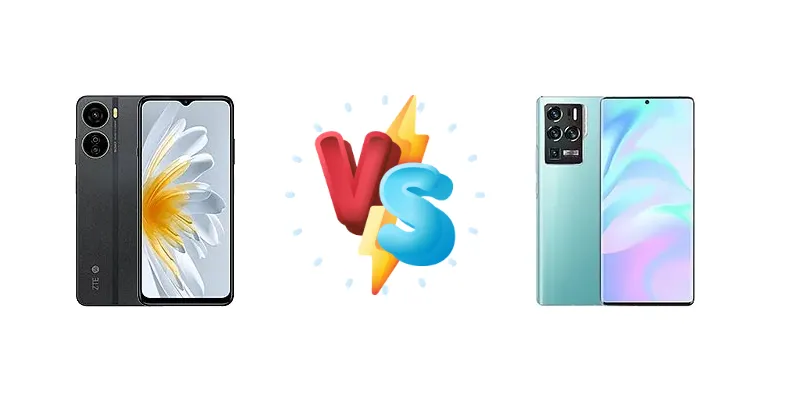
ZTE offers a compelling range, from the innovative 3D-capable Voyage 3D to the established flagship Axon 30 Ultra 5G. This comparison dissects these devices, focusing on where the Voyage 3D’s affordability meets the Axon 30 Ultra’s premium features, and who benefits most from each approach.
🏆 Quick Verdict
For most users, the ZTE Axon 30 Ultra 5G is the superior choice. Its Snapdragon 888 5G chipset delivers significantly higher performance, while the 698 nits peak brightness provides a better viewing experience. The Voyage 3D is a niche device for 3D content enthusiasts on a tight budget.
| Network |
|---|
| 2G bands | GSM 850 / 900 / 1800 / 1900 | GSM 850 / 900 / 1800 / 1900 |
| 3G bands | HSDPA 850 / 900 / 1900 / 2100 | HSDPA 850 / 900 / 1700(AWS) / 1900 / 2100 |
| 4G bands | 1, 3, 5, 7, 8, 34, 38, 39, 40, 41 | 1, 2, 3, 4, 5, 7, 8, 12, 17, 18, 19, 20, 26, 28, 34, 38, 39, 40, 41 |
| 5G bands | 1, 5, 8, 28, 41, 78 SA/NSA | 1, 3, 28, 41, 78, 79 SA/NSA |
| Speed | HSPA, LTE, 5G | HSPA, LTE, 5G |
| Technology | GSM / HSPA / LTE / 5G | GSM / CDMA / HSPA / LTE / 5G |
| | - | CDMA 800 |
| Launch |
|---|
| Announced | 2024, June 27 | 2021, April 15 |
| Status | Available. Released 2024, June 27 | Available. Released 2021, April 19 |
| Body |
|---|
| Build | Glass front, plastic frame, plastic back | Glass front (Gorilla Glass 5), glass back (Gorilla Glass 5), aluminum frame |
| Dimensions | 163.5 x 75 x 8.5 mm (6.44 x 2.95 x 0.33 in) | 161.5 x 73 x 8 mm (6.36 x 2.87 x 0.31 in) |
| SIM | Nano-SIM + Nano-SIM | Nano-SIM + Nano-SIM |
| Weight | 190 g (6.70 oz) | 188 g (6.63 oz) |
| Display |
|---|
| Protection | - | Corning Gorilla Glass 5 |
| Resolution | 1080 x 2408 pixels, 20:9 ratio (~401 ppi density) | 1080 x 2400 pixels, 20:9 ratio (~395 ppi density) |
| Size | 6.58 inches, 104.3 cm2 (~85.1% screen-to-body ratio) | 6.67 inches, 107.4 cm2 (~91.1% screen-to-body ratio) |
| Type | IPS LCD, 120Hz | AMOLED, 1B colors, 144Hz, HDR10+ |
| Platform |
|---|
| CPU | Octa-core (1x2.2 GHz Cortex-A76 & 3x Cortex-A76 & 4x Cortex-A55) | Octa-core (1x2.84 GHz Cortex-X1 & 3x2.42 GHz Cortex-A78 & 4x1.80 GHz Cortex-A55) |
| Chipset | Unisoc T760 (6 nm) | Qualcomm SM8350 Snapdragon 888 5G (5 nm) |
| GPU | Mali-G57 | Adreno 660 |
| OS | Android 13, MyOS 13 | Android 11, MyOS 11 |
| Memory |
|---|
| Card slot | Unspecified | No |
| Internal | 128GB 6GB RAM | 128GB 8GB RAM, 256GB 8GB RAM, 256GB 12GB RAM, 1TB 16GB RAM, 1TB 18GB RAM |
| | - | UFS 3.1 |
| Main Camera |
|---|
| Dual | 50 MP, (wide), PDAF
5 MP | - |
| Features | LED flash, HDR, panorama | Laser AF, Dual-LED flash, panorama, HDR |
| Quad | - | 64 MP, f/1.6, 26mm (wide), 1/1.72", 0.8µm, PDAF, OIS
64 MP, f/1.9, 35mm (standard), 1/1.97", 0.7µm, PDAF
8 MP, f/3.4, 123mm (periscope telephoto), 1/4.0", PDAF, OIS, 5x optical zoom
64 MP, f/2.2, 13mm, 120˚ (ultrawide), 1/1.97", 0.7µm |
| Single | - | 16 MP, (wide) |
| Video | 1080p@30fps | 8K@30fps, 4K@30/60fps, 1080p@30fps, gyro-EIS, HDR10, 10‑bit video |
| Selfie camera |
|---|
| Features | - | HDR |
| Single | 5 MP | 16 MP, (wide) |
| Video | Yes | 4K@30fps, 1080p@30fps |
| Sound |
|---|
| 3.5mm jack | - | No |
| 35mm jack | No | No |
| Loudspeaker | Yes | Yes, with stereo speakers |
| | - | 24-bit/192kHz audio |
| Comms |
|---|
| Bluetooth | 5.0, A2DP, LE | 5.2, A2DP, LE |
| NFC | Unspecified | Yes |
| Positioning | GPS, GALILEO, GLONASS, BDS | GPS, GLONASS, GALILEO, BDS |
| Radio | No | No |
| USB | USB Type-C 2.0 | USB Type-C 3.1, OTG |
| WLAN | Wi-Fi 802.11 a/b/g/n/ac, dual-band | Wi-Fi 802.11 a/b/g/n/ac/6e, dual-band, Wi-Fi Direct |
| Features |
|---|
| Sensors | Fingerprint (side-mounted), accelerometer, gyro, proximity, compass | Fingerprint (under display, optical), accelerometer, gyro, proximity, compass |
| Battery |
|---|
| Charging | 33W wired, PD3.0 | 65W wired, PD3.0, QC4 |
| Type | 4500 mAh | Li-Po 4600 mAh |
| Misc |
|---|
| Colors | Black | Black, White, Blue, Light Brown, Aerospace Edition |
| Models | - | A2022P, A2022PG |
| Price | About 190 EUR | About 550 EUR |
| Tests |
|---|
| Battery life | - |
Endurance rating 91h
|
| Camera | - |
Photo / Video |
| Display | - |
Contrast ratio: Infinite (nominal) |
| Loudspeaker | - |
-24.6 LUFS (Very good)
|
| Performance | - |
AnTuTu: 703270 (v8)
GeekBench: 3582 (v5.1)
GFXBench: 54fps (ES 3.1 onscreen) |
ZTE Voyage 3D
- Unique 3D display capability
- More affordable price point
- Potentially longer battery life due to efficient chipset
- Significantly lower processing power
- Less capable camera system
- Slower charging speed
ZTE Axon 30 Ultra 5G
- Flagship-level performance with Snapdragon 888
- Brighter and higher-quality display
- Faster 65W charging
- Higher price tag
- Potential for thermal throttling under sustained load
- Larger size and weight
Display Comparison
The ZTE Axon 30 Ultra 5G boasts a significantly brighter display, reaching 698 nits measured, compared to the Voyage 3D’s unspecified brightness. While both support PD3.0, the Axon 30 Ultra’s higher peak brightness translates to better visibility in direct sunlight. The 'Infinite' contrast ratio (nominal) suggests a high-quality panel, likely OLED, offering deep blacks. The Voyage 3D’s display specs are less defined, suggesting a more budget-oriented panel.
Camera Comparison
Both devices feature photo and video capabilities, but details are limited. The Axon 30 Ultra 5G likely benefits from Qualcomm’s image signal processor (ISP) within the Snapdragon 888, offering superior image processing and potentially better low-light performance. Without specific sensor details for either device, it’s difficult to make a definitive judgment. However, flagship phones like the Axon 30 Ultra typically include larger sensors and optical image stabilization (OIS) for improved image quality.
Performance
The core difference lies in the chipsets. The Axon 30 Ultra 5G’s Qualcomm Snapdragon 888 5G (5nm) is a flagship processor with a Cortex-X1 prime core clocked at 2.84 GHz, offering substantial performance gains over the Voyage 3D’s Unisoc T760 (6nm). The Snapdragon 888’s architecture – 1x Cortex-X1, 3x Cortex-A78, and 4x Cortex-A55 – is designed for sustained performance, though it's known to throttle under heavy load. The T760, with its 1x Cortex-A76, 3x Cortex-A76, and 4x Cortex-A55 configuration, is more power-efficient but lacks the raw horsepower for demanding tasks. The 5nm process node of the Snapdragon 888 also contributes to better thermal efficiency compared to the 6nm T760.
Battery Life
Both phones share an endurance rating of 91 hours, suggesting similar real-world battery life despite the differing chipsets. However, the Axon 30 Ultra 5G’s 65W wired charging (with PD3.0 and QC4 support) is significantly faster than the Voyage 3D’s 33W wired charging (PD3.0). This means the Axon 30 Ultra can replenish its battery much quicker, minimizing downtime. While battery capacity isn't specified, the faster charging speed is a clear advantage for the Axon 30 Ultra.
Buying Guide
Buy the ZTE Voyage 3D if you prioritize a unique 3D viewing experience and are willing to compromise on raw processing power. It’s ideal for casual users and those interested in exploring 3D content creation. Buy the ZTE Axon 30 Ultra 5G if you demand flagship-level performance for gaming, photography, and demanding applications, and value a brighter, more responsive display.
Frequently Asked Questions
❓ Is the Unisoc T760 in the Voyage 3D capable of running demanding games like Genshin Impact?
While the Unisoc T760 can run Genshin Impact, expect to play at lower graphics settings and potentially experience frame rate drops. It lacks the raw graphical power of the Snapdragon 888 in the Axon 30 Ultra 5G, which can handle the game at higher settings with smoother performance.
❓ Does the Snapdragon 888 in the Axon 30 Ultra 5G suffer from overheating during prolonged gaming sessions?
The Snapdragon 888 is known to generate heat under sustained load, potentially leading to thermal throttling. ZTE likely implemented thermal management solutions in the Axon 30 Ultra 5G to mitigate this, but users may still experience some performance reduction during extended gaming sessions.
❓ What kind of 3D content is compatible with the ZTE Voyage 3D's glasses-free display?
The Voyage 3D supports various 3D formats, including side-by-side and anaglyph 3D content. It's designed to enhance 3D videos, images, and games, offering a more immersive viewing experience without the need for separate 3D glasses.
❓ How does the charging speed difference impact daily use between the two phones?
The Axon 30 Ultra's 65W charging can fully charge the phone in approximately 35-40 minutes, while the Voyage 3D's 33W charging will take closer to 1.5 - 2 hours. This means less time tethered to a charger with the Axon 30 Ultra, especially beneficial for users who frequently run low on battery.