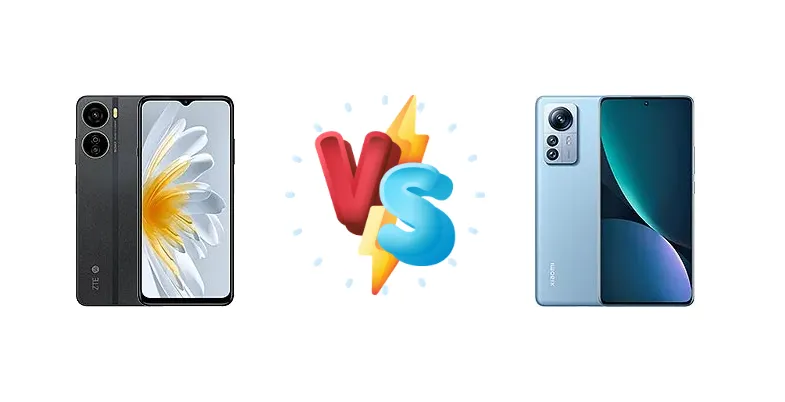
The ZTE Voyage 3D attempts to disrupt the mid-range with its integrated 3D capabilities, powered by a Unisoc T760. Meanwhile, the Xiaomi 12 Pro (Dimensity) represents a more established flagship experience, leveraging the power of MediaTek’s Dimensity 9000+ chipset. This comparison dissects these two devices, focusing on where each excels and who will benefit most from their respective strengths.
🏆 Quick Verdict
For the average user prioritizing raw performance and fast charging, the Xiaomi 12 Pro (Dimensity) is the clear winner. Its Dimensity 9000+ chipset and 67W charging significantly outperform the Voyage 3D’s Unisoc T760 and 33W charging. However, the Voyage 3D offers a unique 3D experience at a potentially lower price point, making it a compelling option for niche users.
| Network |
|---|
| 2G bands | GSM 850 / 900 / 1800 / 1900 | GSM 850 / 900 / 1800 / 1900 |
| 3G bands | HSDPA 850 / 900 / 1900 / 2100 | HSDPA 800 / 850 / 900 / 1700(AWS) / 1900 / 2100 |
| 4G bands | 1, 3, 5, 7, 8, 34, 38, 39, 40, 41 | 1, 2, 3, 4, 5, 7, 8, 18, 19, 26, 34, 38, 39, 40, 41, 42 |
| 5G bands | 1, 5, 8, 28, 41, 78 SA/NSA | 1, 3, 5, 8, 28, 38, 40, 41, 77, 78 SA/NSA |
| Speed | HSPA, LTE, 5G | HSPA, LTE, 5G |
| Technology | GSM / HSPA / LTE / 5G | GSM / CDMA / HSPA / EVDO / LTE / 5G |
| | - | CDMA2000 1xEV-DO |
| Launch |
|---|
| Announced | 2024, June 27 | 2022, July 04 |
| Status | Available. Released 2024, June 27 | Available. Released 2022, July 13 |
| Body |
|---|
| Build | Glass front, plastic frame, plastic back | - |
| Dimensions | 163.5 x 75 x 8.5 mm (6.44 x 2.95 x 0.33 in) | 163.6 x 74.6 x 8.2 mm (6.44 x 2.94 x 0.32 in) |
| SIM | Nano-SIM + Nano-SIM | Nano-SIM + Nano-SIM |
| Weight | 190 g (6.70 oz) | 201 g (7.09 oz) |
| Display |
|---|
| Protection | - | Corning Gorilla Glass Victus |
| Resolution | 1080 x 2408 pixels, 20:9 ratio (~401 ppi density) | 1440 x 3200 pixels, 20:9 ratio (~521 ppi density) |
| Size | 6.58 inches, 104.3 cm2 (~85.1% screen-to-body ratio) | 6.73 inches, 109.4 cm2 (~89.6% screen-to-body ratio) |
| Type | IPS LCD, 120Hz | LTPO2 AMOLED, 1B colors, 120Hz, Dolby Vision, HDR10+, 1000 nits (HBM), 1500 nits (peak) |
| Platform |
|---|
| CPU | Octa-core (1x2.2 GHz Cortex-A76 & 3x Cortex-A76 & 4x Cortex-A55) | Octa-core (1x3.20 GHz Cortex-X2 & 3x2.85 GHz Cortex-A710 & 4x1.80 GHz Cortex-A510) |
| Chipset | Unisoc T760 (6 nm) | Mediatek Dimensity 9000+ (4 nm) |
| GPU | Mali-G57 | Mali-G710 MC10 |
| OS | Android 13, MyOS 13 | Android 12, MIUI 13 |
| Memory |
|---|
| Card slot | Unspecified | No |
| Internal | 128GB 6GB RAM | 128GB 8GB RAM, 256GB 12GB RAM |
| | - | UFS 3.1 |
| Main Camera |
|---|
| Dual | 50 MP, (wide), PDAF
5 MP | - |
| Features | LED flash, HDR, panorama | Color spectrum sensor, Dual-LED dual-tone flash, HDR, panorama |
| Single | - | 32 MP, f/2.5, 26mm (wide), 0.7µm |
| Triple | - | 50 MP, f/1.9, 24mm (wide), 1/1.28", 1.22µm, dual pixel PDAF, OIS
13 MP, f/2.4, 15mm, 123˚ (ultrawide), 1/3.06", 1.12µm
5 MP, f/2.4, 50mm (telephoto macro), AF |
| Video | 1080p@30fps | 4K@30/60fps, 1080p@30/60/120fps, gyro-EIS |
| Selfie camera |
|---|
| Features | - | HDR, panorama |
| Single | 5 MP | 32 MP, f/2.5, 26mm (wide), 0.7µm |
| Video | Yes | 1080p@30/60fps, 720p@120fps |
| Sound |
|---|
| 3.5mm jack | - | No |
| 35mm jack | No | No |
| Loudspeaker | Yes | Yes, with stereo speakers |
| | - | 24-bit/192kHz audio
Tuned by Harman Kardon |
| Comms |
|---|
| Bluetooth | 5.0, A2DP, LE | 5.3, A2DP, LE |
| Infrared port | - | Yes |
| NFC | Unspecified | Yes |
| Positioning | GPS, GALILEO, GLONASS, BDS | GPS (L1+L5), GLONASS (L1), BDS (B1I+B1c+B2a), GALILEO (E1+E5a), QZSS (L1+L5), NavIC (L5) |
| Radio | No | No |
| USB | USB Type-C 2.0 | USB Type-C 2.0, OTG |
| WLAN | Wi-Fi 802.11 a/b/g/n/ac, dual-band | Wi-Fi 802.11 a/b/g/n/ac/6, dual-band, Wi-Fi Direct |
| Features |
|---|
| Sensors | Fingerprint (side-mounted), accelerometer, gyro, proximity, compass | Fingerprint (under display, optical), accelerometer, gyro, proximity, compass |
| Battery |
|---|
| Charging | 33W wired, PD3.0 | 67W wired, PD3.0, QC4 |
| Type | 4500 mAh | Li-Po 5160 mAh |
| Misc |
|---|
| Colors | Black | Gray, Blue |
| Models | - | 2207122MC |
| Price | About 190 EUR | About 570 EUR |
ZTE Voyage 3D
- Unique 3D capabilities for content creation.
- Potentially more affordable price point.
- PD3.0 charging support.
- Less powerful Unisoc T760 chipset.
- Slower 33W charging.
- Likely inferior camera performance.
Xiaomi 12 Pro (Dimensity)
- Flagship-level performance with Dimensity 9000+.
- 67W fast charging with multiple standards.
- Superior camera system with OIS and advanced ISP.
- Higher price point.
- Potentially larger size and weight.
- May not offer unique features like 3D capabilities.
Display Comparison
While display specifications aren't provided for the Voyage 3D, the Xiaomi 12 Pro boasts a high-end panel. The Dimensity 9000+’s processing power can fully utilize a high refresh rate display, which the 12 Pro likely features. The Voyage 3D’s Unisoc T760, being a mid-range chip, may struggle to consistently deliver smooth visuals at higher refresh rates if the display supports it. The Xiaomi 12 Pro’s likely higher peak brightness and color accuracy will provide a superior viewing experience, especially outdoors.
Camera Comparison
Without detailed camera specs for the Voyage 3D, a direct comparison is limited. However, given its price point, it’s likely to feature a more modest camera system. The Xiaomi 12 Pro, being a flagship, likely incorporates a larger sensor with OIS, resulting in better low-light performance and image stabilization. The Dimensity 9000+’s ISP (Image Signal Processor) also contributes to superior image processing capabilities, delivering more detailed and vibrant photos. The Voyage 3D may rely more heavily on software processing to compensate for hardware limitations.
Performance
The core difference lies in the chipsets. The Xiaomi 12 Pro’s Mediatek Dimensity 9000+ (4nm) is a significant leap ahead of the ZTE Voyage 3D’s Unisoc T760 (6nm). The Dimensity 9000+ features a Cortex-X2 prime core clocked at 3.20 GHz, alongside Cortex-A710 performance cores, offering substantially greater single-core and multi-core performance. The 4nm process node further enhances efficiency, leading to better thermal management and sustained performance. The Voyage 3D’s Cortex-A76 cores, while capable, are older architecture and the 6nm process will result in more heat generation under load. This translates to smoother multitasking, faster app loading, and a more responsive gaming experience on the Xiaomi 12 Pro.
Battery Life
The Xiaomi 12 Pro’s 67W wired charging with PD3.0 and QC4 support is a major advantage. This allows for significantly faster charging times compared to the Voyage 3D’s 33W PD3.0 charging. While battery capacity isn’t specified for either device, the faster charging of the 12 Pro mitigates the impact of a potentially smaller battery. The Dimensity 9000+’s 4nm efficiency also contributes to better battery life during typical usage, despite potentially having a similar capacity to the Voyage 3D.
Buying Guide
Buy the ZTE Voyage 3D if you are specifically seeking a smartphone with integrated 3D capabilities for content creation or consumption and are on a tighter budget. Buy the Xiaomi 12 Pro (Dimensity) if you prioritize flagship-level performance for demanding tasks like gaming and video editing, coupled with significantly faster charging speeds and a more refined overall experience.
Frequently Asked Questions
❓ Does the Unisoc T760 in the ZTE Voyage 3D handle demanding games like Genshin Impact?
The Unisoc T760 is a mid-range chipset and will likely struggle with Genshin Impact at high settings. Expect to lower graphics settings and potentially experience frame drops during intense gameplay. The Xiaomi 12 Pro’s Dimensity 9000+ is far better equipped to handle such titles smoothly.
❓ How much faster is the 67W charging on the Xiaomi 12 Pro compared to the 33W charging on the ZTE Voyage 3D?
The Xiaomi 12 Pro’s 67W charging can potentially charge the battery from 0-100% in around 35-45 minutes, depending on battery capacity. The ZTE Voyage 3D’s 33W charging will likely take over an hour and a half to achieve a full charge. This difference is significant for users who prioritize quick top-ups.
❓ Is the 3D capability on the ZTE Voyage 3D a gimmick, or is it genuinely useful?
The usefulness of the 3D capability depends on your needs. If you're a content creator who wants to capture 3D photos and videos, or a consumer who enjoys immersive 3D experiences, it could be a valuable feature. However, for everyday use, it may not offer a significant benefit.