
ZTE Voyage 3D vs Oppo Find X5 Pro: A Deep Dive into Display Tech and Performance
| Phones Images | |||||
|---|---|---|---|---|---|
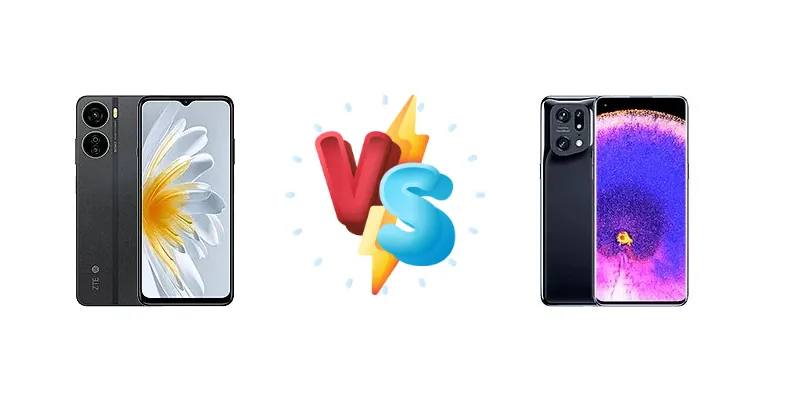
|
🏆 Quick Verdict
For the average user prioritizing raw performance, camera quality, and fast charging, the Oppo Find X5 Pro is the clear winner. However, the ZTE Voyage 3D offers a unique 3D viewing experience at a significantly lower price point, appealing to a niche audience.
| PHONES | ||
|---|---|---|
| Phone Names | ZTE Voyage 3D | Oppo Find X5 Pro |
| Network | ||
|---|---|---|
| 2G bands | GSM 850 / 900 / 1800 / 1900 | GSM 850 / 900 / 1800 / 1900 |
| 3G bands | HSDPA 850 / 900 / 1900 / 2100 | HSDPA 800 / 850 / 900 / 1700(AWS) / 1900 / 2100 |
| 4G bands | 1, 3, 5, 7, 8, 34, 38, 39, 40, 41 | 1, 2, 3, 4, 5, 7, 8, 12, 13, 17, 18, 19, 20, 25, 26, 28, 32, 34, 38, 39, 40, 41, 42, 66 - Global |
| 5G bands | 1, 5, 8, 28, 41, 78 SA/NSA | 1, 2, 3, 5, 7, 8, 12, 13, 18, 20, 25, 26, 28, 38, 40, 41, 66, 77, 78, 79 SA/NSA - Global |
| Speed | HSPA, LTE, 5G | HSPA, LTE, 5G |
| Technology | GSM / HSPA / LTE / 5G | GSM / CDMA / HSPA / CDMA2000 / LTE / 5G |
| - | 1, 2, 3, 5, 8, 20, 28, 38, 41, 66, 77, 78, 79 SA/NSA - China | |
| Launch | ||
|---|---|---|
| Announced | 2024, June 27 | 2022, February 24 |
| Status | Available. Released 2024, June 27 | Available. Released 2022, March 14 |
| Body | ||
|---|---|---|
| Build | Glass front, plastic frame, plastic back | Glass front (Gorilla Glass Victus), ceramic back or eco leather back, aluminum frame |
| Dimensions | 163.5 x 75 x 8.5 mm (6.44 x 2.95 x 0.33 in) | 163.7 x 73.9 x 8.5 or 8.8 mm |
| SIM | Nano-SIM + Nano-SIM | Nano-SIM + eSIM |
| Weight | 190 g (6.70 oz) | 218 g or 195 g (6.88 oz) |
| - | IP68 dust/water resistant (up to 1.5m for 30 min) | |
| Display | ||
|---|---|---|
| Protection | - | Corning Gorilla Glass Victus |
| Resolution | 1080 x 2408 pixels, 20:9 ratio (~401 ppi density) | 1440 x 3216 pixels, 20:9 ratio (~525 ppi density) |
| Size | 6.58 inches, 104.3 cm2 (~85.1% screen-to-body ratio) | 6.7 inches, 108.4 cm2 (~89.6% screen-to-body ratio) |
| Type | IPS LCD, 120Hz | LTPO2 AMOLED, 1B colors, 120Hz, HDR10+, BT.2020, 500 nits (typ), 800 nits (HBM), 1300 nits (peak) |
| Platform | ||
|---|---|---|
| CPU | Octa-core (1x2.2 GHz Cortex-A76 & 3x Cortex-A76 & 4x Cortex-A55) | Octa-core (1x3.00 GHz Cortex-X2 & 3x2.50 GHz Cortex-A710 & 4x1.80 GHz Cortex-A510) - GlobalOcta-core (1x3.05 GHz Cortex-X2 & 3x2.85 GHz Cortex-A710 & 4x1.80 GHz Cortex-A510) - China |
| Chipset | Unisoc T760 (6 nm) | Qualcomm SM8450 Snapdragon 8 Gen 1 (4 nm) - GlobalMediatek Dimensity 9000 (4 nm) - China |
| GPU | Mali-G57 | Adreno 730 - GlobalMali-G710 MC10 - China |
| OS | Android 13, MyOS 13 | Android 12, upgradable to Android 14, ColorOS 14 |
| Memory | ||
|---|---|---|
| Card slot | Unspecified | No |
| Internal | 128GB 6GB RAM | 256GB 8GB RAM, 256GB 12GB RAM, 512GB 12GB RAM |
| - | UFS 3.1 | |
| Main Camera | ||
|---|---|---|
| Dual | 50 MP, (wide), PDAF 5 MP | - |
| Features | LED flash, HDR, panorama | Hasselblad Color Calibration, color spectrum sensor, LED flash, HDR, panorama |
| Single | - | 32 MP, f/2.4, 21mm (wide), 1/2.74", 0.8µm |
| Triple | - | 50 MP, f/1.7, 25mm (wide), 1/1.56", 1.0µm, multi-directional PDAF, OIS (3-axis sensor-shift, 2-axis lens-shift) 13 MP, f/2.4, 52mm (telephoto), 1/3.4", 2x optical zoom, PDAF 50 MP, f/2.2, 15mm, 110˚ (ultrawide), 1/1.56", 1.0µm, multi-directional PDAF |
| Video | 1080p@30fps | 4K@30/60fps, 1080p@30/60/240fps; gyro-EIS; HDR, 10‑bit video |
| Selfie camera | ||
|---|---|---|
| Features | - | Panorama |
| Single | 5 MP | 32 MP, f/2.4, 21mm (wide), 1/2.74", 0.8µm |
| Video | Yes | 1080p@30fps, gyro-EIS |
| Sound | ||
|---|---|---|
| 3.5mm jack | - | No |
| 35mm jack | No | No |
| Loudspeaker | Yes | Yes, with stereo speakers |
| Comms | ||
|---|---|---|
| Bluetooth | 5.0, A2DP, LE | 5.2, A2DP, LE, aptX HD |
| NFC | Unspecified | Yes |
| Positioning | GPS, GALILEO, GLONASS, BDS | GPS (L1), GLONASS (L1), BDS (B1I+B1c), GALILEO (E1+E5a), QZSS (L1) |
| Radio | No | No |
| USB | USB Type-C 2.0 | USB Type-C 3.1, OTG |
| WLAN | Wi-Fi 802.11 a/b/g/n/ac, dual-band | Wi-Fi 802.11 a/b/g/n/ac/6e, dual-band, Wi-Fi Direct |
| Features | ||
|---|---|---|
| Sensors | Fingerprint (side-mounted), accelerometer, gyro, proximity, compass | Fingerprint (under display, optical), accelerometer, gyro, proximity, compass |
| - | Oppo Find X5 Pro Dimensity model has no MariSilicon X image chip, 5-axis OIS and Hasselblad’s color calibration | |
| Battery | ||
|---|---|---|
| Charging | 33W wired, PD3.0 | 80W wired, PD, 50% in 12 min 50W wireless, 100% in 47 min 10W reverse wireless |
| Type | 4500 mAh | Li-Po 5000 mAh |
| Misc | ||
|---|---|---|
| Colors | Black | Ceramic Black, Ceramic White, Blue (eco leather) |
| Models | - | PFEM10, CPH2305, PFFM20 |
| Price | About 190 EUR | € 449.00 / $ 430.24 / £ 1,049.00 |
| Tests | ||
|---|---|---|
| Battery life | - | Endurance rating 101h |
| Camera | - | Photo / Video |
| Display | - | Contrast ratio: Infinite (nominal) |
| Loudspeaker | - | -24.7 LUFS (Very good) |
| Performance | - | AnTuTu: 1012896 (v9) GeekBench: 3433 (v5.1) GFXBench: 44fps (ES 3.1 onscreen) |
ZTE Voyage 3D
- Unique glasses-free 3D display
- More affordable price point
- PD3.0 charging support
- Less powerful Unisoc T760 chipset
- Limited camera specifications
- Slower charging speed
Oppo Find X5 Pro
- Powerful Snapdragon 8 Gen 1 (or Dimensity 9000)
- Fast 80W wired and 50W wireless charging
- Superior camera system
- Higher price tag
- Potential for thermal throttling under heavy load
- No 3D display
Display Comparison
The Oppo Find X5 Pro boasts a high peak brightness of 762 nits, ensuring excellent visibility even in direct sunlight. While the Voyage 3D’s display specs are not provided, its key feature is its glasses-free 3D technology. This fundamentally alters the viewing experience, potentially sacrificing color accuracy and viewing angles for the 3D effect. The Find X5 Pro’s infinite contrast ratio (nominal) suggests a superior viewing experience for standard 2D content, while the Voyage 3D’s display is optimized for its unique 3D output. The lack of refresh rate information for the Voyage 3D is a significant omission, potentially impacting smoothness compared to the likely 120Hz panel on the Find X5 Pro.
Camera Comparison
Both devices feature capable camera systems, but the Oppo Find X5 Pro is expected to offer a more refined and versatile experience. While both are listed as having Photo/Video capabilities, the Find X5 Pro benefits from a flagship-level sensor and image processing pipeline. The Voyage 3D’s camera specs are not detailed, making a direct comparison difficult. However, given its price point, it’s unlikely to match the Find X5 Pro’s image quality, particularly in low-light conditions. The Find X5 Pro likely includes advanced features like OIS and sophisticated computational photography algorithms, absent from the Voyage 3D.
Performance
The Oppo Find X5 Pro, equipped with the Qualcomm Snapdragon 8 Gen 1 (Global) or MediaTek Dimensity 9000 (China), delivers significantly more processing power than the ZTE Voyage 3D’s Unisoc T760. The Snapdragon 8 Gen 1’s Cortex-X2 core clocked at 3.00 GHz, alongside the A710 cores, provides a substantial performance advantage in demanding tasks like gaming and video editing. The Unisoc T760, while a capable chip, utilizes older Cortex-A76 cores and a 6nm process, resulting in lower peak performance and potentially higher power consumption. The Find X5 Pro’s LPDDR5 RAM further enhances performance, while the Voyage 3D’s RAM specification is unknown. The 4nm process node of the Snapdragon/Dimensity chips also contributes to better thermal efficiency, minimizing throttling during sustained workloads.
Battery Life
The Oppo Find X5 Pro boasts impressive charging capabilities with 80W wired charging, achieving 50% charge in just 12 minutes, and 50W wireless charging, reaching 100% in 47 minutes. It also offers 10W reverse wireless charging. The ZTE Voyage 3D’s 33W wired charging with PD3.0 is considerably slower. Both phones share an endurance rating of 101h, suggesting similar battery life despite the difference in charging speeds. This implies the Voyage 3D’s battery capacity is optimized for its less power-hungry chipset, while the Find X5 Pro’s larger battery compensates for the more demanding Snapdragon 8 Gen 1.
Buying Guide
Buy the ZTE Voyage 3D if you're intrigued by the novelty of a glasses-free 3D display and are willing to compromise on peak performance and camera capabilities. It's ideal for media consumption and casual gaming. Buy the Oppo Find X5 Pro if you demand a top-tier Android experience with a powerful Snapdragon 8 Gen 1 (or Dimensity 9000 in China), exceptional camera system, and blazing-fast 80W charging – a true flagship for power users.