
ZTE Voyage 20 Pro vs Google Pixel 6 Pro: A Detailed Comparison
| Phones Images | |||||
|---|---|---|---|---|---|
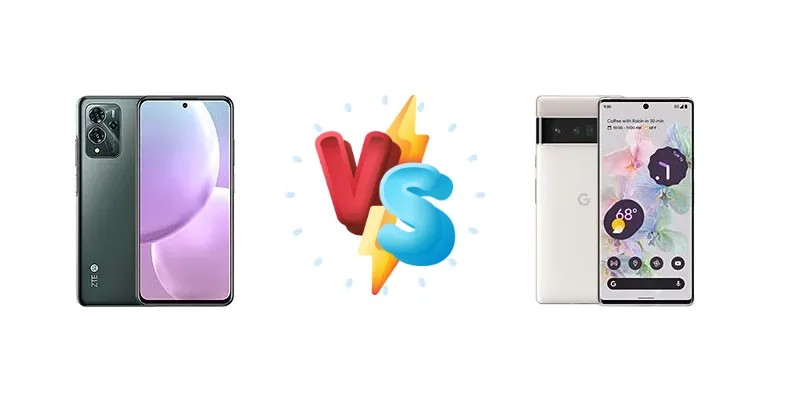
|
🏆 Quick Verdict
For the average user prioritizing a smooth, intelligent experience and excellent camera capabilities, the Google Pixel 6 Pro is the superior choice. However, the ZTE Voyage 20 Pro offers a compelling value proposition with its significantly faster 66W charging and respectable performance for the price-conscious buyer.
| PHONES | ||
|---|---|---|
| Phone Names | ZTE Voyage 20 Pro | Google Pixel 6 Pro |
| Network | ||
|---|---|---|
| 2G bands | GSM 850 / 900 / 1800 / 1900 | GSM 850 / 900 / 1800 / 1900 |
| 3G bands | HSDPA 850 / 900 / 1900 / 2100 | HSDPA 800 / 850 / 900 / 1700(AWS) / 1900 / 2100 |
| 4G bands | 1, 3, 5, 7, 8, 34, 39, 40, 41 | 1, 2, 3, 4, 5, 7, 8, 12, 13, 14, 17, 18, 19, 20, 25, 26, 28, 29, 30, 32, 38, 39, 40, 41, 42, 46, 48, 66, 71 - GLUOG, G8VOU |
| 5G bands | 1, 28, 41, 78 SA/NSA | 1, 2, 3, 5, 7, 8, 12, 14, 20, 25, 28, 30, 38, 40, 41, 48, 66, 71, 77, 78, 257, 258, 260, 261 SA/NSA/Sub6/mmWave - G8VOU |
| Speed | HSPA, LTE, 5G | HSPA, LTE, 5G |
| Technology | GSM / CDMA / HSPA / LTE / 5G | GSM / CDMA / HSPA / EVDO / LTE / 5G |
| CDMA 800 | 1, 2, 3, 5, 7, 8, 12, 14, 20, 25, 28, 30, 38, 40, 41, 48, 66, 71, 77, 78 SA/NSA/Sub6 - GLUOG | |
| Launch | ||
|---|---|---|
| Announced | 2021, November 25 | 2021, October 19 |
| Status | Available. Released 2021, December 04 | Available. Released 2021, October 28 |
| Body | ||
|---|---|---|
| Build | Glass front, plastic back, plastic frame | Glass front (Gorilla Glass Victus), glass back (Gorilla Glass Victus), aluminum frame |
| Dimensions | 163.9 x 76.2 x 8.3 mm (6.45 x 3.00 x 0.33 in) | 163.9 x 75.9 x 8.9 mm (6.45 x 2.99 x 0.35 in) |
| SIM | Nano-SIM + Nano-SIM | Nano-SIM + eSIM |
| Weight | 190 g (6.70 oz) | 210 g (7.41 oz) |
| - | IP68 dust/water resistant (up to 1.5m for 30 min) | |
| Display | ||
|---|---|---|
| Protection | - | Corning Gorilla Glass Victus |
| Resolution | 1080 x 2400 pixels, 20:9 ratio (~395 ppi density) | 1440 x 3120 pixels, 19.5:9 ratio (~512 ppi density) |
| Size | 6.67 inches, 107.4 cm2 (~86.0% screen-to-body ratio) | 6.7 inches, 110.6 cm2 (~88.9% screen-to-body ratio) |
| Type | AMOLED, 90Hz | LTPO AMOLED, 120Hz, HDR10+ |
| - | Always-on display | |
| Platform | ||
|---|---|---|
| CPU | Octa-core (2x2.0 GHz Cortex-A76 & 6x2.0 GHz Cortex-A55) | Octa-core (2x2.80 GHz Cortex-X1 & 2x2.25 GHz Cortex-A76 & 4x1.80 GHz Cortex-A55) |
| Chipset | Mediatek Dimensity 720 (7 nm) | Google Tensor (5 nm) |
| GPU | Mali-G57 MC3 | Mali-G78 MP20 |
| OS | Android 11, MyOS 11 | Android 12, upgradable to Android 15, up to 5 major Android upgrades |
| Memory | ||
|---|---|---|
| Card slot | No | No |
| Internal | 256GB 8GB RAM | 128GB 12GB RAM, 256GB 12GB RAM, 512GB 12GB RAM |
| - | UFS 3.1 | |
| Main Camera | ||
|---|---|---|
| Features | LED flash, HDR, panorama | Laser AF, Dual-LED flash, Pixel Shift, Auto-HDR, panorama |
| Quad | 64 MP, f/1.8, 25mm (wide), PDAF 8 MP, f/2.2, 120˚, 16mm (ultrawide) 5 MP (macro) | - |
| Single | 16 MP | 11.1 MP, f/2.2, 20mm (ultrawide), 1.22µm |
| Triple | - | 50 MP, f/1.9, 25mm (wide), 1/1.31", 1.2µm, dual pixel PDAF, OIS 48 MP, f/3.5, 104mm (periscope telephoto), 1/2.0", 0.8µm, PDAF, OIS, 4x optical zoom 12 MP, f/2.2, 17mm, 114˚ (ultrawide), 1.25µm |
| Video | 4K@30fps, 1080p@30ps | 4K@30/60fps, 1080p@30/60/120/240fps; gyro-EIS, OIS |
| Selfie camera | ||
|---|---|---|
| Features | HDR | HDR, panorama |
| Single | 16 MP | 11.1 MP, f/2.2, 20mm (ultrawide), 1.22µm |
| Video | 1080p@30fps | 4K@30fps, 1080p@30/60fps |
| Sound | ||
|---|---|---|
| 3.5mm jack | No | No |
| 35mm jack | No | No |
| Loudspeaker | Yes | Yes, with stereo speakers |
| Comms | ||
|---|---|---|
| Bluetooth | 5.1, A2DP, LE | 5.2, A2DP, LE, aptX HD |
| NFC | No | Yes |
| Positioning | GPS | GPS (L1+L5), GLONASS (G1), BDS (B1I+B1c+B2a), GALILEO (E1+E5a), QZSS (L1+L5) |
| Radio | No | No |
| USB | USB Type-C 2.0 | USB Type-C 3.1 |
| WLAN | Wi-Fi 802.11 a/b/g/n/ac, dual-band, Wi-Fi Direct | Wi-Fi 802.11 a/b/g/n/ac/6e, dual-band, Wi-Fi Direct |
| Features | ||
|---|---|---|
| Sensors | Fingerprint (side-mounted), accelerometer, gyro, proximity, compass | Fingerprint (under display, optical), accelerometer, gyro, proximity, compass, barometer |
| - | Ultra Wideband (UWB) support | |
| Battery | ||
|---|---|---|
| Charging | 66W wired, 50% in 15 min | 23W wired, PD3.0, 50% in 30 min 23W wireless Reverse wireless |
| Type | Li-Po 5100 mAh | Li-Ion 5003 mAh |
| Misc | ||
|---|---|---|
| Colors | Black, Aurora | Cloudy White, Sorta Sunny, Stormy Black |
| Models | 9040N | GLUOG, G8VOU, GF5KQ |
| Price | About 310 EUR | € 199.99 / $ 204.99 / £ 275.00 / ₹ 29,699 |
| Tests | ||
|---|---|---|
| Battery life | - | Endurance rating 84h |
| Display | - | Contrast ratio: Infinite (nominal) |
| Performance | - | AnTuTu: 585485 (v8), 719815 (v9) GeekBench: 2831 (v5.1) GFXBench: 39 fps (ES 3.1 onscreen) |
ZTE Voyage 20 Pro
- Significantly faster 66W charging
- Potentially lower price point
- Respectable performance for the price
- Less powerful chipset compared to Google Tensor
- Likely inferior camera performance
- Software updates may be less frequent
Google Pixel 6 Pro
- Superior performance with Google Tensor
- Excellent camera system and image processing
- Refined software experience with guaranteed updates
- Slower 23W wired charging
- Higher price tag
- Potential for thermal throttling under sustained load
Display Comparison
The Google Pixel 6 Pro boasts a brighter display, reaching a measured 846 nits, compared to an unspecified peak brightness for the Voyage 20 Pro. While the Voyage 20 Pro’s panel specifications are unknown, the Pixel 6 Pro’s infinite contrast ratio suggests a superior viewing experience, particularly with HDR content. The Pixel 6 Pro’s larger display size and potentially higher resolution (based on its flagship positioning) contribute to a more immersive visual experience. The Pixel 6 Pro’s display is likely to have a variable refresh rate (LTPO) for improved efficiency, a feature not confirmed on the Voyage 20 Pro.
Camera Comparison
The Pixel 6 Pro is expected to have a more sophisticated camera system, leveraging Google’s computational photography prowess. While specific sensor details for the Voyage 20 Pro are missing, the Pixel 6 Pro’s image processing algorithms and likely larger main sensor (based on Pixel tradition) will deliver superior image quality, particularly in low-light conditions. The Pixel 6 Pro’s OIS (Optical Image Stabilization) will further enhance image clarity and video stability. The Voyage 20 Pro may include multiple lenses, but the Pixel 6 Pro’s focus on software optimization and sensor quality will likely result in more consistently impressive results.
Performance
The Google Pixel 6 Pro’s Google Tensor chip, fabricated on a 5nm process, offers a significant architectural advantage over the ZTE Voyage 20 Pro’s Mediatek Dimensity 720 (7nm). The Tensor’s Cortex-X1 prime core, clocked at 2.80 GHz, provides a substantial performance boost over the Voyage 20 Pro’s Cortex-A76 cores at 2.0 GHz. This translates to faster app loading times, smoother multitasking, and improved performance in demanding applications. While the Voyage 20 Pro’s octa-core CPU is competent, the Tensor’s dedicated AI processing capabilities and optimized software integration give the Pixel 6 Pro a clear edge in machine learning tasks and overall responsiveness.
Battery Life
Both devices share an endurance rating of 84 hours, suggesting comparable real-world battery life despite differing charging speeds. However, the ZTE Voyage 20 Pro’s 66W wired charging is significantly faster than the Pixel 6 Pro’s 23W charging, achieving 50% charge in just 15 minutes versus 30 minutes. The Pixel 6 Pro also offers 23W wireless charging and reverse wireless charging, features absent on the Voyage 20 Pro. While the Pixel 6 Pro’s battery capacity is unknown, the faster charging of the Voyage 20 Pro is a significant convenience factor for users who frequently need to quickly top up their device.
Buying Guide
Buy the ZTE Voyage 20 Pro if you need rapid charging and are willing to compromise on peak performance and software features. It’s ideal for users who frequently top up their phones and prioritize value. Buy the Google Pixel 6 Pro if you prefer a refined software experience, a class-leading camera system, and the benefits of Google’s Tensor chip, even if it means slower charging and a higher price tag.