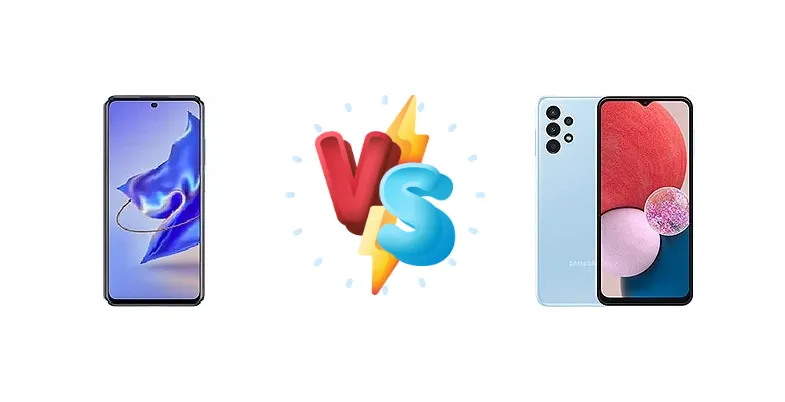
The ZTE V70 and Samsung Galaxy A13 (SM-A137) represent distinct approaches to the budget smartphone market. The V70 prioritizes raw performance and charging speed, while the A13 leans on Samsung’s brand recognition and software experience. This comparison dissects their key specifications to determine which device offers the best value for your money.
🏆 Quick Verdict
For users prioritizing performance and rapid charging, the ZTE V70 is the clear winner. Its Mediatek Dimensity 810 chipset and 66W charging significantly outperform the Galaxy A13’s Helio G80 and 15W charging. However, the A13 remains a viable option for those deeply embedded in the Samsung ecosystem.
| Network |
|---|
| 2G bands | GSM 850 / 900 / 1800 / 1900 | GSM 850 / 900 / 1800 / 1900 |
| 3G bands | HSDPA 850 / 900 / 1900 / 2100 | HSDPA 850 / 900 / 2100 |
| 4G bands | LTE | 1, 3, 5, 7, 8, 20, 28, 38, 40, 41 |
| 5G bands | SA/NSA | - |
| Speed | HSPA, LTE, 5G | HSPA, LTE |
| Technology | GSM / HSPA / LTE / 5G | GSM / HSPA / LTE |
| Launch |
|---|
| Announced | 2023, June 05 | 2022, June |
| Status | Available. Released 2023, June | Available. Released 2022, July |
| Body |
|---|
| Build | - | Glass front (Gorilla Glass 5), plastic frame, plastic back |
| Dimensions | 163.9 x 76.2 x 8.3 mm (6.45 x 3.00 x 0.33 in) | 165.1 x 76.4 x 8.8 mm (6.5 x 3.01 x 0.35 in) |
| SIM | Nano-SIM + Nano-SIM | · Nano-SIM· Nano-SIM + Nano-SIM |
| Weight | 192 g (6.77 oz) | 195 g (6.88 oz) |
| Display |
|---|
| Protection | - | Corning Gorilla Glass 5 |
| Resolution | 1080 x 2400 pixels, 20:9 ratio (~395 ppi density) | 1080 x 2408 pixels, 20:9 ratio (~400 ppi density) |
| Size | 6.67 inches, 107.4 cm2 (~86.0% screen-to-body ratio) | 6.6 inches, 104.9 cm2 (~83.2% screen-to-body ratio) |
| Type | AMOLED, 1B colors | PLS LCD |
| Platform |
|---|
| CPU | Octa-core (2x2.4 GHz Cortex-A76 & 6x2.0 GHz Cortex-A55) | Octa-core (2x2.0 GHz Cortex-A75 & 6x1.8 GHz Cortex-A55) |
| Chipset | Mediatek Dimensity 810 (6 nm) | Mediatek MT6769V/CU Helio G80 (12 nm) |
| GPU | Mali-G57 MC2 | Mali-G52 MC2 |
| OS | Android 11, MyOS 11.5 | Android 12, upgradable to Android 14, One UI 6.1 |
| Memory |
|---|
| Card slot | No | microSDXC (dedicated slot) |
| Internal | 256GB 8GB RAM | 32GB 3GB RAM, 32GB 4GB RAM, 64GB 4GB RAM, 128GB 4GB RAM |
| | - | eMMC 5.1 |
| Main Camera |
|---|
| Features | LED flash, HDR, panorama | LED flash, panorama, HDR |
| Quad | - | 50 MP, f/1.8, (wide), PDAF
5 MP, f/2.2, 123˚ (ultrawide), 1/5.0", 1.12µm
2 MP (macro)
Auxiliary lens |
| Single | - | 8 MP, f/2.2, (wide) |
| Triple | 64 MP, f/1.8, 25mm (wide), PDAF
8 MP, f/2.2, 16mm, 120˚ (ultrawide)
5 MP (macro) | - |
| Video | 1080p@30fps | 1080p@30fps |
| Selfie camera |
|---|
| Single | 16 MP, (wide) | 8 MP, f/2.2, (wide) |
| Video | 1080p@30fps | 1080p@30fps |
| Sound |
|---|
| 3.5mm jack | - | Yes |
| 35mm jack | Yes | Yes |
| Loudspeaker | Yes | Yes |
| Comms |
|---|
| Bluetooth | 5.1, A2DP, LE | 5.2, A2DP, LE |
| NFC | Yes | Yes |
| Positioning | GPS, GLONASS, GALILEO, BDS | GPS, GLONASS, GALILEO, BDS |
| Radio | Unspecified | No |
| USB | USB Type-C 2.0 | USB Type-C 2.0, OTG |
| WLAN | Wi-Fi 802.11 a/b/g/n/ac, dual-band | Wi-Fi 802.11 a/b/g/n/ac, dual-band, Wi-Fi Direct |
| Features |
|---|
| Sensors | Fingerprint (side-mounted), accelerometer, gyro, proximity, compass | Fingerprint (side-mounted), accelerometer, compass |
| | - | Virtual proximity sensing |
| Battery |
|---|
| Charging | 66W wired, 50% in 15 min | 15W wired |
| Type | Li-Po 5100 mAh | Li-Po 5000 mAh |
| Misc |
|---|
| Colors | Olive Green | Black, White, Blue |
| Models | - | SM-A137F, SM-A137F/DSN, SM-A137F/DS |
| Price | - | About 180 EUR |
| SAR EU | - | 0.35 W/kg (head) 1.22 W/kg (body) |
ZTE V70
- Significantly faster 66W charging
- More powerful Mediatek Dimensity 810 chipset
- Potentially better image processing capabilities
- Brand recognition is lower than Samsung
- Software support may be less extensive than Samsung
Samsung Galaxy A13 (SM-A137)
- Samsung’s One UI software experience
- Strong brand reputation and reliability
- Potentially better long-term software support
- Slow 15W charging
- Less powerful Mediatek Helio G80 chipset
- May struggle with demanding applications
Display Comparison
Neither device boasts a standout display. While specific display specs (resolution, panel type) are missing for both, the focus here is on performance. The lack of information prevents a detailed comparison of color accuracy or brightness. However, the more powerful GPU in the V70 *could* translate to smoother scrolling and animations, even if the panels are similar.
Camera Comparison
Without detailed camera specifications beyond the chipsets, a direct comparison is limited. However, the processing capabilities of the Dimensity 810 in the V70 suggest potentially better image processing and noise reduction. The A13’s Helio G80 will likely produce acceptable images in good lighting conditions, but may struggle in low-light scenarios. The prevalence of 2MP macro lenses on both devices suggests these are largely marketing features with limited practical utility.
Performance
The ZTE V70’s Mediatek Dimensity 810 (6nm) represents a substantial leap in processing power compared to the Samsung Galaxy A13’s Helio G80 (12nm). The Dimensity 810’s Cortex-A76 cores, clocked at 2.4 GHz, offer significantly higher single-core performance than the A13’s 2.0 GHz Cortex-A75 cores. The 6nm process node also contributes to improved power efficiency and reduced thermal throttling. This means the V70 will handle demanding games and multitasking with greater ease. The A13’s Helio G80 is adequate for everyday tasks, but will struggle with graphically intensive applications.
Battery Life
While battery capacity isn’t specified, the charging speeds are a defining difference. The ZTE V70’s 66W wired charging is a massive advantage, capable of delivering a 50% charge in just 15 minutes. This drastically reduces downtime. The Samsung Galaxy A13’s 15W charging is comparatively slow, requiring significantly longer to reach a full charge. Even if the A13 has a slightly larger battery, the V70’s faster charging will likely result in less perceived battery anxiety for power users.
Buying Guide
Buy the ZTE V70 if you need a phone capable of handling demanding apps and games, and if minimizing charging downtime is crucial. Its 66W charging is a game-changer in this price bracket. Buy the Samsung Galaxy A13 (SM-A137) if you prefer Samsung’s One UI software, value brand reliability, and prioritize a more balanced, if less powerful, experience. It's a good choice for basic smartphone tasks and media consumption.
Frequently Asked Questions
❓ Will the Mediatek Helio G80 in the Galaxy A13 struggle with popular games like PUBG or Call of Duty?
The Helio G80 is capable of running these games, but you’ll likely need to lower the graphics settings to achieve a smooth frame rate. The ZTE V70’s Dimensity 810 will provide a significantly better gaming experience with higher settings and more consistent performance.
❓ How much faster is the 66W charging on the ZTE V70 compared to the 15W charging on the Galaxy A13 in real-world use?
The ZTE V70 can gain approximately 50% charge in 15 minutes, while the Galaxy A13 will take well over an hour to achieve the same level. This means you can quickly top up the V70 during short breaks, whereas the A13 requires a much longer charging period.
❓ Does the ZTE V70’s processor generate excessive heat during prolonged gaming sessions?
The Dimensity 810’s 6nm process node is designed for improved thermal efficiency. While some heat generation is inevitable during gaming, it’s unlikely to cause significant throttling or discomfort, especially compared to the less efficient 12nm Helio G80.