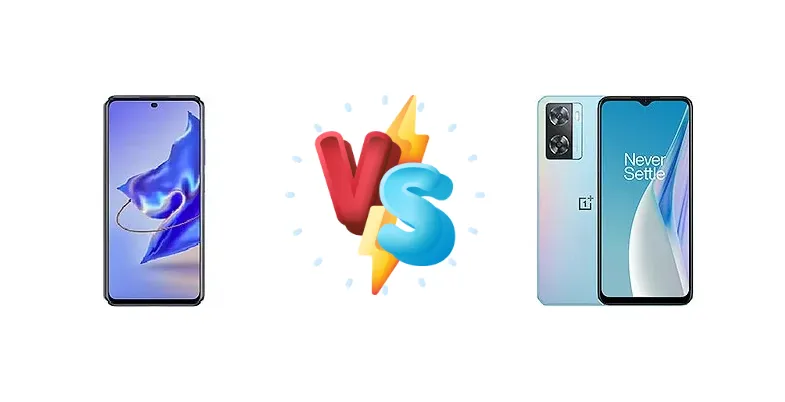
The ZTE V70 and OnePlus Nord N20 SE occupy a similar price bracket, targeting budget-conscious consumers. However, their internal hardware diverges significantly. The V70 aims for a performance edge with a modern Dimensity 810 chipset, while the N20 SE opts for the more economical Helio G35. This comparison dissects these differences to determine which phone delivers the best value for your money.
🏆 Quick Verdict
For most users, the ZTE V70 is the superior choice. Its Mediatek Dimensity 810 chipset provides a substantial performance boost over the Nord N20 SE’s Helio G35, making it better suited for gaming and demanding applications. While the N20 SE is cheaper, the performance gap justifies the price difference for all but the most basic users.
| Network |
|---|
| 2G bands | GSM 850 / 900 / 1800 / 1900 | GSM 850 / 900 / 1800 / 1900 |
| 3G bands | HSDPA 850 / 900 / 1900 / 2100 | HSDPA 850 / 900 / 2100 - Global |
| 4G bands | LTE | 1, 3, 5, 7, 8, 20, 28, 38, 40, 41 - Global |
| 5G bands | SA/NSA | - |
| Speed | HSPA, LTE, 5G | HSPA, LTE |
| Technology | GSM / HSPA / LTE / 5G | GSM / HSPA / LTE |
| | - | 1, 2, 3, 4, 5, 7, 8, 12, 13, 17, 18, 19, 26, 28, 38, 41, 66 - LATAM |
| Launch |
|---|
| Announced | 2023, June 05 | 2022, August 05 |
| Status | Available. Released 2023, June | Available. Released 2022, August 08 |
| Body |
|---|
| Build | - | Glass front, plastic frame, plastic back |
| Dimensions | 163.9 x 76.2 x 8.3 mm (6.45 x 3.00 x 0.33 in) | 163.8 x 75 x 8 mm (6.45 x 2.95 x 0.31 in) |
| SIM | Nano-SIM + Nano-SIM | Nano-SIM + Nano-SIM |
| Weight | 192 g (6.77 oz) | 187 g (6.60 oz) |
| Display |
|---|
| Resolution | 1080 x 2400 pixels, 20:9 ratio (~395 ppi density) | 720 x 1612 pixels, 20:9 ratio (~269 ppi density) |
| Size | 6.67 inches, 107.4 cm2 (~86.0% screen-to-body ratio) | 6.56 inches, 103.4 cm2 (~84.2% screen-to-body ratio) |
| Type | AMOLED, 1B colors | IPS LCD, 480 nits (typ), 600 nits (HBM) |
| Platform |
|---|
| CPU | Octa-core (2x2.4 GHz Cortex-A76 & 6x2.0 GHz Cortex-A55) | Octa-core (4x2.3 GHz Cortex-A53 & 4x1.8 GHz Cortex-A53) |
| Chipset | Mediatek Dimensity 810 (6 nm) | Mediatek MT6765G Helio G35 (12 nm) |
| GPU | Mali-G57 MC2 | PowerVR GE8320 |
| OS | Android 11, MyOS 11.5 | Android 12, OxygenOS 12.1 |
| Memory |
|---|
| Card slot | No | microSDXC |
| Internal | 256GB 8GB RAM | 64GB 4GB RAM, 128GB 4GB RAM |
| | - | eMMC 5.1 |
| Main Camera |
|---|
| Dual | - | 50 MP, f/1.8, (wide), 1/2.76", 0.64µm, PDAF
Auxiliary lens |
| Features | LED flash, HDR, panorama | LED flash, HDR, panorama |
| Single | - | 8 MP, f/2.0, 26mm (wide), 1/4", 1.12µm |
| Triple | 64 MP, f/1.8, 25mm (wide), PDAF
8 MP, f/2.2, 16mm, 120˚ (ultrawide)
5 MP (macro) | - |
| Video | 1080p@30fps | 1080p@30fps |
| Selfie camera |
|---|
| Single | 16 MP, (wide) | 8 MP, f/2.0, 26mm (wide), 1/4.0", 1.12µm |
| Video | 1080p@30fps | 1080p@30fps |
| Sound |
|---|
| 3.5mm jack | - | Yes |
| 35mm jack | Yes | Yes |
| Loudspeaker | Yes | Yes, with dual speakers |
| Comms |
|---|
| Bluetooth | 5.1, A2DP, LE | 5.3, A2DP, LE, aptX HD |
| NFC | Yes | No |
| Positioning | GPS, GLONASS, GALILEO, BDS | GPS, GLONASS, BDS, GALILEO, QZSS |
| Radio | Unspecified | No |
| USB | USB Type-C 2.0 | USB Type-C 2.0, OTG |
| WLAN | Wi-Fi 802.11 a/b/g/n/ac, dual-band | Wi-Fi 802.11 a/b/g/n/ac, dual-band, Wi-Fi Direct |
| Features |
|---|
| Sensors | Fingerprint (side-mounted), accelerometer, gyro, proximity, compass | Fingerprint (side-mounted), accelerometer, proximity, compass |
| Battery |
|---|
| Charging | 66W wired, 50% in 15 min | 33W wired, 50% in 34 min, 100% in 69 min |
| Type | Li-Po 5100 mAh | Li-Po 5000 mAh |
| Misc |
|---|
| Colors | Olive Green | Blue Oasis, Celestial Black |
| Models | - | CPH2469 |
| Price | - | About 190 EUR |
ZTE V70
- Significantly faster processor (Dimensity 810)
- Much faster charging (66W)
- More efficient chipset for better battery life
- Potentially higher price
- May not have a significantly better display
OnePlus Nord N20 SE
- Lower price point
- Adequate for basic smartphone tasks
- Acceptable battery life for light usage
- Slow processor (Helio G35)
- Slow charging (33W)
- Struggles with demanding apps and games
Display Comparison
Neither device boasts a standout display. Given the context data focuses on internals, we can infer both likely utilize LCD panels common in this price segment. The key difference lies in the processing power needed to drive them. The Dimensity 810 in the V70 has a more capable GPU, potentially leading to smoother animations and better graphics rendering, even on a similar panel. Bezels are likely comparable, and color accuracy will depend on software calibration, a detail not provided.
Camera Comparison
Without detailed camera specs, a direct comparison is limited. However, the chipset plays a crucial role in image processing. The Dimensity 810’s ISP (Image Signal Processor) is significantly more advanced than the Helio G35’s, enabling faster image processing, better noise reduction, and improved dynamic range. While both phones likely feature a primary camera, the V70 will likely produce superior image quality, especially in challenging lighting conditions. We can assume both will include lower-resolution auxiliary cameras of limited utility.
Performance
The performance disparity is the defining factor. The ZTE V70’s Mediatek Dimensity 810 (6nm) features a more modern CPU architecture – Cortex-A76 cores – compared to the OnePlus Nord N20 SE’s Helio G35 (12nm) which relies on older Cortex-A53 cores. This translates to a significant advantage in CPU-intensive tasks. The 6nm process node of the Dimensity 810 also offers superior power efficiency and thermal management, reducing the likelihood of throttling during sustained workloads. The Helio G35, while adequate for basic tasks, will struggle with demanding games and multitasking.
Battery Life
The ZTE V70’s 66W wired charging is a major advantage, achieving 50% charge in just 15 minutes. The OnePlus Nord N20 SE’s 33W charging takes considerably longer – 34 minutes for 50% and 69 minutes for a full charge. While battery capacity isn’t specified, the Dimensity 810’s superior power efficiency means the V70 is likely to offer comparable or even better battery life despite potentially having a similar capacity. The faster charging significantly reduces downtime.
Buying Guide
Buy the ZTE V70 if you prioritize smooth multitasking, responsive gaming, and faster charging speeds. It’s ideal for users who frequently use demanding apps or enjoy mobile games. Buy the OnePlus Nord N20 SE if your primary needs are basic communication, light social media use, and a lower upfront cost. It’s a suitable option for first-time smartphone users or those on a very tight budget.
Frequently Asked Questions
❓ Will the OnePlus Nord N20 SE struggle with popular games like PUBG Mobile or Call of Duty?
Yes, the Helio G35 chipset in the Nord N20 SE is not powerful enough to deliver a smooth gaming experience in demanding titles like PUBG Mobile or Call of Duty. You’ll likely encounter low frame rates, stuttering, and lag, even on low graphics settings. The ZTE V70’s Dimensity 810 is far better suited for mobile gaming.
❓ How much faster is the charging on the ZTE V70 compared to the OnePlus Nord N20 SE in real-world use?
The ZTE V70’s 66W charging is significantly faster. Reaching 50% charge takes only 15 minutes, while the Nord N20 SE requires 34 minutes for the same level. A full charge on the V70 will also be quicker, minimizing downtime and keeping you connected for longer. This is a substantial advantage for users who frequently need to top up their battery.
❓ Is the difference in processor performance between the Dimensity 810 and Helio G35 noticeable for everyday tasks like browsing and social media?
While both phones can handle basic tasks, the difference is noticeable. The ZTE V70 will feel snappier and more responsive when switching between apps, opening websites, and scrolling through social media feeds. The Nord N20 SE may exhibit slight lag or delays, especially with multiple apps open.