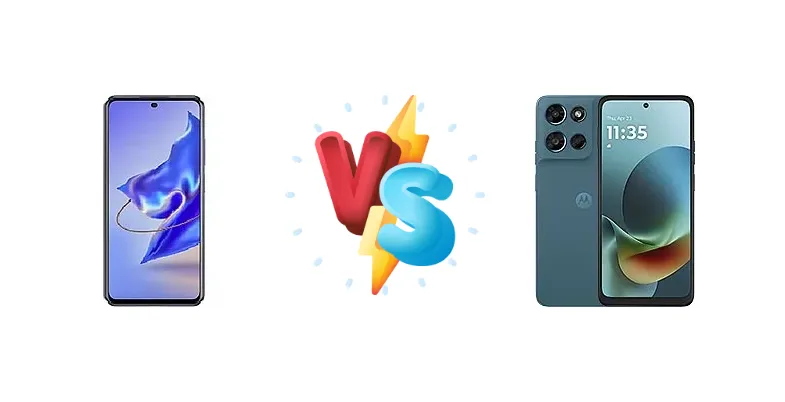
The ZTE V70 and Motorola Moto G Play (2026) represent compelling options in the increasingly competitive budget and mid-range smartphone market. While both leverage Mediatek Dimensity chipsets, they diverge significantly in charging speed and potentially, overall user experience. This comparison dissects their key specifications to determine which device delivers the most value.
🏆 Quick Verdict
For users prioritizing rapid replenishment, the ZTE V70 is the clear winner thanks to its 66W charging, capable of adding 50% charge in just 15 minutes. However, the Motorola Moto G Play (2026) offers a comparable processor and may appeal to those who value a more balanced approach to features and price.
| Network |
|---|
| 2G bands | GSM 850 / 900 / 1800 / 1900 | GSM 850 / 900 / 1800 / 1900 |
| 3G bands | HSDPA 850 / 900 / 1900 / 2100 | HSDPA 850 / 900 / 1700(AWS) / 1900 / 2100 |
| 4G bands | LTE | 1, 2, 3, 4, 5, 7, 8, 12, 13, 14, 17, 18, 20, 25, 26, 28, 29, 30, 38, 39, 40, 41, 48, 66, 71 |
| 5G bands | SA/NSA | 2, 5, 7, 12, 14, 25, 26, 29, 30, 41, 48, 66, 70, 71, 77, 78 SA/NSA/Sub6 |
| Speed | HSPA, LTE, 5G | HSPA, LTE, 5G |
| Technology | GSM / HSPA / LTE / 5G | GSM / HSPA / LTE / 5G |
| Launch |
|---|
| Announced | 2023, June 05 | 2025, November 05 |
| Status | Available. Released 2023, June | Available. Released 2025, November 13 |
| Body |
|---|
| Build | - | Glass front (Gorilla Glass 3), silicone polymer (eco leather) back, plastic frame |
| Dimensions | 163.9 x 76.2 x 8.3 mm (6.45 x 3.00 x 0.33 in) | 167.2 x 76.4 x 8.5 mm (6.58 x 3.01 x 0.33 in) |
| SIM | Nano-SIM + Nano-SIM | Nano-SIM + eSIM |
| Weight | 192 g (6.77 oz) | 202 g (7.13 oz) |
| Display |
|---|
| Protection | - | Corning Gorilla Glass 3 |
| Resolution | 1080 x 2400 pixels, 20:9 ratio (~395 ppi density) | 720 x 1604 pixels, 20:9 ratio (~262 ppi density) |
| Size | 6.67 inches, 107.4 cm2 (~86.0% screen-to-body ratio) | 6.7 inches, 108.2 cm2 (~84.7% screen-to-body ratio) |
| Type | AMOLED, 1B colors | IPS LCD, 120Hz, 1000 nits (peak) |
| Platform |
|---|
| CPU | Octa-core (2x2.4 GHz Cortex-A76 & 6x2.0 GHz Cortex-A55) | Octa-core (2x2.4 GHz Cortex-A76 & 6x2.0 GHz Cortex-A55) |
| Chipset | Mediatek Dimensity 810 (6 nm) | Mediatek Dimensity 6300 (6 nm) |
| GPU | Mali-G57 MC2 | Mali-G57 MC2 |
| OS | Android 11, MyOS 11.5 | Android 16 |
| Memory |
|---|
| Card slot | No | microSDXC (dedicated slot) |
| Internal | 256GB 8GB RAM | 64GB 4GB RAM |
| Main Camera |
|---|
| Features | LED flash, HDR, panorama | LED flash, HDR, panorama |
| Single | - | 32 MP, f/2.2, (wide), 0.64µm, PDAF |
| Triple | 64 MP, f/1.8, 25mm (wide), PDAF
8 MP, f/2.2, 16mm, 120˚ (ultrawide)
5 MP (macro) | - |
| Video | 1080p@30fps | 1080p@30fps |
| Selfie camera |
|---|
| Single | 16 MP, (wide) | 8 MP, f/2.0, (wide) |
| Video | 1080p@30fps | 1080p@30fps |
| Sound |
|---|
| 35mm jack | Yes | Yes |
| Loudspeaker | Yes | Yes, with stereo speakers (with Dolby Atmos) |
| Comms |
|---|
| Bluetooth | 5.1, A2DP, LE | Yes |
| NFC | Yes | Yes |
| Positioning | GPS, GLONASS, GALILEO, BDS | GPS, GALILEO, GLONASS |
| Radio | Unspecified | No |
| USB | USB Type-C 2.0 | USB Type-C 2.0 |
| WLAN | Wi-Fi 802.11 a/b/g/n/ac, dual-band | Wi-Fi 802.11 a/b/g/n/ac, dual-band |
| Features |
|---|
| Sensors | Fingerprint (side-mounted), accelerometer, gyro, proximity, compass | Fingerprint (side-mounted), accelerometer, gyro, proximity, compass |
| Battery |
|---|
| Charging | 66W wired, 50% in 15 min | 18W wired |
| Type | Li-Po 5100 mAh | 5200 mAh |
| Misc |
|---|
| Colors | Olive Green | Pantone Tapestry |
| Price | - | $ 179.99 |
ZTE V70
- Significantly faster 66W charging
- Potentially more powerful GPU with Dimensity 810
- Likely better image processing capabilities
- May be priced higher than the Moto G Play (2026)
- Battery capacity unknown - could be smaller than the competition
Motorola Moto G Play (2026)
- Potentially more affordable price point
- Comparable CPU performance to the ZTE V70
- Dimensity 6300 offers good efficiency
- Slow 18W charging
- Potentially less capable GPU for gaming
- Image processing may be less refined
Display Comparison
Display specifications are absent from the provided data, but given the market positioning, both devices likely feature LCD panels. The absence of LTPO or high refresh rate technology is expected. Bezels will likely be similar, with Motorola historically favoring slightly more conservative designs. Color accuracy will likely be standard for this price bracket, leaning towards sRGB coverage rather than DCI-P3.
Camera Comparison
Camera details are limited. Without sensor size or aperture information, a direct comparison is difficult. However, the market segment suggests both will rely on multi-camera systems with a primary sensor, an ultrawide, and potentially a macro lens. The ZTE V70 may benefit from slightly more advanced image processing capabilities due to the more powerful Dimensity 810 chipset. The inclusion of Optical Image Stabilization (OIS) is unlikely on either device, given the price point.
Performance
Both the ZTE V70 and Motorola Moto G Play (2026) utilize the Mediatek Dimensity platform, specifically the Dimensity 810 and Dimensity 6300 respectively. Critically, both chipsets share the same CPU configuration: an octa-core setup with 2x2.4 GHz Cortex-A76 cores and 6x2.0 GHz Cortex-A55 cores. This suggests similar CPU performance in day-to-day tasks. The Dimensity 810, however, generally offers a more powerful GPU, potentially translating to a smoother gaming experience. Both devices are built on a 6nm process, indicating comparable power efficiency. RAM speed (LPDDR4X vs LPDDR5) is unknown, but could be a differentiating factor.
Battery Life
Battery capacity is not specified, but both devices likely fall in the 4000-5000 mAh range. The key differentiator is charging speed. The ZTE V70’s 66W wired charging is a significant advantage, promising a 50% charge in just 15 minutes. The Motorola Moto G Play (2026) is limited to 18W, resulting in a considerably longer charging time. This difference will be particularly noticeable for users who frequently need to quickly replenish their battery.
Buying Guide
Buy the ZTE V70 if you absolutely need the fastest possible charging speeds and frequently find yourself needing to top up your battery quickly. Buy the Motorola Moto G Play (2026) if you prioritize a balanced feature set and are less concerned with having the absolute fastest charging, potentially benefiting from a lower overall price point.
Frequently Asked Questions
❓ Will the ZTE V70's 66W charging degrade the battery faster over time?
While faster charging generates more heat, modern smartphones employ sophisticated battery management systems to mitigate degradation. The ZTE V70's charging circuitry is designed to optimize the charging process and minimize long-term battery health impact. However, consistently using the fastest charging speeds *may* slightly accelerate degradation compared to slower charging.
❓ Is the Dimensity 6300 in the Motorola Moto G Play (2026) sufficient for playing demanding games like Genshin Impact?
The Dimensity 6300 is a capable chipset, but Genshin Impact is a particularly demanding title. Expect to play at medium settings with moderate frame rates. The ZTE V70, with its Dimensity 810, will likely offer a smoother experience at higher settings, but both devices will require some graphical compromises.
❓ Does either phone support 5G connectivity?
Both the Mediatek Dimensity 810 and 6300 chipsets integrate 5G modems. Therefore, both the ZTE V70 and Motorola Moto G Play (2026) are expected to support 5G connectivity, provided they are used with a compatible carrier and SIM card.