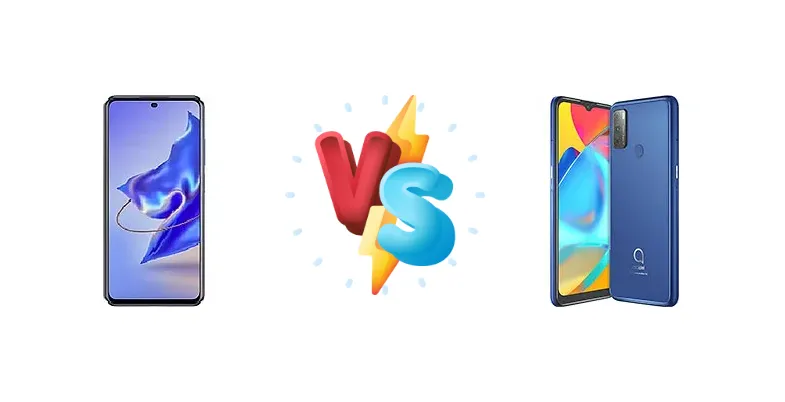
The ZTE V70 and alcatel 3L (2021) represent opposite ends of the entry-level smartphone spectrum. The alcatel 3L focuses on affordability, while the ZTE V70 aims to deliver significantly improved performance and charging speeds. This comparison dissects the core differences to help you determine which device best aligns with your needs and budget.
🏆 Quick Verdict
For users prioritizing responsiveness and future-proofing, the ZTE V70 is the clear winner. Its Dimensity 810 chipset and 66W charging offer a dramatically improved experience. However, the alcatel 3L (2021) remains a viable option for those on the tightest budgets who only need basic smartphone functionality.
| Network |
|---|
| 2G bands | GSM 850 / 900 / 1800 / 1900 | GSM 850 / 900 / 1800 / 1900 |
| 3G bands | HSDPA 850 / 900 / 1900 / 2100 | HSDPA 850 / 900 / 1900 / 2100 |
| 4G bands | LTE | 1, 3, 7, 8, 20, 28 |
| 5G bands | SA/NSA | - |
| Speed | HSPA, LTE, 5G | HSPA 42.2/5.76 Mbps, LTE Cat4 150/50 Mbps |
| Technology | GSM / HSPA / LTE / 5G | GSM / HSPA / LTE |
| Launch |
|---|
| Announced | 2023, June 05 | 2021, January 12 |
| Status | Available. Released 2023, June | Available. Released 2021, April 26 |
| Body |
|---|
| Build | - | Glass front, plastic back, plastic frame |
| Dimensions | 163.9 x 76.2 x 8.3 mm (6.45 x 3.00 x 0.33 in) | 165.6 x 75.6 x 8.7 mm (6.52 x 2.98 x 0.34 in) |
| SIM | Nano-SIM + Nano-SIM | · Nano-SIM· Nano-SIM + Nano-SIM |
| Weight | 192 g (6.77 oz) | 194 g (6.84 oz) |
| Display |
|---|
| Resolution | 1080 x 2400 pixels, 20:9 ratio (~395 ppi density) | 720 x 1600 pixels, 20:9 ratio (~269 ppi density) |
| Size | 6.67 inches, 107.4 cm2 (~86.0% screen-to-body ratio) | 6.52 inches, 102.6 cm2 (~82.0% screen-to-body ratio) |
| Type | AMOLED, 1B colors | IPS LCD |
| Platform |
|---|
| CPU | Octa-core (2x2.4 GHz Cortex-A76 & 6x2.0 GHz Cortex-A55) | Octa-core (4x1.8 GHz Cortex-A53 & 4x1.5 GHz Cortex-A53) |
| Chipset | Mediatek Dimensity 810 (6 nm) | Mediatek MT6762D Helio P22 (12 nm) |
| GPU | Mali-G57 MC2 | PowerVR GE8320 |
| OS | Android 11, MyOS 11.5 | Android 11 |
| Memory |
|---|
| Card slot | No | microSDXC (only single sim model) |
| Internal | 256GB 8GB RAM | 64GB 4GB RAM |
| | - | eMMC 5.1 |
| Main Camera |
|---|
| Features | LED flash, HDR, panorama | LED flash, HDR, panorama |
| Triple | 64 MP, f/1.8, 25mm (wide), PDAF
8 MP, f/2.2, 16mm, 120˚ (ultrawide)
5 MP (macro) | 48 MP, f/1.8, 26mm (wide), 1/2.0", 0.8µm, PDAF
2 MP (macro)
Auxiliary lens |
| Video | 1080p@30fps | 1080p@30fps |
| Selfie camera |
|---|
| Features | - | HDR |
| Single | 16 MP, (wide) | 8 MP, f/2.0, 26mm (wide), 1/4.0", 1.12µm |
| Video | 1080p@30fps | 1080p@30fps |
| Sound |
|---|
| 3.5mm jack | - | Yes |
| 35mm jack | Yes | Yes |
| Loudspeaker | Yes | Yes |
| Comms |
|---|
| Bluetooth | 5.1, A2DP, LE | 5.0, A2DP, LE |
| NFC | Yes | Yes |
| Positioning | GPS, GLONASS, GALILEO, BDS | GPS, GLONASS, GALILEO, BDS |
| Radio | Unspecified | FM radio |
| USB | USB Type-C 2.0 | microUSB 2.0, OTG |
| WLAN | Wi-Fi 802.11 a/b/g/n/ac, dual-band | Wi-Fi 802.11 b/g/n, Wi-Fi Direct |
| Features |
|---|
| Sensors | Fingerprint (side-mounted), accelerometer, gyro, proximity, compass | Fingerprint (rear-mounted), accelerometer, proximity, compass |
| Battery |
|---|
| Charging | 66W wired, 50% in 15 min | 10W wired |
| Type | Li-Po 5100 mAh | Li-Po 4000 mAh |
| Misc |
|---|
| Colors | Olive Green | Jewelry Blue, Jewelry Black |
| Models | - | 6056D |
| Price | - | About 330 EUR |
ZTE V70
- Significantly faster performance with the Dimensity 810 chipset.
- Ultra-fast 66W charging for minimal downtime.
- Likely better camera performance and image quality.
- Higher price point compared to the alcatel 3L (2021).
- May have a less durable build quality than some competitors.
alcatel 3L (2021)
- Extremely affordable price point.
- Simple and easy-to-use interface.
- Acceptable for basic smartphone tasks.
- Slow performance with the Helio P22 chipset.
- Very slow 10W charging.
- Limited capabilities for gaming and demanding apps.
Display Comparison
Neither device's display specifications are provided, so a direct comparison is limited. However, given the ZTE V70's higher overall positioning, it likely features a panel with better color accuracy and potentially a higher refresh rate. The alcatel 3L (2021) will likely prioritize cost savings, resulting in a more basic display experience. Expect wider bezels and lower peak brightness on the alcatel.
Camera Comparison
Without detailed camera specifications, a precise comparison is difficult. However, the ZTE V70, being a more premium device, likely features a more capable main sensor and potentially better image processing algorithms. The alcatel 3L (2021) likely relies on a simpler camera setup, prioritizing cost over image quality. It's reasonable to assume the ZTE V70 will deliver sharper images with better dynamic range, especially in challenging lighting conditions. The presence of a 2MP macro lens on the alcatel is unlikely to provide a significant benefit due to its limited resolution and image quality.
Performance
The performance gap between these two devices is substantial. The ZTE V70's Mediatek Dimensity 810 (6nm) utilizes Cortex-A76 cores, offering significantly higher single-core and multi-core performance compared to the alcatel 3L's Helio P22 (12nm) and its Cortex-A53 cores. The 6nm process node of the Dimensity 810 also translates to improved power efficiency and reduced thermal throttling during sustained workloads. This means the ZTE V70 will handle multitasking, gaming, and demanding applications with far greater ease. The Helio P22 is adequate for basic tasks, but will struggle with anything beyond light usage.
Battery Life
While battery capacity isn't specified, the ZTE V70's 66W wired charging is a game-changer. It can reportedly reach 50% charge in just 15 minutes, offering a significant convenience advantage. The alcatel 3L (2021)'s 10W charging is considerably slower, requiring significantly longer to fully charge the device. Even if the alcatel 3L has a slightly larger battery capacity, the ZTE V70's faster charging will likely result in less downtime.
Buying Guide
Buy the ZTE V70 if you need a phone capable of handling demanding apps, moderate gaming, and appreciate significantly faster charging. This is for users who want a device that won't feel sluggish after a year of use. Buy the alcatel 3L (2021) if you prioritize absolute affordability and only require basic tasks like calls, texts, and light social media browsing. It's a good choice for first-time smartphone users or as a reliable backup device.
Frequently Asked Questions
❓ Will the ZTE V70 be able to run demanding games like PUBG or Call of Duty Mobile smoothly?
The Dimensity 810 chipset in the ZTE V70 is capable of running PUBG and Call of Duty Mobile at medium settings with reasonable frame rates. While it won't deliver a flagship gaming experience, it's a significant step up from the alcatel 3L (2021), which would struggle to maintain playable frame rates in these titles.
❓ Is the 10W charging on the alcatel 3L (2021) really that slow? How long will it take to fully charge?
Yes, 10W charging is considerably slower than modern fast charging standards. Expect the alcatel 3L (2021) to take upwards of 3-4 hours to fully charge from 0% to 100%, depending on battery capacity. This is a significant inconvenience compared to the ZTE V70's 66W charging, which can add hours of usage in just 15 minutes.
❓ How much of a difference will the 6nm process node of the Dimensity 810 make in real-world usage?
The 6nm process node is a key advantage for the ZTE V70. It allows the Dimensity 810 to operate more efficiently, generating less heat and consuming less power. This translates to better battery life and reduced thermal throttling during prolonged use, meaning the phone will maintain its performance for longer periods.