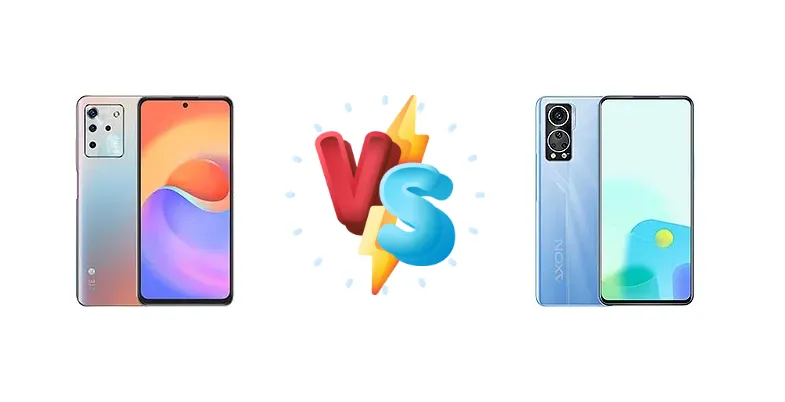
ZTE offers a compelling range of smartphones, and the S30 and Axon 30S represent distinct points within their lineup. The S30 targets the value-conscious user, while the Axon 30S aims for a more performance-driven experience. This comparison dissects the key differences between these two devices, focusing on how their core specifications translate into real-world usability.
🏆 Quick Verdict
For most users, the ZTE Axon 30S is the superior choice. Its Snapdragon 870 chipset delivers a substantial performance uplift over the S30’s Snapdragon 720G, making it better suited for demanding tasks like gaming and video editing. However, the S30 remains a viable option for those prioritizing affordability and basic smartphone functionality.
| Network |
|---|
| 2G bands | GSM 850 / 900 / 1800 / 1900 | GSM 850 / 900 / 1800 / 1900 |
| 3G bands | HSDPA 850 / 900 / 1900 / 2100 | HSDPA 850 / 900 / 1900 / 2100 |
| 4G bands | 1, 3, 5, 7, 8, 34, 38, 39, 40, 41 | 1, 3, 4, 5, 7, 8, 12, 17, 20, 34, 38, 39, 40, 41 |
| 5G bands | 1, 28, 41, 78 SA/NSA | 1, 3, 28, 38, 41, 78 SA/NSA |
| Speed | HSPA, LTE, 5G | HSPA, LTE, 5G |
| Technology | GSM / HSPA / LTE / 5G | GSM / CDMA / HSPA / LTE / 5G |
| Launch |
|---|
| Announced | 2021, March 31 | 2022, September 26 |
| Status | Available. Released 2021, April 03 | Available. Released 2022, September 26 |
| Body |
|---|
| Build | - | Glass front, plastic back, plastic frame |
| Dimensions | 164.8 x 76.4 x 7.9 mm (6.49 x 3.01 x 0.31 in) | 170.2 x 77.8 x 7.8 mm (6.70 x 3.06 x 0.31 in) |
| SIM | Nano-SIM + Nano-SIM | Nano-SIM + Nano-SIM |
| Weight | 184 g (6.49 oz) | 189 g (6.67 oz) |
| Display |
|---|
| Protection | - | Corning Gorilla Glass |
| Resolution | 1080 x 2400 pixels, 20:9 ratio (~395 ppi density) | 1080 x 2460 pixels (~400 ppi density) |
| Size | 6.67 inches, 107.4 cm2 (~85.3% screen-to-body ratio) | 6.92 inches, 107.0 cm2 (~80.8% screen-to-body ratio) |
| Type | IPS LCD, 90Hz | AMOLED, 1B colors, 120Hz |
| Platform |
|---|
| CPU | Octa-core (2x2.3 GHz Kryo 465 Gold & 6x1.8 GHz Kryo 465 Silver) | Octa-core (1x3.2 GHz Kryo 585 & 3x2.42 GHz Kryo 585 & 4x1.80 GHz Kryo 585) |
| Chipset | Qualcomm SM7125 Snapdragon 720G (8 nm) | Qualcomm SM8250-AC Snapdragon 870 5G (7 nm) |
| GPU | Adreno 618 | Adreno 650 |
| OS | Android 11, MyOS 11 | Android 12, MyOS 12 |
| Memory |
|---|
| Card slot | No | microSDXC (uses shared SIM slot) |
| Internal | 128GB 8GB RAM, 256GB 8GB RAM | 128GB 8GB RAM, 256GB 12GB RAM |
| Main Camera |
|---|
| Features | Dual-LED flash, HDR, panorama | Dual-LED flash, HDR, panorama |
| Quad | 64 MP, f/1.8, 26mm (wide), 1/1.72", 0.8µm, PDAF
8 MP, f/2.4, 120˚, 16mm (ultrawide)
5 MP (macro)
Auxiliary lens | 64 MP, f/1.8, 25mm (wide), 1/1.73", 0.8µm, PDAF
8 MP, f/2.2, 120˚, 16mm (ultrawide)
5 MP (macro)
Auxiliary lens |
| Video | 4K@30fps, 1080p@30fps, gyro-EIS | 4K@30/60fps, 1080p@30fps, gyro-EIS, HDR, 10‑bit video |
| Selfie camera |
|---|
| Features | HDR | HDR |
| Single | 16 MP | 16 MP, f/2.5, (wide), under display |
| Video | 1080p@30fps | 1080p@30fps |
| Sound |
|---|
| 3.5mm jack | - | No |
| 35mm jack | Yes | No |
| Loudspeaker | Yes | Yes |
| Comms |
|---|
| Bluetooth | 5.1, A2DP, LE | 5.1, A2DP, LE |
| NFC | No | Yes |
| Positioning | GPS, BDS | GPS, GLONASS, GALILEO, BDS |
| Radio | No | No |
| USB | USB Type-C 2.0 | USB Type-C 3.0, OTG |
| WLAN | Wi-Fi 802.11 a/b/g/n/ac, dual-band, Wi-Fi Direct | Wi-Fi 802.11 a/b/g/n/ac/6, dual-band, Wi-Fi Direct |
| Features |
|---|
| Sensors | Fingerprint (side-mounted), accelerometer, gyro, proximity, compass | Fingerprint (under display, optical), accelerometer, gyro, proximity, compass |
| Battery |
|---|
| Charging | 30W wired | 55W wired, PD, QC4 |
| Type | Li-Ion 4000 mAh | Li-Ion 4200 mAh |
| Misc |
|---|
| Colors | Black, Pink/Blue | Black, Blue |
| Models | 9030N | A2322 |
| Price | About 290 EUR | About 250 EUR |
ZTE S30
- More affordable price point
- Sufficient for basic smartphone tasks
- Decent battery life for light usage
- Significantly slower performance than the Axon 30S
- Slower charging speeds
- Less capable GPU for gaming
ZTE Axon 30S
- Superior performance with Snapdragon 870
- Faster 55W charging with PD/QC4
- Better gaming experience
- Higher price tag
- Potentially more heat generation under heavy load
- May require more frequent charging with intensive use
Display Comparison
While specific display details (resolution, panel type) are absent, the core difference lies in the processing power driving the visuals. Both phones likely utilize LCD or AMOLED panels common in their respective price brackets. However, the Axon 30S’s Snapdragon 870 will ensure smoother animations and faster rendering of graphics-intensive content. The S30’s Snapdragon 720G, while capable, will exhibit more noticeable lag in demanding scenarios.
Camera Comparison
Without detailed camera specifications, a direct comparison is limited. However, the processing power of the Axon 30S’s Snapdragon 870 will contribute to faster image processing and potentially better low-light performance. The ISP (Image Signal Processor) within the 870 is more advanced, enabling features like improved noise reduction and dynamic range. While both phones likely feature multi-camera setups, the Axon 30S’s chipset will allow for more sophisticated computational photography techniques.
Performance
The performance gap is the most significant differentiator. The ZTE Axon 30S boasts the Qualcomm SM8250-AC Snapdragon 870 5G (7 nm), featuring a Kryo 585 CPU with a prime core clocked at 3.2 GHz. This contrasts sharply with the ZTE S30’s Snapdragon 720G (8 nm) and its 2.3 GHz Kryo 465 Gold core. The 7nm process node of the Snapdragon 870 is more efficient, allowing for sustained performance without excessive throttling. The 870’s Adreno 660 GPU also provides a considerable advantage in gaming and graphics-intensive applications. The S30’s Adreno 618 is adequate for casual gaming but will struggle with newer, more demanding titles.
Battery Life
The Axon 30S’s 55W wired charging with PD and QC4 support is a clear advantage over the S30’s 30W charging. This translates to significantly faster charging times – potentially reaching 100% in under an hour compared to the S30’s longer charge cycle. While battery capacity isn’t specified, the more efficient Snapdragon 870 in the Axon 30S may offset a potentially smaller battery size, resulting in comparable real-world battery life.
Buying Guide
Buy the ZTE S30 if you need a reliable smartphone for everyday tasks like browsing, social media, and light media consumption, and your budget is a primary concern. Buy the ZTE Axon 30S if you prioritize smooth performance in demanding applications, enjoy mobile gaming, and appreciate faster charging speeds, even at a higher price point.
Frequently Asked Questions
❓ Will the Snapdragon 720G in the ZTE S30 struggle with graphically demanding games like Genshin Impact?
Yes, the Snapdragon 720G is likely to struggle with Genshin Impact and similar titles. You’ll likely need to lower graphics settings significantly to achieve playable frame rates, and even then, expect occasional stuttering. The Axon 30S’s Snapdragon 870 is far better equipped to handle these games at higher settings.
❓ How much faster is the 55W charging on the Axon 30S compared to the 30W charging on the S30 in real-world use?
The Axon 30S’s 55W charging can realistically shave off 30-45 minutes from a full 0-100% charge compared to the S30’s 30W charging. This is a significant difference for users who frequently need to top up their battery quickly.
❓ Is the Snapdragon 870 in the Axon 30S likely to overheat during extended gaming sessions?
While the Snapdragon 870 is a powerful chip, ZTE likely implemented thermal management solutions to mitigate overheating. However, prolonged gaming at maximum settings *may* result in some thermal throttling, reducing performance slightly. The S30’s 720G will generate less heat, but also offer lower peak performance.