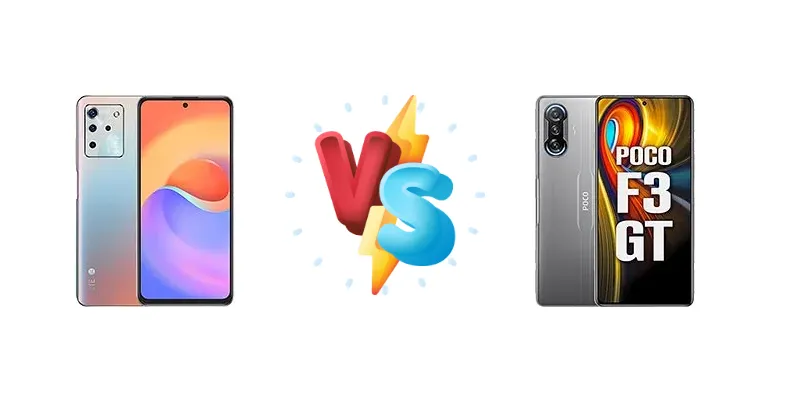
The ZTE S30 and Xiaomi Poco F3 GT represent distinct approaches to the mid-range smartphone market. The S30 aims for a balanced experience with a focus on efficiency, while the F3 GT aggressively targets gamers with a powerful chipset and rapid charging. This comparison dissects their key differences to help you choose the right device.
🏆 Quick Verdict
For most users, the Xiaomi Poco F3 GT is the superior choice. Its Mediatek Dimensity 1200 chipset delivers significantly faster performance than the ZTE S30’s Snapdragon 720G, and the 67W charging is a game-changer. However, the S30 remains a viable option for those prioritizing efficiency and a lower price point.
| Network |
|---|
| 2G bands | GSM 850 / 900 / 1800 / 1900 | GSM 850 / 900 / 1800 / 1900 |
| 3G bands | HSDPA 850 / 900 / 1900 / 2100 | HSDPA 850 / 900 / 1900 / 2100 |
| 4G bands | 1, 3, 5, 7, 8, 34, 38, 39, 40, 41 | 1, 3, 5, 8, 40, 41 |
| 5G bands | 1, 28, 41, 78 SA/NSA | 77, 78 SA/NSA |
| Speed | HSPA, LTE, 5G | HSPA, LTE, 5G |
| Technology | GSM / HSPA / LTE / 5G | GSM / HSPA / LTE / 5G |
| Launch |
|---|
| Announced | 2021, March 31 | 2021, July 23 |
| Status | Available. Released 2021, April 03 | Available. Released 2021, July 26 |
| Body |
|---|
| Build | - | Glass front (Gorilla Glass 5), glass back (Gorilla Glass 5) |
| Dimensions | 164.8 x 76.4 x 7.9 mm (6.49 x 3.01 x 0.31 in) | 161.9 x 76.9 x 8.3 mm (6.37 x 3.03 x 0.33 in) |
| SIM | Nano-SIM + Nano-SIM | Nano-SIM + Nano-SIM |
| Weight | 184 g (6.49 oz) | 205 g (7.23 oz) |
| | - | Physical pop-up gaming triggers
IP53, dust and splash resistant |
| Display |
|---|
| Protection | - | Corning Gorilla Glass 5 |
| Resolution | 1080 x 2400 pixels, 20:9 ratio (~395 ppi density) | 1080 x 2400 pixels, 20:9 ratio (~395 ppi density) |
| Size | 6.67 inches, 107.4 cm2 (~85.3% screen-to-body ratio) | 6.67 inches, 107.4 cm2 (~86.3% screen-to-body ratio) |
| Type | IPS LCD, 90Hz | AMOLED, 1B colors, 120Hz, HDR10+, 500 nits (typ) |
| Platform |
|---|
| CPU | Octa-core (2x2.3 GHz Kryo 465 Gold & 6x1.8 GHz Kryo 465 Silver) | Octa-core (1x3.0 GHz Cortex-A78 & 3x2.6 GHz Cortex-A78 & 4x2.0 GHz Cortex-A55) |
| Chipset | Qualcomm SM7125 Snapdragon 720G (8 nm) | Mediatek Dimensity 1200 (6 nm) |
| GPU | Adreno 618 | Mali-G77 MC9 |
| OS | Android 11, MyOS 11 | Android 11, upgradable to Android 12, MIUI 13 for POCO |
| Memory |
|---|
| Card slot | No | No |
| Internal | 128GB 8GB RAM, 256GB 8GB RAM | 128GB 6GB RAM, 128GB 8GB RAM, 256GB 8GB RAM |
| | - | UFS 3.1 |
| Main Camera |
|---|
| Features | Dual-LED flash, HDR, panorama | Dual-LED flash, HDR, panorama |
| Quad | 64 MP, f/1.8, 26mm (wide), 1/1.72", 0.8µm, PDAF
8 MP, f/2.4, 120˚, 16mm (ultrawide)
5 MP (macro)
Auxiliary lens | - |
| Single | - | 16 MP, f/2.5, (wide), 1/3.06" 1.0µm |
| Triple | - | 64 MP, f/1.7, 26mm (wide), 1/2.0", 0.7µm, PDAF
8 MP, f/2.2, 120˚ (ultrawide)
2 MP (macro) |
| Video | 4K@30fps, 1080p@30fps, gyro-EIS | 4K@30fps, 1080p@30/60/120fps, 720p@960fps, HDR |
| Selfie camera |
|---|
| Features | HDR | HDR, panorama |
| Single | 16 MP | 16 MP, f/2.5, (wide), 1/3.06" 1.0µm |
| Video | 1080p@30fps | 1080p@30fps, HDR |
| Sound |
|---|
| 3.5mm jack | - | No |
| 35mm jack | Yes | No |
| Loudspeaker | Yes | Yes, with stereo speakers |
| | - | 24-bit/192kHz audio
Tuned by JBL |
| Comms |
|---|
| Bluetooth | 5.1, A2DP, LE | 5.1, A2DP, LE |
| Infrared port | - | Yes |
| NFC | No | Yes (market/region dependent) |
| Positioning | GPS, BDS | GPS, GLONASS, GALILEO, BDS |
| Radio | No | No |
| USB | USB Type-C 2.0 | USB Type-C 2.0, OTG |
| WLAN | Wi-Fi 802.11 a/b/g/n/ac, dual-band, Wi-Fi Direct | Wi-Fi 802.11 a/b/g/n/ac/6, dual-band, Wi-Fi Direct |
| Features |
|---|
| Sensors | Fingerprint (side-mounted), accelerometer, gyro, proximity, compass | Fingerprint (side-mounted), accelerometer, gyro, proximity, compass |
| Battery |
|---|
| Charging | 30W wired | 67W wired, PD3.0, QC3, 100% in 42 min |
| Type | Li-Ion 4000 mAh | Li-Po 5065 mAh |
| Misc |
|---|
| Colors | Black, Pink/Blue | Predator Black, Gunmetal Silver |
| Models | 9030N | MZB09C6IN, M2104K10I |
| Price | About 290 EUR | About 300 EUR |
| SAR | - | 0.81 W/kg (head) 0.48 W/kg (body) |
ZTE S30
- Potentially better battery efficiency due to the Snapdragon 720G's 8nm process.
- Likely a more affordable price point.
- Sufficient performance for everyday tasks.
- Significantly slower performance compared to the Dimensity 1200.
- Slower 30W charging.
- May lack advanced camera features.
Xiaomi Poco F3 GT
- Much faster performance with the Dimensity 1200 chipset.
- Ultra-fast 67W charging with PD3.0 and QC3 support.
- Likely a more advanced camera system.
- Potentially higher power consumption.
- May be more expensive than the ZTE S30.
- Dimensity 1200 can generate more heat under sustained load.
Display Comparison
Neither device's display specifications are provided, so a direct comparison is limited. However, given the F3 GT's gaming focus, it likely features a higher refresh rate panel than the S30. The S30, positioned as a more mainstream device, likely prioritizes power efficiency in its display technology. Color accuracy and peak brightness will be key differentiators, but without data, we can only speculate that the F3 GT may offer a more vibrant and responsive visual experience.
Camera Comparison
Without detailed camera specifications, a comprehensive comparison is impossible. However, the market positioning suggests the Poco F3 GT may feature a more advanced camera system. Xiaomi typically invests heavily in camera technology, and the F3 GT’s gaming focus often extends to content creation. The S30 likely offers a capable camera for everyday photography, but may lack features like optical image stabilization (OIS) or advanced image processing algorithms found in the F3 GT. Sensor size and lens aperture will be crucial factors, but are currently unknown.
Performance
The core difference lies in the chipsets. The Poco F3 GT’s Mediatek Dimensity 1200, built on a 6nm process, is a substantial upgrade over the ZTE S30’s 8nm Qualcomm Snapdragon 720G. The Dimensity 1200’s octa-core configuration, featuring a high-clocked Cortex-A78 prime core (3.0 GHz) and additional A78 cores (2.6 GHz), provides a significant performance advantage in CPU-intensive tasks and gaming. The Snapdragon 720G’s Kryo 465 cores, while competent, simply can’t match the raw processing power. This translates to faster app loading, smoother multitasking, and higher frame rates in demanding games. The 6nm node of the Dimensity 1200 also contributes to better thermal efficiency, potentially mitigating throttling during extended gaming sessions.
Battery Life
The Xiaomi Poco F3 GT’s 67W wired charging is a standout feature, capable of charging the device to 100% in just 42 minutes. This is a massive advantage over the ZTE S30’s 30W charging. While battery capacity isn’t specified for either device, the faster charging of the F3 GT effectively mitigates any potential disadvantage from a smaller battery size. The F3 GT also supports PD3.0 and QC3 standards, offering wider compatibility with chargers. The S30’s 30W charging is adequate, but significantly slower, requiring more downtime to fully recharge.
Buying Guide
Buy the ZTE S30 if you need a reliable, everyday smartphone with decent performance for basic tasks and prioritize battery life over raw power. Buy the Xiaomi Poco F3 GT if you’re a mobile gamer, frequently multitask, or value incredibly fast charging and are willing to accept potentially higher power consumption.
Frequently Asked Questions
❓ Will the Poco F3 GT’s Dimensity 1200 overheat during prolonged gaming sessions?
The Dimensity 1200 is a powerful chip and can generate heat under sustained load. However, the 6nm process and Xiaomi’s thermal management solutions (likely including vapor chamber cooling) are designed to mitigate throttling. While some heat is expected, the F3 GT should maintain stable performance for extended gaming periods, unlike some older chipsets.
❓ Is the 30W charging on the ZTE S30 slow compared to modern standards?
Yes, 30W charging is relatively slow compared to the 67W charging on the Poco F3 GT and other recent smartphones. Expect a significantly longer recharge time with the S30, potentially taking over two hours to fully charge from 0%.
❓ Does the Snapdragon 720G in the ZTE S30 still offer a good gaming experience?
The Snapdragon 720G is capable of running most mobile games at medium settings. However, it will struggle with demanding titles at high settings and may exhibit frame drops during intense gameplay. The Poco F3 GT’s Dimensity 1200 provides a much smoother and more consistent gaming experience.
❓ What type of user would benefit most from the Poco F3 GT's fast charging?
Users who frequently find themselves with low battery and need a quick top-up will greatly benefit from the 67W charging. This is especially useful for gamers who drain their battery quickly during long sessions, or for anyone who doesn't have time to wait for hours for a full charge.