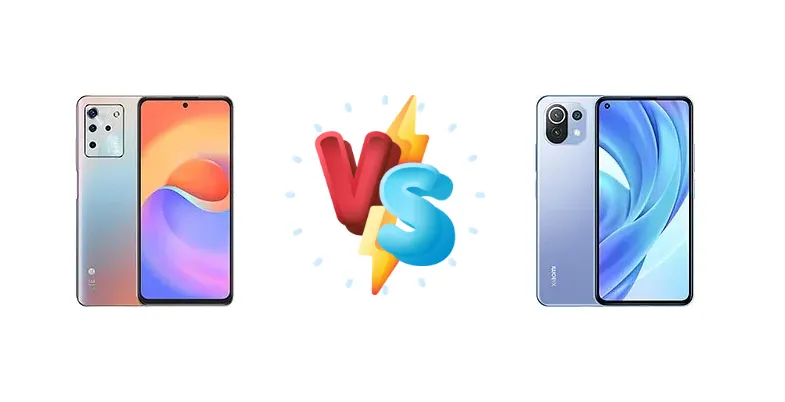
The ZTE S30 and Xiaomi Mi 11 Lite represent a sweet spot in the smartphone market, offering a balance of features and affordability. Both leverage Qualcomm's Snapdragon 7-series, but subtle differences in chipset, display technology, and charging capabilities create distinct user experiences. This comparison dissects these nuances to determine which device delivers the most value.
🏆 Quick Verdict
For the average user prioritizing display brightness and slightly faster charging, the Xiaomi Mi 11 Lite emerges as the better choice. However, the ZTE S30 remains a compelling option for those seeking a similar experience at potentially a lower price point, depending on current market conditions.
| Network |
|---|
| 2G bands | GSM 850 / 900 / 1800 / 1900 | GSM 850 / 900 / 1800 / 1900 |
| 3G bands | HSDPA 850 / 900 / 1900 / 2100 | HSDPA 850 / 900 / 1700(AWS) / 1900 / 2100 |
| 4G bands | 1, 3, 5, 7, 8, 34, 38, 39, 40, 41 | 1, 2, 3, 4, 5, 7, 8, 12, 17, 20, 28, 32, 38, 40, 41, 66 |
| 5G bands | 1, 28, 41, 78 SA/NSA | - |
| Speed | HSPA, LTE, 5G | HSPA, LTE |
| Technology | GSM / HSPA / LTE / 5G | GSM / HSPA / LTE |
| Launch |
|---|
| Announced | 2021, March 31 | 2021, March 29 |
| Status | Available. Released 2021, April 03 | Available. Released 2021, April 16 |
| Body |
|---|
| Dimensions | 164.8 x 76.4 x 7.9 mm (6.49 x 3.01 x 0.31 in) | 160.5 x 75.7 x 6.8 mm (6.32 x 2.98 x 0.27 in) |
| SIM | Nano-SIM + Nano-SIM | Nano-SIM + Nano-SIM |
| Weight | 184 g (6.49 oz) | 157 g (5.54 oz) |
| | - | IP53, dust and splash resistant |
| Display |
|---|
| Protection | - | Corning Gorilla Glass 5 |
| Resolution | 1080 x 2400 pixels, 20:9 ratio (~395 ppi density) | 1080 x 2400 pixels, 20:9 ratio (~402 ppi density) |
| Size | 6.67 inches, 107.4 cm2 (~85.3% screen-to-body ratio) | 6.55 inches, 103.6 cm2 (~85.3% screen-to-body ratio) |
| Type | IPS LCD, 90Hz | AMOLED, 1B colors, HDR10, 90Hz, 500 nits (typ), 800 nits |
| Platform |
|---|
| CPU | Octa-core (2x2.3 GHz Kryo 465 Gold & 6x1.8 GHz Kryo 465 Silver) | Octa-core (2x2.3 GHz Kryo 470 Gold & 6x1.8 GHz Kryo 470 Silver) |
| Chipset | Qualcomm SM7125 Snapdragon 720G (8 nm) | Qualcomm SM7150 Snapdragon 732G (8 nm) |
| GPU | Adreno 618 | Adreno 618 |
| OS | Android 11, MyOS 11 | Android 11, MIUI 12 |
| Memory |
|---|
| Card slot | No | microSDXC (uses shared SIM slot) |
| Internal | 128GB 8GB RAM, 256GB 8GB RAM | 64GB 4GB RAM, 64GB 6GB RAM, 128GB 6GB RAM, 128GB 8GB RAM |
| | - | UFS 2.2 |
| Main Camera |
|---|
| Features | Dual-LED flash, HDR, panorama | Dual-LED dual-tone flash, HDR, panorama |
| Quad | 64 MP, f/1.8, 26mm (wide), 1/1.72", 0.8µm, PDAF
8 MP, f/2.4, 120˚, 16mm (ultrawide)
5 MP (macro)
Auxiliary lens | - |
| Triple | - | 64 MP, f/1.8, 26mm (wide), 1/1.97", 0.7µm, PDAF
8 MP, f/2.2, 119˚ (ultrawide), 1/4.0", 1.12µm
5 MP (macro), AF |
| Video | 4K@30fps, 1080p@30fps, gyro-EIS | 4K@30fps, 1080p@30/60/120fps; gyro-EIS |
| Selfie camera |
|---|
| Features | HDR | HDR, panorama |
| Single | 16 MP | 16 MP, f/2.5, (wide), 1/3.06" 1.0µm |
| Video | 1080p@30fps | 1080p@30fps, 720p@120fps |
| Sound |
|---|
| 3.5mm jack | - | No |
| 35mm jack | Yes | No |
| Loudspeaker | Yes | Yes, with dual speakers |
| | - | 24-bit/192kHz audio |
| Comms |
|---|
| Bluetooth | 5.1, A2DP, LE | 5.1, A2DP, LE |
| Infrared port | - | Yes |
| NFC | No | Yes (market/region dependent) |
| Positioning | GPS, BDS | GPS, GLONASS, BDS, GALILEO |
| Radio | No | No |
| USB | USB Type-C 2.0 | USB Type-C 2.0, OTG |
| WLAN | Wi-Fi 802.11 a/b/g/n/ac, dual-band, Wi-Fi Direct | Wi-Fi 802.11 a/b/g/n/ac, dual-band, Wi-Fi Direct |
| Features |
|---|
| Sensors | Fingerprint (side-mounted), accelerometer, gyro, proximity, compass | Fingerprint (side-mounted), accelerometer, gyro, compass |
| | - | Virtual proximity sensing |
| Battery |
|---|
| Charging | 30W wired | 33W wired |
| Type | Li-Ion 4000 mAh | Li-Po 4250 mAh |
| Misc |
|---|
| Colors | Black, Pink/Blue | Boba Black (Vinyl Black), Peach Pink (Tuscany Coral), Bubblegum Blue (Jazz Blue) |
| Models | 9030N | M2101K9AG, M2101K9AI |
| Price | About 290 EUR | £ 221.40 / € 106.34 |
| SAR | - | 1.07 W/kg (head) 0.82 W/kg (body) |
| SAR EU | - | 0.60 W/kg (head) 0.95 W/kg (body) |
| Tests |
|---|
| Battery life | - |
Endurance rating 100h
|
| Camera | - |
Photo / Video |
| Display | - |
Contrast ratio: Infinite (nominal) |
| Loudspeaker | - |
-24.2 LUFS (Very good)
|
| Performance | - |
AnTuTu: 290172 (v8), 294251 (v9)
GeekBench: 1796 (v5.1)
GFXBench: 17fps (ES 3.1 onscreen) |
ZTE S30
- Potentially lower price point
- Capable Snapdragon 720G processor
- Reliable daily driver performance
- Likely lower display brightness
- Slower charging speed (30W)
- Limited information on camera capabilities
Xiaomi Mi 11 Lite
- Brighter display (826 nits)
- Faster charging (33W)
- Slightly more powerful Snapdragon 732G
- Potentially higher price
- Similar battery endurance to S30
- Camera details are still limited
Display Comparison
The Xiaomi Mi 11 Lite boasts a significant advantage in display quality, achieving a measured peak brightness of 826 nits. This is crucial for outdoor visibility, where the ZTE S30's unspecified brightness will likely struggle in direct sunlight. While both feature an 'infinite' contrast ratio (typical for AMOLED panels), the higher brightness of the Mi 11 Lite translates to a more dynamic and engaging viewing experience. The absence of refresh rate data for the ZTE S30 suggests the Mi 11 Lite may also offer smoother scrolling if it includes a higher refresh rate panel.
Camera Comparison
Both phones are listed as having 'Photo / Video' capabilities, lacking specific details. Without sensor size or aperture information, a direct comparison is difficult. However, the market positioning of the Mi 11 Lite suggests a potentially more refined camera system with better image processing algorithms. The absence of details on OIS (Optical Image Stabilization) for either device implies reliance on software stabilization, which can introduce artifacts in low-light conditions. It's reasonable to assume the Mi 11 Lite, being a slightly higher-tier device, may offer more versatile camera modes and better overall image quality.
Performance
Both devices utilize Qualcomm's 8nm Snapdragon 7-series, but the Mi 11 Lite's Snapdragon 732G represents a modest upgrade over the S30's Snapdragon 720G. The 732G features Kryo 470 cores versus the 720G's Kryo 465 cores, offering a slight performance boost in CPU and GPU tasks. While both CPUs share the same 2x2.3 GHz + 6x1.8 GHz configuration, the architectural improvements in the 732G contribute to better efficiency and responsiveness. The impact on real-world usage will be noticeable in demanding applications and multitasking, favoring the Mi 11 Lite.
Battery Life
Both the ZTE S30 and Xiaomi Mi 11 Lite achieve an endurance rating of 100 hours, suggesting similar real-world battery life despite potentially different battery capacities (not specified for the S30). However, the Mi 11 Lite's 33W wired charging offers a faster replenishment rate compared to the S30's 30W charging. This translates to quicker top-ups, reducing downtime and providing greater convenience for users who frequently need to recharge their devices. While the endurance rating is identical, the charging speed gives the Mi 11 Lite a practical advantage.
Buying Guide
Buy the ZTE S30 if you need a reliable daily driver with a capable processor and aren't overly concerned with having the brightest display. It's ideal for users who prioritize value and don't engage in extensive outdoor use. Buy the Xiaomi Mi 11 Lite if you prefer a brighter, more vibrant display for media consumption and a slightly faster charging experience, making it better suited for users who are frequently on the go and rely heavily on their phone's screen.
Frequently Asked Questions
❓ Is the Snapdragon 732G in the Mi 11 Lite a significant upgrade for gaming compared to the 720G in the S30?
While not a massive leap, the Snapdragon 732G offers a modest performance increase in GPU tasks, resulting in slightly higher frame rates and smoother gameplay in demanding titles. However, both chipsets are mid-range and will likely require reduced graphics settings for optimal performance in the most graphically intensive games.
❓ How much does the brighter display on the Mi 11 Lite matter for everyday use?
The 826 nits peak brightness of the Mi 11 Lite makes a substantial difference in outdoor visibility, especially under direct sunlight. It also enhances the viewing experience for media consumption, providing richer colors and better contrast. If you frequently use your phone outdoors or enjoy watching videos, the brighter display is a significant advantage.
❓ Given the similar endurance ratings, will I notice a real-world difference in battery life between the two phones?
The 100-hour endurance rating suggests similar battery life under typical usage. However, the Mi 11 Lite's faster charging allows for quicker top-ups, which can mitigate any perceived difference in longevity. If you often find yourself needing to recharge throughout the day, the Mi 11 Lite's charging speed will be more beneficial.