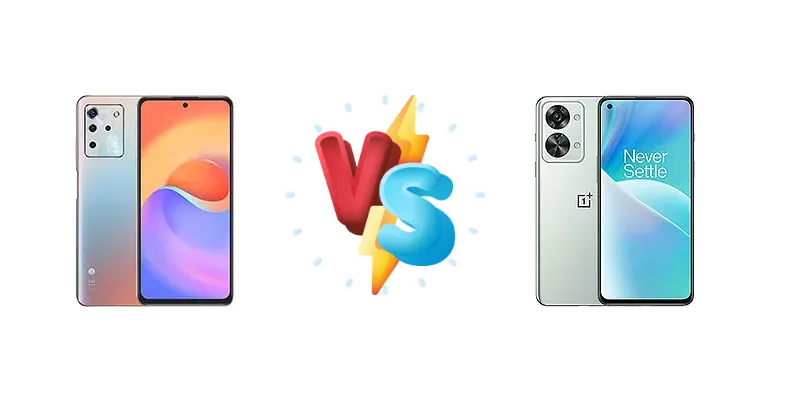
The mid-range smartphone market is fiercely competitive, and the ZTE S30 and OnePlus Nord 2T represent compelling options for budget-conscious buyers. The S30, leveraging Qualcomm's Snapdragon 720G, aims for efficiency, while the Nord 2T counters with MediaTek's more powerful Dimensity 1300 and a significantly faster charging solution. This comparison will dissect their strengths and weaknesses to determine which device offers the best overall package.
🏆 Quick Verdict
For most users, the OnePlus Nord 2T emerges as the stronger choice. Its Dimensity 1300 chipset delivers noticeably better performance, and the 80W SuperVOOC charging is a game-changer, offsetting the shared 100-hour endurance rating with significantly faster top-ups. While the ZTE S30 offers a more economical entry point, the Nord 2T’s advantages justify the price difference.
| Network |
|---|
| 2G bands | GSM 850 / 900 / 1800 / 1900 | GSM 850 / 900 / 1800 / 1900 |
| 3G bands | HSDPA 850 / 900 / 1900 / 2100 | HSDPA 800 / 850 / 900 / 1700(AWS) / 1800 / 1900 / 2100 |
| 4G bands | 1, 3, 5, 7, 8, 34, 38, 39, 40, 41 | 1, 2, 3, 4, 5, 7, 8, 12, 17, 18, 19, 20, 26, 28, 32, 34, 38, 39, 40, 41, 66 |
| 5G bands | 1, 28, 41, 78 SA/NSA | 1, 3, 7, 8, 20, 28, 38, 41, 78 SA/NSA |
| Speed | HSPA, LTE, 5G | HSPA 42.2/5.76 Mbps, LTE Cat18 1200/150 Mbps, 5G |
| Technology | GSM / HSPA / LTE / 5G | GSM / HSPA / LTE / 5G |
| Launch |
|---|
| Announced | 2021, March 31 | 2022, May 19 |
| Status | Available. Released 2021, April 03 | Available. Released 2022, May 21 |
| Body |
|---|
| Build | - | Glass front (Gorilla Glass 5), plastic frame |
| Dimensions | 164.8 x 76.4 x 7.9 mm (6.49 x 3.01 x 0.31 in) | 159.1 x 73.2 x 8.2 mm (6.26 x 2.88 x 0.32 in) |
| SIM | Nano-SIM + Nano-SIM | Nano-SIM + Nano-SIM |
| Weight | 184 g (6.49 oz) | 190 g (6.70 oz) |
| Display |
|---|
| Protection | - | Corning Gorilla Glass 5 |
| Resolution | 1080 x 2400 pixels, 20:9 ratio (~395 ppi density) | 1080 x 2400 pixels, 20:9 ratio (~409 ppi density) |
| Size | 6.67 inches, 107.4 cm2 (~85.3% screen-to-body ratio) | 6.43 inches, 99.8 cm2 (~85.7% screen-to-body ratio) |
| Type | IPS LCD, 90Hz | AMOLED, 90Hz, HDR10+ |
| Platform |
|---|
| CPU | Octa-core (2x2.3 GHz Kryo 465 Gold & 6x1.8 GHz Kryo 465 Silver) | Octa-core (1x3.0 GHz Cortex-A78 & 3x2.6 GHz Cortex-A78 & 4x2.0 GHz Cortex-A55) |
| Chipset | Qualcomm SM7125 Snapdragon 720G (8 nm) | Mediatek Dimensity 1300 (6 nm) |
| GPU | Adreno 618 | Mali-G77 MC9 |
| OS | Android 11, MyOS 11 | Android 12, upgradable to Android 14, OxygenOS 14 |
| Memory |
|---|
| Card slot | No | No |
| Internal | 128GB 8GB RAM, 256GB 8GB RAM | 128GB 8GB RAM, 256GB 12GB RAM |
| | - | UFS 3.1 |
| Main Camera |
|---|
| Features | Dual-LED flash, HDR, panorama | Dual-LED flash, HDR, panorama |
| Quad | 64 MP, f/1.8, 26mm (wide), 1/1.72", 0.8µm, PDAF
8 MP, f/2.4, 120˚, 16mm (ultrawide)
5 MP (macro)
Auxiliary lens | - |
| Single | - | 32 MP, f/2.4, (wide), 1/2.8", 0.8µm |
| Triple | - | 50 MP, f/1.9, 24mm (wide), 1/1.56", 1.0µm, PDAF, OIS
8 MP, f/2.2, 120˚ (ultrawide)
Auxiliary lens |
| Video | 4K@30fps, 1080p@30fps, gyro-EIS | 4K@30fps, 1080p@30/60/120/480fps, gyro-EIS |
| Selfie camera |
|---|
| Features | HDR | Auto HDR |
| Single | 16 MP | 32 MP, f/2.4, (wide), 1/2.8", 0.8µm |
| Video | 1080p@30fps | 1080p@30fps, gyro-EIS |
| Sound |
|---|
| 3.5mm jack | - | No |
| 35mm jack | Yes | No |
| Loudspeaker | Yes | Yes, with stereo speakers |
| Comms |
|---|
| Bluetooth | 5.1, A2DP, LE | 5.2, A2DP, LE, aptX HD |
| NFC | No | Yes |
| Positioning | GPS, BDS | GPS, GLONASS, GALILEO, BDS, NavIC |
| Radio | No | No |
| USB | USB Type-C 2.0 | USB Type-C 2.0, OTG |
| WLAN | Wi-Fi 802.11 a/b/g/n/ac, dual-band, Wi-Fi Direct | Wi-Fi 802.11 a/b/g/n/ac/6, dual-band, Wi-Fi Direct |
| Features |
|---|
| Sensors | Fingerprint (side-mounted), accelerometer, gyro, proximity, compass | Fingerprint (under display, optical), accelerometer, gyro, proximity, compass |
| Battery |
|---|
| Charging | 30W wired | 80W wired, PD |
| Type | Li-Ion 4000 mAh | Li-Po 4500 mAh |
| Misc |
|---|
| Colors | Black, Pink/Blue | Gray Shadow, Jade Fog |
| Models | 9030N | CPH2399, CPH2401 |
| Price | About 290 EUR | € 144.39 / $ 169.99 / ₹ 31,490 |
| Tests |
|---|
| Battery life | - |
Endurance rating 100h
|
| Camera | - |
Photo / Video |
| Display | - |
Contrast ratio: Infinite (nominal) |
| Loudspeaker | - |
-25.6 LUFS (Very good)
|
| Performance | - |
AnTuTu: 490545 (v8) | 604467 (v9)
GeekBench: 2790 (v5.1)
GFXBench: 40fps (ES 3.1 onscreen) |
ZTE S30
- Lower price point makes it accessible.
- Qualcomm chipset offers good power efficiency.
- Decent battery life for everyday use.
- Significantly slower charging speed.
- Less powerful processor compared to the Nord 2T.
- Camera system likely less advanced.
OnePlus Nord 2T
- Much faster 80W SuperVOOC charging.
- More powerful MediaTek Dimensity 1300 chipset.
- Brighter display for better outdoor visibility.
- Higher price compared to the ZTE S30.
- Potential for more heat generation under heavy load.
- Software experience may not appeal to all users.
Display Comparison
The OnePlus Nord 2T boasts a brighter display, reaching a measured 636 nits, compared to an unspecified brightness for the ZTE S30. While both phones likely utilize AMOLED panels (based on market segment), the Nord 2T’s higher peak brightness translates to better visibility outdoors. The Nord 2T’s ‘Infinite’ contrast ratio (nominal) suggests a standard AMOLED experience, while details on the S30’s panel are lacking. Bezels are likely comparable given the similar overall design philosophies of both devices.
Camera Comparison
Both devices feature photo and video capabilities, but specifics are limited. Without sensor size or aperture information, a direct comparison is difficult. However, the market positioning suggests the Nord 2T likely incorporates a more sophisticated camera system. The ZTE S30, aiming for cost-effectiveness, may utilize simpler sensors. The presence of OIS (Optical Image Stabilization) on the Nord 2T would be a significant advantage for capturing sharper images and smoother videos, particularly in low-light conditions. We can safely assume the 2MP macro cameras on both devices offer limited utility.
Performance
The core difference lies in the chipsets. The OnePlus Nord 2T’s MediaTek Dimensity 1300, built on a 6nm process, significantly outperforms the ZTE S30’s Qualcomm Snapdragon 720G (8nm). The Dimensity 1300’s octa-core configuration, featuring a high-clocked Cortex-A78 prime core, provides a substantial boost in CPU and GPU performance. This translates to snappier app launches, smoother multitasking, and a more enjoyable gaming experience. The Snapdragon 720G is adequate for everyday tasks, but will struggle with demanding games or resource-intensive applications. RAM configurations are not specified, but faster LPDDR5 RAM in the Nord 2T would further enhance its performance advantage.
Battery Life
Both phones share a 100-hour endurance rating, indicating similar battery life under typical usage. However, the charging speeds are drastically different. The OnePlus Nord 2T’s 80W SuperVOOC charging, with PD support, can fully charge the battery in a fraction of the time compared to the ZTE S30’s 30W wired charging. This is a crucial advantage for users who prioritize convenience and need to quickly top up their battery throughout the day. While the S30’s battery capacity isn’t specified, the Nord 2T’s faster charging effectively mitigates any potential capacity disadvantage.
Buying Guide
Buy the ZTE S30 if you prioritize a lower upfront cost and are comfortable with a more modest performance profile for everyday tasks like browsing and social media. Buy the OnePlus Nord 2T if you demand smoother multitasking, enjoy mobile gaming, and value the convenience of incredibly fast charging – especially if you frequently find yourself needing to quickly replenish your battery.
Frequently Asked Questions
❓ Does the MediaTek Dimensity 1300 in the OnePlus Nord 2T tend to overheat during prolonged gaming sessions?
While the Dimensity 1300 is a powerful chip, thermal management is crucial. OnePlus typically employs effective cooling solutions, but sustained gaming at maximum settings could lead to some throttling. However, the 6nm process node is more efficient than the 8nm Snapdragon 720G in the ZTE S30, suggesting the Nord 2T will handle heat better overall.
❓ Is the 30W charging on the ZTE S30 slow enough to be a significant inconvenience in daily use?
Yes, compared to the 80W charging on the Nord 2T, 30W charging is considerably slower. Expect a full charge to take well over an hour, potentially requiring overnight charging. This is a major trade-off for those who value quick top-ups.
❓ How does the Snapdragon 720G in the ZTE S30 perform with graphically demanding games like PUBG Mobile?
The Snapdragon 720G can run PUBG Mobile, but you'll likely need to lower the graphics settings to achieve a smooth frame rate. Expect some stuttering or frame drops during intense action sequences. The Dimensity 1300 in the Nord 2T will provide a significantly more fluid and responsive gaming experience.
❓ Are there any significant software differences between the ZTE S30 and the OnePlus Nord 2T that might influence the user experience?
OnePlus' OxygenOS is generally regarded as a clean and user-friendly Android skin, offering a good balance of features and customization options. ZTE's MyOS is less well-known and may include more pre-installed bloatware. Software updates and long-term support are also typically more consistent with OnePlus.