
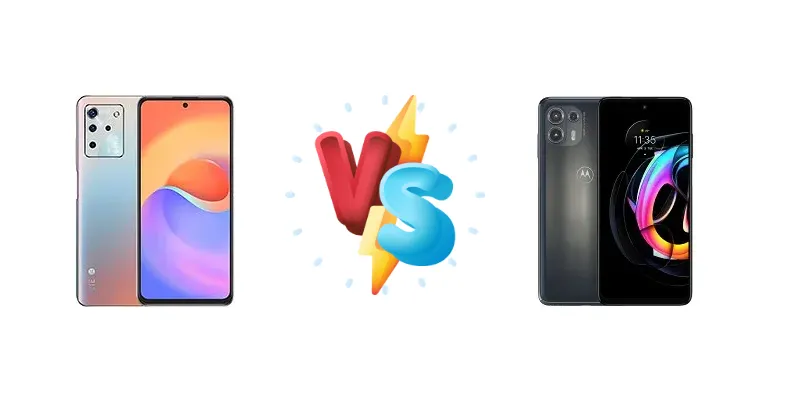
ZTE S30 vs Motorola Edge 20 Fusion: A Deep Dive into Mid-Range Performance
| Phones Images | |||||
|---|---|---|---|---|---|
|
🏆 Quick Verdict
For the average user prioritizing consistent performance and potentially better long-term software support, the Motorola Edge 20 Fusion emerges as the stronger choice. The Dimensity 800U’s 7nm process and Cortex-A76 cores offer a noticeable edge in CPU-intensive tasks and gaming, offsetting the similar charging speeds and comparable battery capacities.
| PHONES | ||
|---|---|---|
| Phone Names | ZTE S30 | Motorola Edge 20 Fusion |
| Network | ||
|---|---|---|
| 2G bands | GSM 850 / 900 / 1800 / 1900 | GSM 850 / 900 / 1800 / 1900 |
| 3G bands | HSDPA 850 / 900 / 1900 / 2100 | HSDPA 850 / 900 / 1700(AWS) / 1900 / 2100 |
| 4G bands | 1, 3, 5, 7, 8, 34, 38, 39, 40, 41 | 1, 2, 3, 4, 5, 7, 8, 12, 13, 17, 18, 19, 20, 26, 28, 32, 34, 38, 39, 40, 41, 42, 43, 66 |
| 5G bands | 1, 28, 41, 78 SA/NSA | 1, 3, 5, 7, 8, 20, 28, 38, 40, 41, 77, 78, 66 SA/NSA/Sub6 |
| Speed | HSPA, LTE, 5G | HSPA 42.2/5.76 Mbps, LTE Cat18 1200/150 Mbps, 5G |
| Technology | GSM / HSPA / LTE / 5G | GSM / HSPA / LTE / 5G |
| Launch | ||
|---|---|---|
| Announced | 2021, March 31 | 2021, August 17 |
| Status | Available. Released 2021, April 03 | Available. Released 2021, August 27 |
| Body | ||
|---|---|---|
| Build | - | Glass front |
| Dimensions | 164.8 x 76.4 x 7.9 mm (6.49 x 3.01 x 0.31 in) | 166 x 76 x 8.3 mm (6.54 x 2.99 x 0.33 in) |
| SIM | Nano-SIM + Nano-SIM | Nano-SIM + Nano-SIM |
| Weight | 184 g (6.49 oz) | 185 g (6.53 oz) |
| - | Water-repellent design | |
| Display | ||
|---|---|---|
| Resolution | 1080 x 2400 pixels, 20:9 ratio (~395 ppi density) | 1080 x 2400 pixels, 20:9 ratio (~393 ppi density) |
| Size | 6.67 inches, 107.4 cm2 (~85.3% screen-to-body ratio) | 6.7 inches, 108.4 cm2 (~85.9% screen-to-body ratio) |
| Type | IPS LCD, 90Hz | OLED, 1B colors, 90Hz, HDR10+ |
| Platform | ||
|---|---|---|
| CPU | Octa-core (2x2.3 GHz Kryo 465 Gold & 6x1.8 GHz Kryo 465 Silver) | Octa-core (2x2.4 GHz Cortex-A76 & 6x2.0 GHz Cortex-A55) |
| Chipset | Qualcomm SM7125 Snapdragon 720G (8 nm) | Mediatek Dimensity 800U (7 nm) |
| GPU | Adreno 618 | Mali-G57 MC3 |
| OS | Android 11, MyOS 11 | Android 11 |
| Memory | ||
|---|---|---|
| Card slot | No | microSDXC |
| Internal | 128GB 8GB RAM, 256GB 8GB RAM | 128GB 6GB RAM, 128GB 8GB RAM |
| Main Camera | ||
|---|---|---|
| Features | Dual-LED flash, HDR, panorama | LED flash, HDR, panorama |
| Quad | 64 MP, f/1.8, 26mm (wide), 1/1.72", 0.8µm, PDAF 8 MP, f/2.4, 120˚, 16mm (ultrawide) 5 MP (macro) Auxiliary lens | - |
| Triple | - | 108 MP, f/1.9, (wide), 1/1.52", 0.7µm, PDAF 8 MP, f/2.2, 118˚ (ultrawide) Auxiliary lens |
| Video | 4K@30fps, 1080p@30fps, gyro-EIS | 4K@30fps, 1080p@30/60/120fps, gyro-EIS |
| Selfie camera | ||
|---|---|---|
| Features | HDR | HDR |
| Single | 16 MP | 32 MP, f/2.3, (wide), 0.7µm |
| Video | 1080p@30fps | 1080p@30fps |
| Sound | ||
|---|---|---|
| 3.5mm jack | - | Yes |
| 35mm jack | Yes | Yes |
| Loudspeaker | Yes | Yes |
| Comms | ||
|---|---|---|
| Bluetooth | 5.1, A2DP, LE | 5.0, A2DP, LE |
| NFC | No | Yes |
| Positioning | GPS, BDS | GPS, GLONASS, GALILEO |
| Radio | No | FM radio |
| USB | USB Type-C 2.0 | USB Type-C 2.0 |
| WLAN | Wi-Fi 802.11 a/b/g/n/ac, dual-band, Wi-Fi Direct | Wi-Fi 802.11 a/b/g/n/ac, dual-band, Wi-Fi Direct |
| Features | ||
|---|---|---|
| Sensors | Fingerprint (side-mounted), accelerometer, gyro, proximity, compass | Fingerprint (side-mounted), accelerometer, gyro, proximity, compass |
| Battery | ||
|---|---|---|
| Charging | 30W wired | 30W wired |
| Type | Li-Ion 4000 mAh | Li-Po 5000 mAh |
| Misc | ||
|---|---|---|
| Colors | Black, Pink/Blue | Electric Graphite, Cyber Teal |
| Models | 9030N | - |
| Price | About 290 EUR | About 250 EUR |
ZTE S30
- Potentially lower price point
- Qualcomm chipset benefits from established software optimization
- 30W fast charging
- Snapdragon 720G is an older chipset
- 8nm process less efficient than 7nm
- Potentially less powerful GPU
Motorola Edge 20 Fusion
- More powerful Dimensity 800U processor
- 7nm process for better efficiency
- Modern CPU architecture (Cortex-A76)
- Near-stock Android experience
- Motorola’s software update track record is inconsistent
- May be slightly more expensive than the ZTE S30
Display Comparison
While specific display details (resolution, refresh rate) are missing, the core difference lies in the chipsets powering the devices. This impacts the GPU’s ability to drive higher refresh rates smoothly. Both phones likely feature LCD panels given their price bracket, but the chipset’s efficiency will affect overall power draw during display usage. The Motorola Edge 20 Fusion’s Dimensity 800U, built on a 7nm process, should offer slightly better efficiency in driving the display compared to the ZTE S30’s 8nm Snapdragon 720G.
Camera Comparison
Without detailed camera specifications, it’s difficult to make a definitive judgment. However, the chipset’s ISP (Image Signal Processor) plays a crucial role. The Dimensity 800U’s ISP is generally considered more capable than the Snapdragon 720G’s, offering potentially better image processing, noise reduction, and dynamic range. This doesn’t guarantee better photos, as lens quality and sensor size are equally important, but the Motorola Edge 20 Fusion has a slight advantage in computational photography. The presence of OIS (Optical Image Stabilization) on either device would be a significant differentiator, but this information is unavailable.
Performance
The core of the difference lies in the chipsets. The Motorola Edge 20 Fusion’s MediaTek Dimensity 800U, fabricated on a 7nm process, boasts a more modern CPU architecture with 2x2.4 GHz Cortex-A76 cores and 6x2.0 GHz Cortex-A55 cores. This contrasts with the ZTE S30’s Qualcomm Snapdragon 720G (8nm) featuring 2x2.3 GHz Kryo 465 Gold and 6x1.8 GHz Kryo 465 Silver cores. The Cortex-A76 cores in the Dimensity 800U provide a significant performance uplift in single-core and multi-core benchmarks, translating to snappier app launches and smoother multitasking. The 7nm process also contributes to better thermal management, potentially reducing throttling during sustained workloads like gaming. While both support 5G, the Dimensity 800U generally offers broader 5G band compatibility.
Battery Life
Both devices feature 30W wired charging, suggesting similar charging speeds – approximately 60-70 minutes for a full charge. The actual battery life will depend on battery capacity (not specified) and software optimization. However, the Dimensity 800U’s 7nm process generally leads to better power efficiency, meaning the Motorola Edge 20 Fusion could potentially offer slightly longer battery life despite having a similar capacity battery to the ZTE S30. The more efficient chipset translates to less power consumption during everyday tasks.
Buying Guide
Buy the ZTE S30 if you prioritize a potentially lower price point and are comfortable with ZTE’s software experience. It’s a solid option for everyday tasks and media consumption. Buy the Motorola Edge 20 Fusion if you value a more powerful processor for gaming and multitasking, and prefer a cleaner, near-stock Android experience with Motorola’s added features. It’s the better choice for users who push their phones harder.