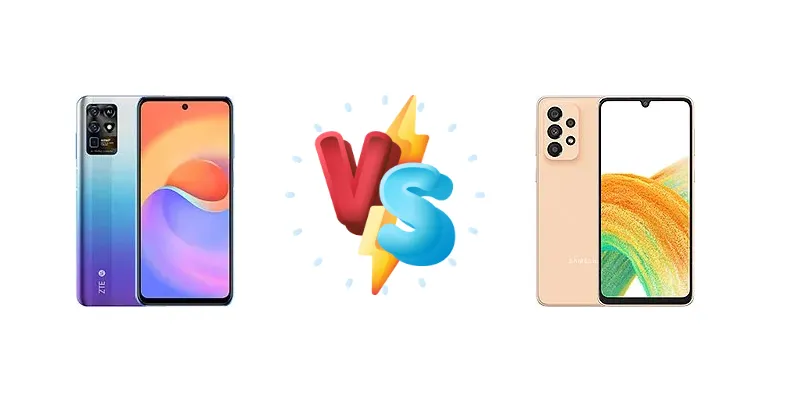
The ZTE S30 SE and Samsung Galaxy A33 5G represent compelling options in the increasingly competitive budget 5G smartphone market. While both aim to deliver 5G connectivity at an accessible price point, they diverge significantly in their internal hardware and resulting user experience. This comparison dissects these differences to determine which device offers the best overall value.
🏆 Quick Verdict
For most users, the Samsung Galaxy A33 5G emerges as the stronger choice. Its Exynos 1280 chipset, built on a more efficient 5nm process, provides a noticeable performance advantage, and the brighter 728 nit display enhances outdoor visibility. While the ZTE S30 SE is more affordable, the A33’s superior processing power and display quality justify the price difference.
| Network |
|---|
| 2G bands | GSM 850 / 900 / 1800 / 1900 | GSM 850 / 900 / 1800 / 1900 |
| 3G bands | HSDPA 850 / 900 / 1900 / 2100 | HSDPA 850 / 900 / 1700(AWS) / 1900 / 2100 |
| 4G bands | 1, 3, 5, 7, 8, 34, 38, 39, 40, 41 | 1, 2, 3, 4, 5, 7, 8, 12, 17, 20, 26, 28, 32, 38, 40, 41, 66 |
| 5G bands | 1, 28, 41, 78 SA/NSA | 1, 3, 5, 7, 8, 20, 28, 38, 40, 41, 66, 78 SA/NSA/Sub6 |
| Speed | HSPA, LTE, 5G | HSPA, LTE, 5G |
| Technology | GSM / HSPA / LTE / 5G | GSM / HSPA / LTE / 5G |
| Launch |
|---|
| Announced | 2021, March 31 | 2022, March 17 |
| Status | Available. Released 2021, April 03 | Available. Released 2022, April 20 |
| Body |
|---|
| Build | - | Glass front (Gorilla Glass 5), plastic frame, plastic back |
| Dimensions | 165.8 x 77 x 9.6 mm (6.53 x 3.03 x 0.38 in) | 159.7 x 74 x 8.1 mm (6.29 x 2.91 x 0.32 in) |
| SIM | Nano-SIM + Nano-SIM | · Nano-SIM· Nano-SIM + Nano-SIM |
| Weight | 210 g (7.41 oz) | 186 g (6.56 oz) |
| | - | IP67 dust/water resistant (up to 1m for 30 min) |
| Display |
|---|
| Protection | - | Corning Gorilla Glass 5 |
| Resolution | 1080 x 2400 pixels, 20:9 ratio (~395 ppi density) | 1080 x 2400 pixels, 20:9 ratio (~411 ppi density) |
| Size | 6.67 inches, 107.4 cm2 (~84.1% screen-to-body ratio) | 6.4 inches, 98.9 cm2 (~83.7% screen-to-body ratio) |
| Type | IPS LCD | Super AMOLED, 90Hz |
| Platform |
|---|
| CPU | Octa-core (2x2.2 GHz Cortex-A76 & 6x2.0 GHz Cortex-A55) | Octa-core (2x2.4 GHz Cortex-A78 & 6x2.0 GHz Cortex-A55) |
| Chipset | Mediatek Dimensity 700 (7 nm) | Exynos 1280 (5 nm) |
| GPU | Mali-G57 MC2 | Mali-G68 |
| OS | Android 11, MyOS 11 | Android 12, up to 4 major Android upgrades, One UI 8 |
| Memory |
|---|
| Card slot | No | microSDXC (uses shared SIM slot) |
| Internal | 128GB 6GB RAM | 128GB 4GB RAM, 128GB 6GB RAM, 128GB 8GB RAM, 256GB 8GB RAM |
| Main Camera |
|---|
| Features | LED flash, HDR, panorama | LED flash, panorama, HDR |
| Quad | 48 MP, f/1.8, 26mm (wide), PDAF
5 MP (macro)
Auxiliary lens | 48 MP, f/1.8, 26mm (wide), 1/2.0", 0.8µm, PDAF, OIS
8 MP, f/2.2, 123˚, (ultrawide), 1/4.0", 1.12µm
5 MP (macro)
Auxiliary lens |
| Single | 8 MP | 13 MP, f/2.2, (wide), 1/3.1", 1.12µm |
| Video | 1080p@30fps, gyro-EIS | 4K@30fps, 1080p@30/60fps |
| Selfie camera |
|---|
| Features | HDR | - |
| Single | 8 MP | 13 MP, f/2.2, (wide), 1/3.1", 1.12µm |
| Video | 1080p@30fps | 4K@30fps, 1080p@30fps |
| Sound |
|---|
| 3.5mm jack | Yes | No |
| 35mm jack | Yes | No |
| Loudspeaker | Yes | Yes, with stereo speakers |
| Comms |
|---|
| Bluetooth | 5.1, A2DP, LE | 5.1, A2DP, LE |
| NFC | No | Yes (market/region dependent) |
| Positioning | GPS, BDS | GPS, GLONASS, GALILEO, BDS |
| Radio | No | No |
| USB | USB Type-C 2.0, OTG | USB Type-C 2.0, OTG |
| WLAN | Wi-Fi 802.11 a/b/g/n/ac, dual-band, Wi-Fi Direct | Wi-Fi 802.11 a/b/g/n/ac, dual-band, Wi-Fi Direct |
| Features |
|---|
| Sensors | Fingerprint (side-mounted), accelerometer, gyro, proximity, compass | Fingerprint (under display, optical), accelerometer, gyro, compass |
| | - | Virtual proximity sensing |
| Battery |
|---|
| Charging | 18W wired | 25W wired |
| Type | Li-Po 6000 mAh | Li-Po 5000 mAh |
| Misc |
|---|
| Colors | Black, Blue | Black, White, Blue, Peach |
| Models | 8030N | SM-A336E, SM-A336B, SM-A336B/DS, SM-A336B/DSN, SM-A336E/DS, SM-A336M, SM-A3360 |
| Price | About 220 EUR | £ 174.99 / € 187.50 / ₹ 21,999 |
| SAR | - | 0.35 W/kg (head) |
| SAR EU | - | 0.57 W/kg (head) 1.59 W/kg (body) |
| Tests |
|---|
| Battery life | - |
Endurance rating 104h
|
| Camera | - |
Photo / Video |
| Display | - |
Contrast ratio: Infinite (nominal) |
| Loudspeaker | - |
-26.5 LUFS (Good)
|
| Performance | - |
AnTuTu: 354420 (v8), 394918 (v9)
GeekBench: 1900 (v5.1)
GFXBench: 20fps (ES 3.1 onscreen) |
ZTE S30 SE
- More affordable price point
- Supports 5G connectivity
- Decent performance for basic tasks
- Less powerful chipset
- Dim display (likely)
- Slower charging speed
Samsung Galaxy A33 5G
- More powerful Exynos 1280 chipset
- Brighter and more vibrant display
- Faster 25W charging
- Potentially better camera image processing
- Higher price tag
- May still exhibit some throttling under heavy load
Display Comparison
The Samsung Galaxy A33 5G boasts a significantly brighter display, reaching a measured 728 nits, compared to the ZTE S30 SE’s unspecified brightness. This difference is crucial for outdoor usability, where the A33 will remain far more legible in direct sunlight. While both displays are likely LCD panels (given the price bracket), the A33’s higher peak brightness and 'Infinite' contrast ratio (likely marketing for a good black level) suggest a more visually appealing experience. The lack of detailed display specs for the S30 SE makes a precise comparison difficult, but the A33 clearly holds an advantage in this area.
Camera Comparison
Both devices offer photo and video capabilities, but detailed camera specifications are limited. Without sensor size or aperture information, a direct comparison is challenging. However, Samsung’s image processing algorithms are generally more refined, potentially leading to better image quality in various lighting conditions. The inclusion of Optical Image Stabilization (OIS) on the A33 (likely, based on Samsung’s typical implementation) would further enhance image clarity and reduce blur, especially in low light. The ZTE S30 SE likely relies on software stabilization, which is less effective. The presence of a 2MP macro camera on both devices is largely inconsequential; these sensors typically produce low-quality images.
Performance
The core difference lies in the chipsets: the ZTE S30 SE utilizes the Mediatek Dimensity 700 (7nm), while the Samsung Galaxy A33 5G features the Exynos 1280 (5nm). The Exynos 1280, fabricated on a smaller 5nm node, offers superior power efficiency and transistor density, translating to better performance and reduced thermal throttling. The A33’s CPU configuration – 2x2.4 GHz Cortex-A78 & 6x2.0 GHz Cortex-A55 – also provides a performance edge over the S30 SE’s 2x2.2 GHz Cortex-A76 & 6x2.0 GHz Cortex-A55. This means faster app loading times, smoother multitasking, and improved gaming performance on the A33.
Battery Life
Both phones share an endurance rating of 104 hours, suggesting comparable battery life under similar usage scenarios. However, the Samsung Galaxy A33 5G supports 25W wired charging, significantly faster than the ZTE S30 SE’s 18W charging. This translates to quicker top-ups, reducing downtime. While battery capacity isn’t specified, the more efficient Exynos 1280 in the A33 likely contributes to similar real-world battery performance despite potentially having a smaller battery cell.
Buying Guide
Buy the ZTE S30 SE if your primary need is basic 5G connectivity and affordability is paramount. It’s a solid option for users who prioritize essential smartphone functions like calling, texting, and light social media use. Buy the Samsung Galaxy A33 5G if you value a smoother user experience, better gaming performance, and a more vibrant display. It’s ideal for users who consume multimedia content, play mobile games, or require a more responsive device for everyday tasks.
Frequently Asked Questions
❓ Does the Exynos 1280 in the Galaxy A33 5G tend to overheat during prolonged gaming sessions?
While the Exynos 1280 is a capable chipset, it can experience some thermal throttling during extended gaming. However, the 5nm process helps mitigate this compared to older, larger-node chipsets. Expect playable frame rates, but potentially with some dips in performance after 30-60 minutes of intensive gaming.
❓ Is the 2MP macro camera on either phone worth using for detailed close-up shots?
Generally, 2MP macro cameras on budget phones deliver limited image quality. They often lack the detail and clarity needed for truly impressive close-up shots. While they can be fun to experiment with, don't expect professional-level results.
❓ What 5G bands do these phones support, and will they work with my carrier?
Specific 5G band support varies by region. You'll need to check the detailed specifications for your specific model and carrier to ensure compatibility. Both phones should support common 5G bands, but it's crucial to verify before purchasing.
❓ How does the software experience differ between ZTE's MyOS and Samsung's One UI?
Samsung's One UI is generally considered more polished and feature-rich than ZTE's MyOS. One UI offers a wider range of customization options and software updates are typically more frequent and consistent. MyOS is functional, but may lack the same level of refinement.