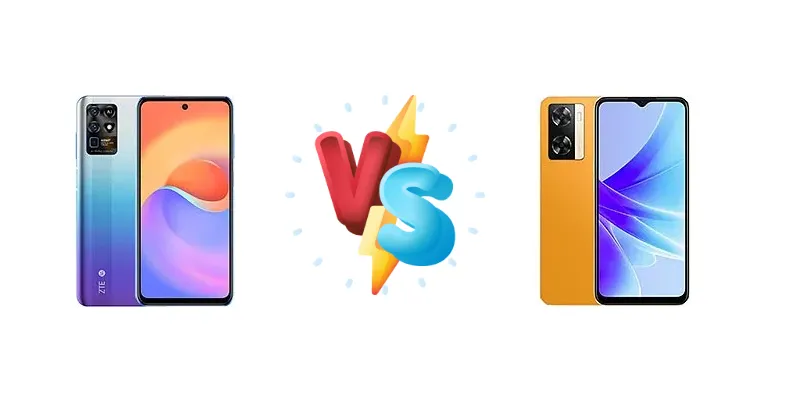
The ZTE S30 SE and Oppo A77s represent compelling options in the crowded budget 4G smartphone market. While both aim to deliver essential features at an accessible price point, they diverge significantly in their core hardware choices – a Mediatek Dimensity 700 versus a Qualcomm Snapdragon 680. This comparison dissects these differences to determine which device offers the best value for your money.
🏆 Quick Verdict
For the average user prioritizing faster charging and potentially smoother everyday performance, the Oppo A77s emerges as the better choice. Its 33W charging significantly reduces downtime, and the Snapdragon 680, built on a 6nm process, offers a slight efficiency advantage over the ZTE's 7nm Dimensity 700. However, the ZTE S30 SE remains a viable option for those on a tighter budget.
| Network |
|---|
| 2G bands | GSM 850 / 900 / 1800 / 1900 | GSM 850 / 900 / 1800 / 1900 |
| 3G bands | HSDPA 850 / 900 / 1900 / 2100 | HSDPA 850 / 900 / 2100 |
| 4G bands | 1, 3, 5, 7, 8, 34, 38, 39, 40, 41 | 1, 3, 5, 7, 8, 28, 38, 40, 41 |
| 5G bands | 1, 28, 41, 78 SA/NSA | - |
| Speed | HSPA, LTE, 5G | HSPA, LTE |
| Technology | GSM / HSPA / LTE / 5G | GSM / HSPA / LTE |
| Launch |
|---|
| Announced | 2021, March 31 | 2022, October 05 |
| Status | Available. Released 2021, April 03 | Available. Released 2022, October 07 |
| Body |
|---|
| Build | - | Glass front, plastic frame, plastic back or eco leather back |
| Dimensions | 165.8 x 77 x 9.6 mm (6.53 x 3.03 x 0.38 in) | 163.8 x 75 x 8 mm (6.45 x 2.95 x 0.31 in) |
| SIM | Nano-SIM + Nano-SIM | Nano-SIM + Nano-SIM |
| Weight | 210 g (7.41 oz) | 187 g / 190 g (6.60 oz) |
| | - | IP54, dust and water resistant |
| Display |
|---|
| Resolution | 1080 x 2400 pixels, 20:9 ratio (~395 ppi density) | 720 x 1612 pixels, 20:9 ratio (~269 ppi density) |
| Size | 6.67 inches, 107.4 cm2 (~84.1% screen-to-body ratio) | 6.56 inches, 103.4 cm2 (~84.2% screen-to-body ratio) |
| Type | IPS LCD | IPS LCD, 90Hz, 480 nits (typ), 600 nits (HBM) |
| Platform |
|---|
| CPU | Octa-core (2x2.2 GHz Cortex-A76 & 6x2.0 GHz Cortex-A55) | Octa-core (4x2.4 GHz Kryo 265 Gold & 4x1.9 GHz Kryo 265 Silver) |
| Chipset | Mediatek Dimensity 700 (7 nm) | Qualcomm SM6225 Snapdragon 680 4G (6 nm) |
| GPU | Mali-G57 MC2 | Adreno 610 |
| OS | Android 11, MyOS 11 | Android 12, upgradable to Android 14, ColorOS 14 |
| Memory |
|---|
| Card slot | No | microSDXC |
| Internal | 128GB 6GB RAM | 128GB 8GB RAM |
| | - | UFS 2.2 |
| Main Camera |
|---|
| Dual | - | 50 MP, f/1.8, 27mm (wide), PDAF
Auxiliary lens |
| Features | LED flash, HDR, panorama | LED flash, HDR, panorama |
| Quad | 48 MP, f/1.8, 26mm (wide), PDAF
5 MP (macro)
Auxiliary lens | - |
| Single | 8 MP | 8 MP, f/2.0, 26mm (wide) |
| Video | 1080p@30fps, gyro-EIS | 1080p@30fps |
| Selfie camera |
|---|
| Features | HDR | Panorama |
| Single | 8 MP | 8 MP, f/2.0, 26mm (wide) |
| Video | 1080p@30fps | 1080p@30fps |
| Sound |
|---|
| 3.5mm jack | Yes | Yes |
| 35mm jack | Yes | Yes |
| Loudspeaker | Yes | Yes, with stereo speakers |
| Comms |
|---|
| Bluetooth | 5.1, A2DP, LE | 5.0, A2DP, LE, aptX HD |
| NFC | No | Yes |
| Positioning | GPS, BDS | GPS, GLONASS, BDS, GALILEO, QZSS |
| Radio | No | FM radio |
| USB | USB Type-C 2.0, OTG | USB Type-C 2.0, OTG |
| WLAN | Wi-Fi 802.11 a/b/g/n/ac, dual-band, Wi-Fi Direct | Wi-Fi 802.11 a/b/g/n/ac, dual-band, Wi-Fi Direct |
| Features |
|---|
| Sensors | Fingerprint (side-mounted), accelerometer, gyro, proximity, compass | Fingerprint (side-mounted), accelerometer, proximity, compass |
| Battery |
|---|
| Charging | 18W wired | 33W wired, 100% in 69 min |
| Type | Li-Po 6000 mAh | Li-Po 5000 mAh |
| Misc |
|---|
| Colors | Black, Blue | Sunset Orange, Starry Black |
| Models | 8030N | CPH2473 |
| Price | About 220 EUR | About 220 EUR |
ZTE S30 SE
- Potentially lower price point
- Dimensity 700 offers 5G connectivity (though limited use in some regions)
- Sufficient for basic smartphone tasks
- Slower 18W charging
- Dimensity 700's 7nm process is less efficient than Snapdragon 680's 6nm
- Likely to exhibit more throttling under sustained load
Oppo A77s
- Faster 33W charging (full charge in 69 minutes)
- Snapdragon 680's 6nm process offers better efficiency
- Potentially smoother performance in demanding apps
- May be slightly more expensive
- Limited to 4G connectivity
- Camera performance is unknown without detailed specs
Display Comparison
Neither ZTE nor Oppo provide display specifications beyond the basic panel type. Given the price bracket, both likely utilize LCD panels. However, the focus should be on the chipsets' ability to drive the displays efficiently. The Snapdragon 680's Adreno 610 GPU may offer slightly better graphics rendering for smoother scrolling and video playback, but without detailed display specs (resolution, brightness, color gamut), a definitive advantage is difficult to ascertain.
Camera Comparison
Detailed camera specs are absent. Both phones likely feature a multi-camera setup, but the quality will heavily depend on sensor size and image processing algorithms. Without this information, it's difficult to assess camera performance. It's reasonable to assume both phones will struggle in low-light conditions, and the inclusion of a 2MP macro lens on either device is likely more for marketing than practical use. The Snapdragon 680’s ISP (Image Signal Processor) may offer slightly better image processing capabilities, but this is speculative.
Performance
The core difference lies in the chipsets. The Oppo A77s boasts the Qualcomm Snapdragon 680, fabricated on a 6nm process, featuring a Kryo CPU with 4x2.4 GHz Cortex-A75 performance cores and 4x1.9 GHz Cortex-A55 efficiency cores. The ZTE S30 SE utilizes the Mediatek Dimensity 700, a 7nm chip with 2x2.2 GHz Cortex-A76 performance cores and 6x2.0 GHz Cortex-A55 efficiency cores. While the Dimensity 700 has a higher core count, the Snapdragon 680’s newer architecture and smaller process node generally translate to better power efficiency and sustained performance. This means the Oppo A77s is less likely to throttle under prolonged load, benefiting users who play mobile games or use demanding apps.
Battery Life
Battery capacity is not specified for either device. However, the Oppo A77s’ 33W wired charging is a significant advantage over the ZTE S30 SE’s 18W charging. Oppo claims a full charge in 69 minutes, which drastically reduces downtime. While a larger battery capacity on the ZTE S30 SE could partially offset the slower charging, the convenience of the Oppo’s faster charging is a compelling benefit for users who frequently need to top up their battery.
Buying Guide
Buy the ZTE S30 SE if you need a functional, no-frills 4G smartphone and prioritize minimizing upfront cost. It's ideal for users who primarily use their phone for basic communication and light tasks. Buy the Oppo A77s if you prefer a more responsive user experience, faster charging speeds, and a slightly more modern chipset, even if it means spending a bit more. This phone suits users who engage in moderate social media browsing, streaming, and casual gaming.
Frequently Asked Questions
❓ Does the Snapdragon 680 in the Oppo A77s struggle with graphically intensive games like PUBG Mobile?
While the Snapdragon 680 isn't a gaming powerhouse, it's capable of running PUBG Mobile at medium settings with reasonable frame rates. The 6nm process and Adreno 610 GPU provide sufficient performance for casual gaming, but demanding titles may require lower graphics settings to maintain a smooth experience.
❓ Is the lack of 5G connectivity on the Oppo A77s a significant drawback?
For users in areas with limited 5G coverage, or those who don't require the fastest possible data speeds, the lack of 5G on the Oppo A77s is unlikely to be a major issue. 4G remains widely available and provides adequate performance for most everyday tasks. The trade-off for losing 5G is a more efficient chipset and potentially better battery life.
❓ How does the charging speed of the Oppo A77s compare to other phones in this price range?
33W charging is relatively fast for a phone in this price bracket. Many competitors offer 15W or 18W charging, making the Oppo A77s a clear winner in terms of charging speed. The 69-minute full charge time is a significant convenience factor.