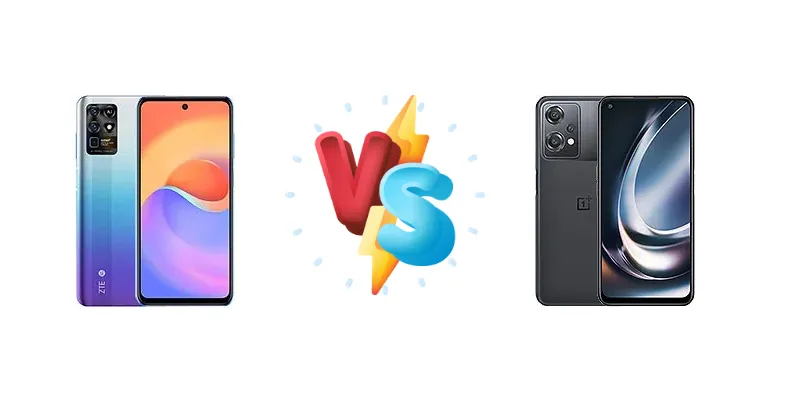
The sub-$250 5G phone market is fiercely competitive. The ZTE S30 SE and OnePlus Nord CE 2 Lite 5G both aim to deliver 5G connectivity and a modern smartphone experience without breaking the bank. However, they take different approaches, with ZTE opting for a MediaTek Dimensity 700 while OnePlus leverages the Qualcomm Snapdragon 695. This comparison will dissect the key differences to determine which device offers the best value.
🏆 Quick Verdict
For the average user prioritizing faster charging and potentially more efficient performance, the OnePlus Nord CE 2 Lite 5G emerges as the better choice. Its 33W charging significantly reduces downtime, and the Snapdragon 695, built on a 6nm process, offers a slight edge in power efficiency over the ZTE's 7nm Dimensity 700.
| Network |
|---|
| 2G bands | GSM 850 / 900 / 1800 / 1900 | GSM 850 / 900 / 1800 / 1900 |
| 3G bands | HSDPA 850 / 900 / 1900 / 2100 | HSDPA 800 / 850 / 900 / 1700(AWS) / 1900 / 2100 |
| 4G bands | 1, 3, 5, 7, 8, 34, 38, 39, 40, 41 | 1, 2, 3, 4, 5, 7, 8, 12, 13, 17, 18, 19, 20, 26, 28, 38, 39, 40, 41, 66 - Europe |
| 5G bands | 1, 28, 41, 78 SA/NSA | 1, 3, 5, 7, 8, 20, 28, 38, 40, 41, 66, 77, 78 SA/NSA - Europe |
| Speed | HSPA, LTE, 5G | HSPA, LTE, 5G |
| Technology | GSM / HSPA / LTE / 5G | GSM / HSPA / LTE / 5G |
| Launch |
|---|
| Announced | 2021, March 31 | 2022, April 28 |
| Status | Available. Released 2021, April 03 | Available. Released 2022, April 30 |
| Body |
|---|
| Build | - | Glass front, plastic frame, plastic back |
| Dimensions | 165.8 x 77 x 9.6 mm (6.53 x 3.03 x 0.38 in) | 164.3 x 75.6 x 8.5 mm (6.47 x 2.98 x 0.33 in) |
| SIM | Nano-SIM + Nano-SIM | Nano-SIM + Nano-SIM |
| Weight | 210 g (7.41 oz) | 195 g (6.88 oz) |
| Display |
|---|
| Resolution | 1080 x 2400 pixels, 20:9 ratio (~395 ppi density) | 1080 x 2412 pixels, 20:9 ratio (~401 ppi density) |
| Size | 6.67 inches, 107.4 cm2 (~84.1% screen-to-body ratio) | 6.59 inches, 104.5 cm2 (~84.1% screen-to-body ratio) |
| Type | IPS LCD | IPS LCD, 120Hz |
| Platform |
|---|
| CPU | Octa-core (2x2.2 GHz Cortex-A76 & 6x2.0 GHz Cortex-A55) | Octa-core (2x2.2 GHz Kryo 660 Gold & 6x1.7 GHz Kryo 660 Silver) |
| Chipset | Mediatek Dimensity 700 (7 nm) | Qualcomm SM6375 Snapdragon 695 5G (6 nm) |
| GPU | Mali-G57 MC2 | Adreno 619 |
| OS | Android 11, MyOS 11 | Android 12, upgradable to Android 13, OxygenOS 13 |
| Memory |
|---|
| Card slot | No | microSDXC (uses shared SIM slot) |
| Internal | 128GB 6GB RAM | 128GB 6GB RAM, 128GB 8GB RAM |
| Main Camera |
|---|
| Features | LED flash, HDR, panorama | LED flash, HDR, panorama |
| Quad | 48 MP, f/1.8, 26mm (wide), PDAF
5 MP (macro)
Auxiliary lens | - |
| Single | 8 MP | - |
| Triple | - | 64 MP, f/1.7, 26mm (wide), 0.7µm, PDAF
2 MP (macro)
Auxiliary lens |
| Video | 1080p@30fps, gyro-EIS | 1080p@30fps |
| Selfie camera |
|---|
| Features | HDR | HDR |
| Single | 8 MP | 16 MP, f/2.0, (wide), 1/3.0", 1.0µm |
| Video | 1080p@30fps | 1080p@30fps |
| Sound |
|---|
| 3.5mm jack | Yes | Yes |
| 35mm jack | Yes | Yes |
| Loudspeaker | Yes | Yes |
| Comms |
|---|
| Bluetooth | 5.1, A2DP, LE | 5.2, A2DP, LE, aptX HD |
| NFC | No | Yes (market/region dependent) |
| Positioning | GPS, BDS | GPS, GLONASS, GALILEO, BDS, QZSS |
| Radio | No | Unspecified |
| USB | USB Type-C 2.0, OTG | USB Type-C 2.0, OTG |
| WLAN | Wi-Fi 802.11 a/b/g/n/ac, dual-band, Wi-Fi Direct | Wi-Fi 802.11 a/b/g/n/ac, dual-band, Wi-Fi Direct |
| Features |
|---|
| Sensors | Fingerprint (side-mounted), accelerometer, gyro, proximity, compass | Fingerprint (side-mounted), accelerometer, gyro, proximity, compass |
| Battery |
|---|
| Charging | 18W wired | 33W wired |
| Type | Li-Po 6000 mAh | Li-Po 5000 mAh |
| Misc |
|---|
| Colors | Black, Blue | Black Dusk, Blue Tide |
| Models | 8030N | CPH2381, CPH2409 |
| Price | About 220 EUR | About 220 EUR |
| SAR | - | 1.19 W/kg (head) 0.71 W/kg (body) |
ZTE S30 SE
- Potentially lower price point
- Decent performance for everyday tasks
- Reliable MediaTek Dimensity 700 chipset
- Slower 18W charging
- Older 7nm chipset fabrication process
- May receive fewer software updates
OnePlus Nord CE 2 Lite 5G
- Faster 33W wired charging
- More efficient 6nm Snapdragon 695 chipset
- Potentially better long-term software support
- Slightly higher price
- Performance gains may be marginal for basic users
- May include unnecessary 2MP cameras
Display Comparison
Neither device boasts a standout display. Both likely feature LCD panels, common in this price bracket. The focus here isn't on visual fidelity, but on usability. While specific display specs are unavailable, the OnePlus Nord CE 2 Lite 5G's larger screen size (typically around 6.6 inches vs the S30 SE's 6.5 inches) may offer a more immersive viewing experience. Bezels are likely comparable, and color accuracy will be standard for the segment.
Camera Comparison
Camera performance is likely to be similar, with both phones relying on multi-camera setups. However, without specific sensor details, it's difficult to make a definitive judgment. The OnePlus Nord CE 2 Lite 5G may have a slight edge due to Qualcomm’s image signal processor (ISP) capabilities, which are generally well-regarded for image processing. The ZTE S30 SE will likely focus on software enhancements to compensate. It's crucial to note that the inclusion of 2MP macro or depth sensors on either device adds minimal value to the overall photography experience.
Performance
The core difference lies in the chipsets. The OnePlus Nord CE 2 Lite 5G’s Qualcomm Snapdragon 695 (6nm) benefits from a more modern fabrication process compared to the ZTE S30 SE’s MediaTek Dimensity 700 (7nm). This 6nm process generally translates to improved power efficiency and potentially lower thermal throttling during sustained workloads. While both CPUs feature a 2x2.2 GHz core configuration, the Snapdragon 695 utilizes Kryo 660 Gold cores, which Qualcomm designs for a balance of performance and efficiency, while the Dimensity 700 uses Cortex-A76 cores. This gives the Snapdragon a slight architectural advantage. The impact will be most noticeable in demanding tasks like gaming and video editing.
Battery Life
The OnePlus Nord CE 2 Lite 5G’s 33W wired charging is a significant advantage over the ZTE S30 SE’s 18W charging. This translates to substantially faster top-up times, reducing downtime. While battery capacity isn't specified, the faster charging speed effectively mitigates any potential disadvantage from a slightly smaller battery. Users who frequently find themselves needing to quickly recharge will greatly benefit from the OnePlus’s charging capabilities.
Buying Guide
Buy the ZTE S30 SE if you prioritize a potentially lower price point and are comfortable with slower charging speeds. It's a solid option for users who primarily use their phone for basic tasks like calling, texting, and light social media. Buy the OnePlus Nord CE 2 Lite 5G if you value faster charging, a more modern chipset fabrication process, and potentially better long-term software support, even if it comes at a slightly higher cost.
Frequently Asked Questions
❓ Will the Snapdragon 695 in the OnePlus Nord CE 2 Lite 5G handle demanding games like PUBG Mobile smoothly?
The Snapdragon 695 is capable of running PUBG Mobile, but you'll likely need to stick to medium graphics settings for a consistently smooth experience. The 6nm process helps with thermal management, reducing the likelihood of significant frame drops during extended gaming sessions, but it won't match the performance of higher-end chipsets.
❓ How long will it take to fully charge the ZTE S30 SE with the 18W charger?
Expect a full charge from 0% to 100% on the ZTE S30 SE to take approximately 2.5 to 3 hours with the included 18W charger. This is considerably slower than the OnePlus Nord CE 2 Lite 5G's 33W charging, making it less convenient for users who need a quick top-up.
❓ Does either phone support expandable storage via microSD card?
Information on microSD card support is unavailable for either device. However, given the budget nature of both phones, it's possible that neither offers expandable storage. Users should confirm this before purchasing if storage capacity is a concern.