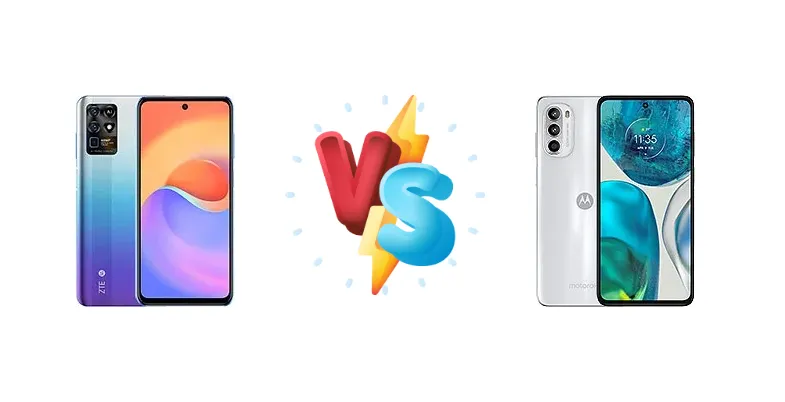
The ZTE S30 SE and Motorola Moto G52 represent compelling options in the crowded budget smartphone market. While both aim to deliver essential features at an accessible price, they take different approaches to achieving this. The S30 SE leverages Mediatek's 7nm Dimensity 700, prioritizing 5G connectivity, while the Moto G52 opts for Qualcomm's more efficient 6nm Snapdragon 680, focusing on optimized power consumption and faster charging.
🏆 Quick Verdict
For the average user prioritizing all-day battery life and faster charging, the Motorola Moto G52 is the better choice. Its Snapdragon 680 chipset, coupled with 30W charging, provides a smoother experience and less downtime. However, the ZTE S30 SE offers 5G connectivity for those who need it.
| Network |
|---|
| 2G bands | GSM 850 / 900 / 1800 / 1900 | GSM 850 / 900 / 1800 / 1900 |
| 3G bands | HSDPA 850 / 900 / 1900 / 2100 | HSDPA 850 / 900 / 1700(AWS) / 1900 / 2100 |
| 4G bands | 1, 3, 5, 7, 8, 34, 38, 39, 40, 41 | LTE |
| 5G bands | 1, 28, 41, 78 SA/NSA | - |
| Speed | HSPA, LTE, 5G | HSPA, LTE |
| Technology | GSM / HSPA / LTE / 5G | GSM / HSPA / LTE |
| Launch |
|---|
| Announced | 2021, March 31 | 2022, April 12 |
| Status | Available. Released 2021, April 03 | Available. Released 2022, April 20 |
| Body |
|---|
| Dimensions | 165.8 x 77 x 9.6 mm (6.53 x 3.03 x 0.38 in) | 160.1 x 74.5 x 8 mm (6.30 x 2.93 x 0.31 in) |
| SIM | Nano-SIM + Nano-SIM | Nano-SIM + Nano-SIM |
| Weight | 210 g (7.41 oz) | 169 g (5.96 oz) |
| | - | Water-repellent design |
| Display |
|---|
| Resolution | 1080 x 2400 pixels, 20:9 ratio (~395 ppi density) | 1080 x 2400 pixels, 20:9 ratio (~402 ppi density) |
| Size | 6.67 inches, 107.4 cm2 (~84.1% screen-to-body ratio) | 6.6 inches, 103.6 cm2 (~86.9% screen-to-body ratio) |
| Type | IPS LCD | AMOLED, 90Hz |
| Platform |
|---|
| CPU | Octa-core (2x2.2 GHz Cortex-A76 & 6x2.0 GHz Cortex-A55) | Octa-core (4x2.4 GHz Kryo 265 Gold & 4x1.9 GHz Kryo 265 Silver) |
| Chipset | Mediatek Dimensity 700 (7 nm) | Qualcomm SM6225 Snapdragon 680 4G (6 nm) |
| GPU | Mali-G57 MC2 | Adreno 610 |
| OS | Android 11, MyOS 11 | Android 12, planned upgrade to Android 13 |
| Memory |
|---|
| Card slot | No | microSDXC (uses shared SIM slot) |
| Internal | 128GB 6GB RAM | 64GB 4GB RAM, 128GB 4GB RAM, 128GB 6GB RAM, 256GB 6GB RAM |
| Main Camera |
|---|
| Features | LED flash, HDR, panorama | LED flash, HDR, panorama |
| Quad | 48 MP, f/1.8, 26mm (wide), PDAF
5 MP (macro)
Auxiliary lens | - |
| Single | 8 MP | - |
| Triple | - | 50 MP, f/1.8 (wide), 1/2.76", 0.64µm, PDAF
8 MP, f/2.2, 118˚ (ultrawide), 1/4.0", 1.12µm
2 MP (macro) |
| Video | 1080p@30fps, gyro-EIS | 1080p@30fps |
| Selfie camera |
|---|
| Features | HDR | - |
| Single | 8 MP | 16 MP, f/2.5, (wide), 1.0µm |
| Video | 1080p@30fps | 1080p@30fps |
| Sound |
|---|
| 3.5mm jack | Yes | Yes |
| 35mm jack | Yes | Yes |
| Loudspeaker | Yes | Yes, with stereo speakers |
| Comms |
|---|
| Bluetooth | 5.1, A2DP, LE | 5.0, A2DP, LE |
| NFC | No | Yes (market/region dependent) |
| Positioning | GPS, BDS | GPS, GLONASS, GALILEO |
| Radio | No | Unspecified |
| USB | USB Type-C 2.0, OTG | USB Type-C 2.0 |
| WLAN | Wi-Fi 802.11 a/b/g/n/ac, dual-band, Wi-Fi Direct | Wi-Fi 802.11 a/b/g/n/ac, dual-band, Wi-Fi Direct |
| Features |
|---|
| Sensors | Fingerprint (side-mounted), accelerometer, gyro, proximity, compass | Fingerprint (side-mounted), accelerometer, gyro, proximity, compass |
| Battery |
|---|
| Charging | 18W wired | 30W wired |
| Type | Li-Po 6000 mAh | Li-Po 5000 mAh |
| Misc |
|---|
| Colors | Black, Blue | Charcoal Gray, Porcelain White |
| Models | 8030N | XT2221-1, XT2221-2 |
| Price | About 220 EUR | About 470 EUR |
ZTE S30 SE
- 5G Connectivity: Offers faster data speeds where available.
- Potentially Lower Price: ZTE often targets the ultra-budget segment.
- Decent Performance for Basic Tasks: The Dimensity 700 is capable for everyday use.
- Slower Charging: 18W charging is significantly slower than the Moto G52.
- Less Efficient Chipset: The 7nm Dimensity 700 consumes more power.
Motorola Moto G52
- Faster Charging: 30W charging significantly reduces downtime.
- More Efficient Chipset: The 6nm Snapdragon 680 offers better battery life.
- Refined Image Processing: Snapdragon ISP generally delivers better photo quality.
- Lacks 5G Connectivity: Limited to 4G LTE.
- Potentially Higher Price: Motorola often positions its devices slightly higher.
Display Comparison
Neither ZTE nor Motorola provide display specifications beyond the basic resolution. However, the choice of chipsets hints at display priorities. The Snapdragon 680's ISP is optimized for efficient image processing, suggesting the Moto G52 may offer slightly better color accuracy and dynamic range. Bezels are likely comparable given the price points, and both will likely utilize IPS LCD panels, lacking the vibrancy of OLED displays found in higher-end devices.
Camera Comparison
Detailed camera specs are unavailable, but we can infer some differences. The Snapdragon 680’s image signal processor (ISP) is generally regarded as more refined for computational photography, potentially leading to better low-light performance and dynamic range in the Moto G52. Both phones likely feature a primary camera and depth/macro sensors, but the quality of these secondary sensors will likely be minimal on both devices. Without knowing sensor sizes or apertures, it’s difficult to definitively declare a winner, but the Snapdragon 680’s processing capabilities give the Moto G52 a slight edge.
Performance
The core difference lies in the chipsets. The Mediatek Dimensity 700 (7nm) in the ZTE S30 SE features a 2x2.2 GHz Cortex-A76 and 6x2.0 GHz Cortex-A55 configuration. The Motorola Moto G52’s Qualcomm Snapdragon 680 (6nm) boasts a 4x2.4 GHz Kryo 265 Gold and 4x1.9 GHz Kryo 265 Silver setup. While the Snapdragon 680 has a higher peak clock speed on its performance cores, the 6nm process node provides a significant efficiency advantage. This translates to less heat generation under sustained load, potentially reducing throttling during gaming or demanding tasks. The Dimensity 700's strength is its integrated 5G modem, offering connectivity the Snapdragon 680 lacks.
Battery Life
Battery capacity is not specified for either device. However, the Snapdragon 680’s 6nm process is significantly more power-efficient than the Dimensity 700’s 7nm node. This efficiency, combined with the Moto G52’s 30W wired charging, provides a clear advantage. The ZTE S30 SE is limited to 18W charging, meaning a full charge will take considerably longer. While a larger battery in the S30 SE could partially offset the efficiency difference, the faster charging of the Moto G52 is a significant convenience factor.
Buying Guide
Buy the ZTE S30 SE if you absolutely require 5G connectivity on a tight budget and are willing to compromise on charging speed and potentially battery life. Buy the Motorola Moto G52 if you prioritize a more efficient processor, faster 30W charging, and a generally smoother user experience, even if it means missing out on 5G.
Frequently Asked Questions
❓ Will the ZTE S30 SE overheat during prolonged gaming sessions?
The Mediatek Dimensity 700, being a 7nm chip, is prone to more heat generation than the Snapdragon 680. While it can handle casual gaming, extended sessions with graphically demanding titles may lead to noticeable throttling and reduced performance. The Moto G52's 6nm Snapdragon 680 will likely maintain more consistent performance over longer periods.
❓ Is the 30W charging on the Moto G52 significantly faster than the 18W charging on the ZTE S30 SE?
Yes, the difference is substantial. 30W charging will allow the Moto G52 to charge from 0-100% in approximately 60-75 minutes, while the ZTE S30 SE’s 18W charging will likely take over 90-120 minutes. This faster charging is a significant convenience factor for users who need to quickly top up their battery.
❓ Does the lack of 5G on the Moto G52 matter for most users?
For many users, the answer is no. 5G coverage is still limited in many areas, and 4G LTE provides sufficient speeds for most everyday tasks. Unless you live in an area with widespread 5G coverage and frequently download large files or stream high-resolution video, the lack of 5G on the Moto G52 won't be a significant drawback.