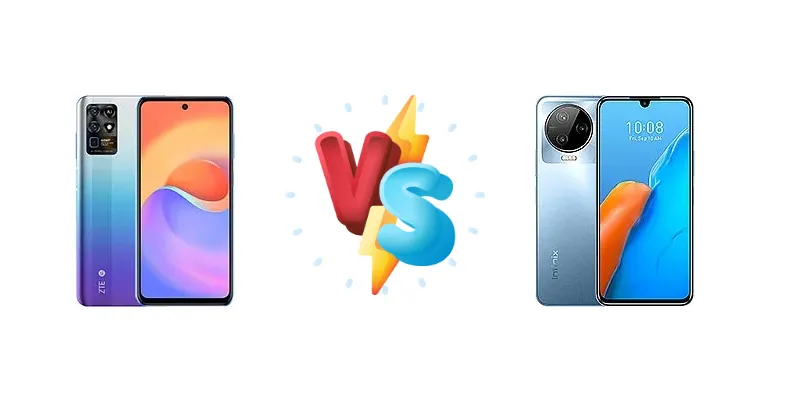
The ZTE S30 SE and Infinix Note 12 Pro represent compelling options in the crowded budget smartphone market. Both leverage Mediatek's chipset expertise, but employ different approaches to performance and features. This comparison dissects the key differences between the Dimensity 700-powered ZTE S30 SE and the Helio G99-equipped Infinix Note 12 Pro, helping you determine which device best suits your needs.
🏆 Quick Verdict
For the average user prioritizing faster charging and potentially slightly better efficiency, the Infinix Note 12 Pro emerges as the winner. Its 33W charging significantly reduces downtime compared to the ZTE S30 SE's 18W. While both share the same CPU core configuration, the Helio G99's 6nm process gives it a slight edge.
| Network |
|---|
| 2G bands | GSM 850 / 900 / 1800 / 1900 | GSM 850 / 900 / 1800 / 1900 |
| 3G bands | HSDPA 850 / 900 / 1900 / 2100 | HSDPA 850 / 900 / 1700(AWS) / 1900 / 2100 |
| 4G bands | 1, 3, 5, 7, 8, 34, 38, 39, 40, 41 | 1, 2, 3, 4, 5, 7, 8, 20, 28, 38, 40, 41 |
| 5G bands | 1, 28, 41, 78 SA/NSA | - |
| Speed | HSPA, LTE, 5G | HSPA, LTE |
| Technology | GSM / HSPA / LTE / 5G | GSM / HSPA / LTE |
| Launch |
|---|
| Announced | 2021, March 31 | 2022, July 16 |
| Status | Available. Released 2021, April 03 | Available. Released 2022, July 18 |
| Body |
|---|
| Build | - | Glass front, plastic frame, plastic back |
| Dimensions | 165.8 x 77 x 9.6 mm (6.53 x 3.03 x 0.38 in) | 164.4 x 76.5 x 7.8 mm (6.47 x 3.01 x 0.31 in) |
| SIM | Nano-SIM + Nano-SIM | Nano-SIM + Nano-SIM |
| Weight | 210 g (7.41 oz) | 192 g (6.77 oz) |
| Display |
|---|
| Resolution | 1080 x 2400 pixels, 20:9 ratio (~395 ppi density) | 1080 x 2400 pixels, 20:9 ratio (~393 ppi density) |
| Size | 6.67 inches, 107.4 cm2 (~84.1% screen-to-body ratio) | 6.7 inches, 108.4 cm2 (~86.2% screen-to-body ratio) |
| Type | IPS LCD | AMOLED |
| Platform |
|---|
| CPU | Octa-core (2x2.2 GHz Cortex-A76 & 6x2.0 GHz Cortex-A55) | Octa-core (2x2.2 GHz Cortex-A76 & 6x2.0 GHz Cortex-A55) |
| Chipset | Mediatek Dimensity 700 (7 nm) | Mediatek Helio G99 (6 nm) |
| GPU | Mali-G57 MC2 | Mali-G57 MC2 |
| OS | Android 11, MyOS 11 | Android 12, XOS 10.6 |
| Memory |
|---|
| Card slot | No | microSDXC (dedicated slot) |
| Internal | 128GB 6GB RAM | 256GB 8GB RAM |
| Main Camera |
|---|
| Features | LED flash, HDR, panorama | Quad-LED flash, HDR, panorama |
| Quad | 48 MP, f/1.8, 26mm (wide), PDAF
5 MP (macro)
Auxiliary lens | - |
| Single | 8 MP | - |
| Triple | - | 108 MP, f/1.8, (wide), 1/1.67", PDAF
Auxiliary lenses |
| Video | 1080p@30fps, gyro-EIS | 1440p@30fps |
| Selfie camera |
|---|
| Features | HDR | Dual-LED flash |
| Single | 8 MP | 16 MP, f/2.0, (wide) |
| Video | 1080p@30fps | 1440p@30fps |
| Sound |
|---|
| 3.5mm jack | Yes | Yes |
| 35mm jack | Yes | Yes |
| Loudspeaker | Yes | Yes, with dual speakers |
| Comms |
|---|
| Bluetooth | 5.1, A2DP, LE | Yes |
| NFC | No | Yes |
| Positioning | GPS, BDS | GPS |
| Radio | No | FM radio |
| USB | USB Type-C 2.0, OTG | USB Type-C 2.0, OTG |
| WLAN | Wi-Fi 802.11 a/b/g/n/ac, dual-band, Wi-Fi Direct | Yes |
| Features |
|---|
| Sensors | Fingerprint (side-mounted), accelerometer, gyro, proximity, compass | Fingerprint (side-mounted), accelerometer, proximity, gyro, compass |
| Battery |
|---|
| Charging | 18W wired | 33W wired |
| Type | Li-Po 6000 mAh | 5000 mAh |
| Misc |
|---|
| Colors | Black, Blue | Volcanic Grey, Tuscany Blue, Alpine White |
| Models | 8030N | X676B |
| Price | About 220 EUR | About 420 EUR |
ZTE S30 SE
- Potentially lower price point
- Reliable Mediatek Dimensity 700 chipset
- Solid performance for everyday tasks
- Slower 18W charging
- Less efficient 7nm process
- Likely older software version
Infinix Note 12 Pro
- Faster 33W charging
- More efficient 6nm Helio G99 chipset
- Potentially better sustained performance
- May be slightly more expensive
- Performance gains over Dimensity 700 are modest
- Software experience may vary
Display Comparison
Neither device's display specifications are provided, so a direct comparison is limited. However, given the price bracket, both likely utilize LCD panels. The Infinix Note 12 Pro, being a newer model, *may* benefit from improved color calibration or slightly higher peak brightness. Bezels are likely comparable, and both will likely target a 60Hz refresh rate to conserve battery life.
Camera Comparison
Without detailed camera specifications, a precise comparison is difficult. However, the market segment suggests both phones will feature a multi-camera setup with a primary sensor, an ultrawide, and potentially a depth or macro lens. The Infinix Note 12 Pro, being a newer device, *may* incorporate a larger primary sensor or improved image processing algorithms. The presence or absence of Optical Image Stabilization (OIS) would be a significant advantage for the device that includes it, particularly in low-light conditions. We can assume both will offer acceptable image quality for social media sharing, but won't compete with flagship-level camera performance.
Performance
Both the ZTE S30 SE and Infinix Note 12 Pro utilize an octa-core CPU configuration with 2x2.2 GHz Cortex-A76 cores and 6x2.0 GHz Cortex-A55 cores. The key differentiator lies in the chipset fabrication process: the ZTE S30 SE uses the 7nm Dimensity 700, while the Infinix Note 12 Pro employs the more efficient 6nm Helio G99. This 6nm process generally translates to lower power consumption at the same performance level, or higher sustained performance before thermal throttling. While the CPU cores are identical, the Helio G99's GPU is likely to offer a modest performance advantage in gaming scenarios.
Battery Life
Battery capacity isn't specified for either device, but the charging wattage is a clear differentiator. The Infinix Note 12 Pro's 33W wired charging is significantly faster than the ZTE S30 SE's 18W. This means the Infinix Note 12 Pro will achieve a full charge in considerably less time, a crucial benefit for users who frequently need to top up their battery. Even with a similar battery capacity, the 6nm Helio G99 in the Infinix Note 12 Pro may offer slightly better battery life due to its improved efficiency.
Buying Guide
Buy the ZTE S30 SE if you prioritize a potentially lower price point and are comfortable with slower charging speeds. It's a solid choice for basic smartphone tasks and light usage. Buy the Infinix Note 12 Pro if you value faster charging, potentially better sustained performance due to the 6nm process, and are willing to spend a little more for those benefits. It's better suited for users who frequently game or stream content.
Frequently Asked Questions
❓ Will the Helio G99 in the Infinix Note 12 Pro handle demanding games like PUBG Mobile smoothly?
The Helio G99 is capable of running PUBG Mobile, but expect to use medium graphics settings for a consistently smooth experience. The 6nm process should help mitigate thermal throttling during extended gaming sessions, but it won't match the performance of flagship-level chipsets.
❓ How long will it take to fully charge the ZTE S30 SE with the 18W charger?
With an 18W charger, expect the ZTE S30 SE to take approximately 2.5 to 3.5 hours to fully charge from 0% to 100%, depending on battery capacity. This is considerably slower than the Infinix Note 12 Pro's 33W charging.
❓ Does the difference between the 7nm and 6nm process significantly impact real-world battery life?
While not a massive difference, the 6nm process of the Helio G99 in the Infinix Note 12 Pro generally results in lower power consumption compared to the 7nm Dimensity 700. This translates to potentially 5-10% longer battery life under similar usage conditions.