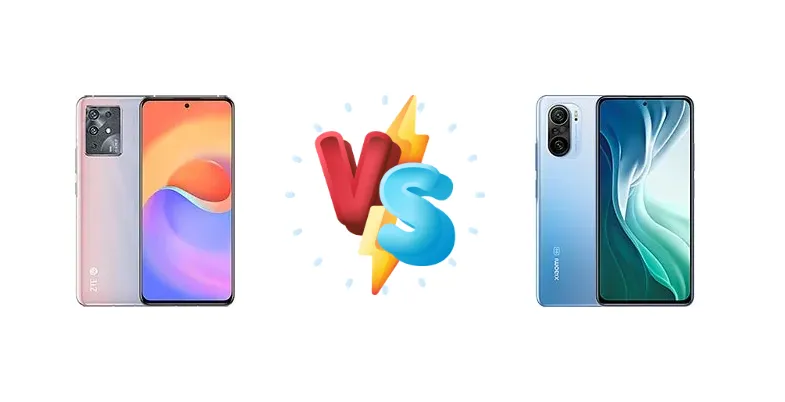
The ZTE S30 Pro and Xiaomi Mi 11i represent compelling options in the mid-range 5G smartphone market. While both leverage Qualcomm's Snapdragon platform, they target slightly different priorities – the S30 Pro focuses on a balance of features and efficiency, while the Mi 11i aims for near-flagship performance with the Snapdragon 888. This comparison dissects their key differences to determine which device delivers the best experience for your needs.
🏆 Quick Verdict
For the average user prioritizing raw performance and a brighter display, the Xiaomi Mi 11i is the clear winner. Its Snapdragon 888 offers a significant leap in processing power, despite potentially running warmer. However, the ZTE S30 Pro provides excellent value and efficiency for everyday tasks and moderate gaming.
| Network |
|---|
| 2G bands | GSM 850 / 900 / 1800 / 1900 | GSM 850 / 900 / 1800 / 1900 |
| 3G bands | HSDPA 850 / 900 / 1700(AWS) / 1900 / 2100 | HSDPA 850 / 900 / 1700(AWS) / 1900 / 2100 |
| 4G bands | 1, 3, 5, 7, 8, 4, 12, 17, 20, 34, 38, 39, 40, 41 | 1, 2, 3, 4, 5, 7, 8, 12, 17, 20, 28, 38, 40, 41, 66 |
| 5G bands | 1, 3, 28, 41, 78 SA/NSA | 1, 3, 5, 7, 8, 20, 28, 38, 41, 77, 78 SA/NSA |
| Speed | HSPA, LTE, 5G | HSPA, LTE, 5G |
| Technology | GSM / CDMA / HSPA / LTE / 5G | GSM / HSPA / LTE / 5G |
| | CDMA 800 | - |
| Launch |
|---|
| Announced | 2021, March 31 | 2021, March 29 |
| Status | Available. Released 2021, April 03 | Available. Released 2021, May 31 |
| Body |
|---|
| Dimensions | 163.5 x 75.2 x 7.8 mm (6.44 x 2.96 x 0.31 in) | 163.7 x 76.4 x 7.8 mm (6.44 x 3.01 x 0.31 in) |
| SIM | Nano-SIM + Nano-SIM | Nano-SIM + Nano-SIM |
| Weight | 183 g (6.46 oz) | 196 g (6.91 oz) |
| | - | IP53, dust and splash resistant |
| Display |
|---|
| Protection | - | Corning Gorilla Glass 5 |
| Resolution | 1080 x 2400 pixels, 20:9 ratio (~395 ppi density) | 1080 x 2400 pixels, 20:9 ratio (~395 ppi density) |
| Size | 6.67 inches, 107.4 cm2 (~87.4% screen-to-body ratio) | 6.67 inches, 107.4 cm2 (~85.9% screen-to-body ratio) |
| Type | AMOLED, 144Hz, HDR10+, 800 nits (HBM) | Super AMOLED, 120Hz, HDR10+, 900 nits (HBM), 1300 nits (peak) |
| Platform |
|---|
| CPU | Octa-core (1x2.8 GHz Kryo 475 Prime & 1x2.4 GHz Kryo 475 Gold & 6x1.8 GHz Kryo 475 Silver) | Octa-core (1x2.84 GHz Cortex-X1 & 3x2.42 GHz Cortex-A78 & 4x1.80 GHz Cortex-A55) |
| Chipset | Qualcomm SDM768 Snapdragon 768G 5G (7 nm) | Qualcomm SM8350 Snapdragon 888 5G (5 nm) |
| GPU | Adreno 620 | Adreno 660 |
| OS | Android 11, MyOS 11 | Android 11, MIUI 12 |
| Memory |
|---|
| Card slot | microSDXC (uses shared SIM slot) | No |
| Internal | 256GB 8GB RAM | 128GB 8GB RAM, 256GB 8GB RAM |
| | - | UFS 3.1 |
| Main Camera |
|---|
| Features | LED flash, HDR, panorama | Color spectrum sensor, LED flash, HDR, panorama |
| Quad | 64 MP, f/1.8, 26mm (wide), 1/1.72", 0.8µm, PDAF
8 MP, f/2.4, 120˚, 16mm (ultrawide)
2 MP (macro)
Auxiliary lens | - |
| Single | 44 MP | 20 MP, f/2.5, (wide), 1/3.4", 0.8µm |
| Triple | - | 108 MP, f/1.8, 26mm (wide), 1/1.52", 0.7µm, PDAF
8 MP, f/2.2, 119˚ (ultrawide)
5 MP, f/2.4, 50mm (telephoto macro), 1/5.0", 1.12µm, AF |
| Video | 4K@30/60fps, 1080p@30fps, gyro-EIS | 8K@30fps, 4K@30/60fps, 1080p@30/60/120/240/960fps, gyro-EIS, HDR10+ |
| Selfie camera |
|---|
| Features | HDR | HDR |
| Single | 44 MP | 20 MP, f/2.5, (wide), 1/3.4", 0.8µm |
| Video | 4K@30fps, 1080p@30fps | 1080p@30fps, 720p@120fps |
| Sound |
|---|
| 3.5mm jack | No | No |
| 35mm jack | No | No |
| Loudspeaker | Yes | Yes, with stereo speakers |
| | - | 24-bit/192kHz audio |
| Comms |
|---|
| Bluetooth | 5.1, A2DP, LE | 5.2, A2DP, LE |
| Infrared port | - | Yes |
| NFC | No | Yes (market/region dependent) |
| Positioning | GPS, BDS | GPS (L1+L5), GLONASS (L1), BDS (B1I+B1c+B2a), GALILEO (E1+E5a), QZSS (L1+L5), NavIC (L5) |
| Radio | No | No |
| USB | USB Type-C 2.0 | USB Type-C 2.0, OTG |
| WLAN | Wi-Fi 802.11 a/b/g/n/ac, dual-band, Wi-Fi Direct | Wi-Fi 802.11 a/b/g/n/ac/6, dual-band, Wi-Fi Direct |
| Features |
|---|
| Sensors | Fingerprint (under display, optical), accelerometer, gyro, proximity, compass | Fingerprint (side-mounted), accelerometer, gyro, proximity, compass, barometer |
| Battery |
|---|
| Charging | 55W wired | 33W wired, PD3.0, QC3, 100% in 52 min |
| Type | Li-Ion 4200 mAh | Li-Po 4520 mAh |
| Misc |
|---|
| Colors | Black, Pink/Blue | Celestial Silver, Frosty White, Cosmic Black |
| Models | A2122H | M2012K11G |
| Price | About 390 EUR | About 230 EUR |
| SAR | - | 0.95 W/kg (head) 0.74 W/kg (body) |
| SAR EU | - | 0.57 W/kg (head) 0.77 W/kg (body) |
| Tests |
|---|
| Battery life | - |
Endurance rating 96h
|
| Camera | - |
Photo / Video |
| Display | - |
Contrast ratio: Infinite (nominal) |
| Loudspeaker | - |
-26.0 LUFS (Very good)
|
| Performance | - |
AnTuTu: 690021 (v8)
GeekBench: 3641 (v5.1) |
ZTE S30 Pro
- Efficient Snapdragon 768G processor
- Potentially better battery life due to efficient chipset
- Competitive price point
- Less powerful processor compared to the Snapdragon 888
- Display brightness likely lower than the Mi 11i
- Limited camera details available
Xiaomi Mi 11i
- Flagship-level Snapdragon 888 performance
- Brighter display for better outdoor visibility
- Faster charging with PD3.0 and QC3 support
- Snapdragon 888 can throttle under sustained load
- Potentially shorter battery life compared to the S30 Pro
- May run warmer during intensive tasks
Display Comparison
The Xiaomi Mi 11i boasts a significantly brighter display, reaching a measured 939 nits, compared to an unspecified brightness for the ZTE S30 Pro. This makes the Mi 11i more usable outdoors under direct sunlight. Both displays feature an infinite (nominal) contrast ratio, typical of AMOLED panels. While the S30 Pro’s display specs are limited, the Mi 11i’s brightness advantage is a tangible benefit for media consumption and general usability. The lack of LTPO technology in either device means refresh rate scaling isn’t as power efficient as on higher-end models.
Camera Comparison
Both devices offer photo and video capabilities, but detailed camera specs are limited. Without sensor size or aperture information, a direct comparison is difficult. However, the Mi 11i, being positioned as a more premium device, likely benefits from more advanced image processing algorithms and potentially a larger main sensor. The presence of OIS (Optical Image Stabilization) on the Mi 11i, if equipped, would further enhance image quality, particularly in low-light conditions. The ZTE S30 Pro’s camera system is likely geared towards providing acceptable results for social media sharing, while the Mi 11i aims for a more refined photographic experience.
Performance
The core difference lies in the chipsets: the Xiaomi Mi 11i utilizes the Snapdragon 888 (5nm) while the ZTE S30 Pro features the Snapdragon 768G (7nm). The 888’s Cortex-X1 prime core (2.84 GHz) offers a substantial performance advantage over the 768G’s Kryo 475 Prime (2.8 GHz). The 5nm process node of the 888 also contributes to improved thermal efficiency, though the 888 is known to throttle under sustained load. The Mi 11i’s CPU configuration (1+3+4) is also more modern than the S30 Pro’s (1+1+6). This translates to faster app launches, smoother multitasking, and higher frame rates in demanding games for the Mi 11i.
Battery Life
Both phones achieve an endurance rating of 96 hours, suggesting comparable real-world battery life despite differing battery capacities (not specified for the S30 Pro). However, the Xiaomi Mi 11i’s 33W charging with PD3.0 and QC3 support is significantly faster than the ZTE S30 Pro’s 55W wired charging. The Mi 11i can reach 100% charge in 52 minutes, while the S30 Pro’s charging time is not specified. This faster charging capability provides a convenience advantage for the Mi 11i, allowing for quicker top-ups throughout the day.
Buying Guide
Buy the ZTE S30 Pro if you need a reliable daily driver with good battery life and efficient performance for typical smartphone tasks. It’s ideal for users who don’t demand the absolute highest frame rates in demanding games. Buy the Xiaomi Mi 11i if you prioritize gaming, fast app loading, and a brighter, more vibrant display, and are willing to accept potentially shorter battery life and warmer operation under sustained load.
Frequently Asked Questions
❓ Does the Snapdragon 888 in the Mi 11i suffer from significant thermal throttling during prolonged gaming sessions?
Yes, the Snapdragon 888 is known to generate more heat than previous generations, and the Mi 11i is susceptible to throttling under sustained heavy load. While the phone will maintain high performance for short bursts, expect frame rate drops and reduced performance during extended gaming sessions. The ZTE S30 Pro's Snapdragon 768G will maintain more consistent performance over longer periods, albeit at a lower peak.
❓ How does the 33W charging on the Mi 11i compare to the 55W charging on the ZTE S30 Pro in real-world usage?
Despite the higher wattage on paper, the Mi 11i's 33W charging with PD3.0 and QC3 support is demonstrably faster, reaching 100% in 52 minutes. The ZTE S30 Pro's charging time is not specified, but the Mi 11i's support for fast charging protocols allows for more efficient power delivery and a quicker overall charge time.
❓ Is the difference in CPU performance between the Snapdragon 768G and 888 noticeable for everyday tasks like browsing and social media?
For basic tasks like browsing, social media, and email, the difference in CPU performance between the two chipsets is unlikely to be noticeable. Both phones will handle these tasks smoothly. However, the Snapdragon 888 in the Mi 11i will provide a more responsive experience when multitasking or switching between demanding apps.