
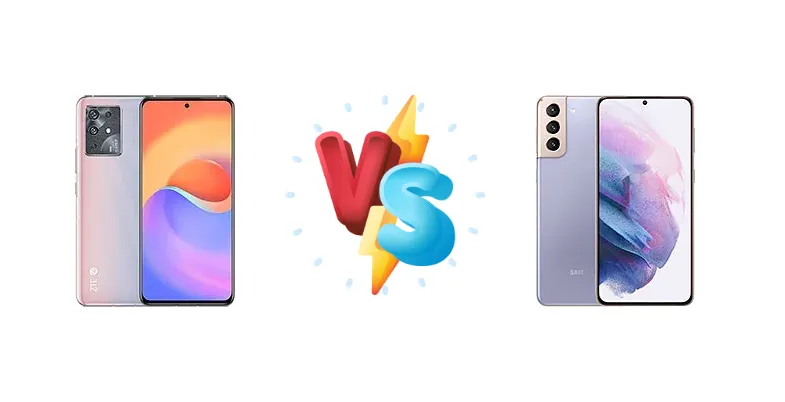
ZTE S30 Pro vs. Samsung Galaxy S21+ 5G: A Detailed Comparison of Mid-Range Power and Flagship Performance
| Phones Images | |||||
|---|---|---|---|---|---|
|
🏆 Quick Verdict
For the average user prioritizing raw performance and a more refined software experience, the Samsung Galaxy S21+ 5G is the better choice. However, the ZTE S30 Pro’s significantly faster 55W charging and lower price make it a strong contender for budget-conscious buyers who don't demand the absolute best in processing power.
| PHONES | ||
|---|---|---|
| Phone Names | ZTE S30 Pro | Samsung Galaxy S21+ 5G |
| Network | ||
|---|---|---|
| 2G bands | GSM 850 / 900 / 1800 / 1900 | GSM 850 / 900 / 1800 / 1900 |
| 3G bands | HSDPA 850 / 900 / 1700(AWS) / 1900 / 2100 | HSDPA 850 / 900 / 1700(AWS) / 1900 / 2100 |
| 4G bands | 1, 3, 5, 7, 8, 4, 12, 17, 20, 34, 38, 39, 40, 41 | 1, 2, 3, 4, 5, 7, 8, 12, 13, 14, 18, 19, 20, 25, 26, 28, 30, 38, 39, 40, 41, 46, 48, 66, 71 - SM-G996U1 |
| 5G bands | 1, 3, 28, 41, 78 SA/NSA | 2, 5, 25, 41, 66, 71, 260, 261 SA/NSA/Sub6/mmWave - SM-G996U1 |
| Speed | HSPA, LTE, 5G | HSPA 42.2/5.76 Mbps, LTE (7CA) Cat20 2000/200 Mbps, 5G (5+ Gbps DL) |
| Technology | GSM / CDMA / HSPA / LTE / 5G | GSM / CDMA / HSPA / EVDO / LTE / 5G |
| CDMA 800 | 1, 3, 5, 7, 8, 20, 28, 38, 40, 41, 66, 77, 78 SA/NSA/Sub6 - SM-G996B | |
| Launch | ||
|---|---|---|
| Announced | 2021, March 31 | 2021, January 14 |
| Status | Available. Released 2021, April 03 | Available. Released 2021, January 29 |
| Body | ||
|---|---|---|
| Build | - | Glass front (Gorilla Glass Victus), glass back (Gorilla Glass Victus), aluminum frame |
| Dimensions | 163.5 x 75.2 x 7.8 mm (6.44 x 2.96 x 0.31 in) | 161.5 x 75.6 x 7.8 mm (6.36 x 2.98 x 0.31 in) |
| SIM | Nano-SIM + Nano-SIM | · Nano-SIM + eSIM· Nano-SIM + Nano-SIM + eSIM (max 2 at a time) |
| Weight | 183 g (6.46 oz) | 200 g (Sub6), 202 g (mmWave) (7.05 oz) |
| - | IP68 dust/water resistant (up to 1.5m for 30 min) | |
| Display | ||
|---|---|---|
| Protection | - | Corning Gorilla Glass Victus |
| Resolution | 1080 x 2400 pixels, 20:9 ratio (~395 ppi density) | 1080 x 2400 pixels, 20:9 ratio (~394 ppi density) |
| Size | 6.67 inches, 107.4 cm2 (~87.4% screen-to-body ratio) | 6.7 inches, 107.8 cm2 (~88.3% screen-to-body ratio) |
| Type | AMOLED, 144Hz, HDR10+, 800 nits (HBM) | Dynamic AMOLED 2X, 120Hz, HDR10+, 1300 nits (peak) |
| - | Always-on display | |
| Platform | ||
|---|---|---|
| CPU | Octa-core (1x2.8 GHz Kryo 475 Prime & 1x2.4 GHz Kryo 475 Gold & 6x1.8 GHz Kryo 475 Silver) | Octa-core (1x2.9 GHz Cortex-X1 & 3x2.80 GHz Cortex-A78 & 4x2.2 GHz Cortex-A55) - InternationalOcta-core (1x2.84 GHz Cortex-X1 & 3x2.42 GHz Cortex-A78 & 4x1.80 GHz Cortex-A55) - USA/China |
| Chipset | Qualcomm SDM768 Snapdragon 768G 5G (7 nm) | Exynos 2100 (5 nm) - InternationalQualcomm SM8350 Snapdragon 888 5G (5 nm) - USA/China |
| GPU | Adreno 620 | Mali-G78 MP14 - InternationalAdreno 660 - USA/China |
| OS | Android 11, MyOS 11 | Android 11, up to 4 major Android upgrades, One UI 6.1 |
| Memory | ||
|---|---|---|
| Card slot | microSDXC (uses shared SIM slot) | No |
| Internal | 256GB 8GB RAM | 128GB 8GB RAM, 256GB 8GB RAM |
| - | UFS 3.1 | |
| Main Camera | ||
|---|---|---|
| Features | LED flash, HDR, panorama | LED flash, auto-HDR, panorama |
| Quad | 64 MP, f/1.8, 26mm (wide), 1/1.72", 0.8µm, PDAF 8 MP, f/2.4, 120˚, 16mm (ultrawide) 2 MP (macro) Auxiliary lens | - |
| Single | 44 MP | - |
| Triple | - | 12 MP, f/1.8, 26mm (wide), 1/1.76", 1.8µm, dual pixel PDAF, OIS 64 MP, f/2.0, 29mm (telephoto), 1/1.72", 0.8µm, PDAF, OIS, 1.1x optical zoom, 3x hybrid zoom 12 MP, f/2.2, 13mm, 120˚ (ultrawide), 1/2.55" 1.4µm, Super Steady video |
| Video | 4K@30/60fps, 1080p@30fps, gyro-EIS | 8K@24fps, 4K@30/60fps, 1080p@30/60/120/240fps, HDR10+, stereo sound rec., gyro-EIS |
| Selfie camera | ||
|---|---|---|
| Features | HDR | HDR |
| Single | 44 MP | 10 MP, f/2.2, 26mm (wide), 1/3.24", 1.22µm, dual pixel PDAF |
| Video | 4K@30fps, 1080p@30fps | 4K@30/60fps, 1080p@30fps |
| Sound | ||
|---|---|---|
| 3.5mm jack | No | No |
| 35mm jack | No | No |
| Loudspeaker | Yes | Yes, with stereo speakers |
| - | 32-bit/384kHz audio Tuned by AKG | |
| Comms | ||
|---|---|---|
| Bluetooth | 5.1, A2DP, LE | 5.0, A2DP, LE |
| NFC | No | Yes |
| Positioning | GPS, BDS | GPS, GLONASS, BDS, GALILEO |
| Radio | No | FM radio (Snapdragon model only; market/operator dependent) |
| USB | USB Type-C 2.0 | USB Type-C 3.2, OTG |
| WLAN | Wi-Fi 802.11 a/b/g/n/ac, dual-band, Wi-Fi Direct | Wi-Fi 802.11 a/b/g/n/ac/6, dual-band, Wi-Fi Direct |
| Features | ||
|---|---|---|
| Sensors | Fingerprint (under display, optical), accelerometer, gyro, proximity, compass | Fingerprint (under display, ultrasonic), accelerometer, gyro, proximity, compass, barometer |
| - | Samsung DeX, Samsung Wireless DeX (desktop experience support) Bixby natural language commands and dictation Samsung Pay (Visa, MasterCard certified) Ultra Wideband (UWB) support | |
| Battery | ||
|---|---|---|
| Charging | 55W wired | 25W wired, PD3.0 15W wireless (Qi) 4.5W reverse wireless |
| Type | Li-Ion 4200 mAh | Li-Ion 4800 mAh |
| Misc | ||
|---|---|---|
| Colors | Black, Pink/Blue | Phantom Black, Phantom Silver, Phantom Violet, Phantom Pink, Phantom Gold, Phantom Red |
| Models | A2122H | SM-G996B, SM-G996B/DS, SM-G996U, SM-G996U1, SM-G996W, SM-G996N, SM-G9960 |
| Price | About 390 EUR | $ 162.99 / £ 185.00 / € 199.00 |
| SAR | - | 0.65 W/kg (head) 0.95 W/kg (body) |
| SAR EU | - | 0.54 W/kg (head) 1.33 W/kg (body) |
| Tests | ||
|---|---|---|
| Battery life | - | Endurance rating 114h |
| Camera | - | Photo / Video |
| Display | - | Contrast ratio: Infinite (nominal) |
| Loudspeaker | - | -25.8 LUFS (Very good) |
| Performance | - | AnTuTu: 622276 (v8) GeekBench: 3476 (v5.1) GFXBench: 54fps (ES 3.1 onscreen) |
ZTE S30 Pro
- Significantly faster 55W wired charging
- Lower price point offers excellent value
- Potentially lighter and more compact design (speculation based on market positioning)
- Less powerful Snapdragon 768G processor
- Likely inferior display quality compared to the S21+
- Camera performance likely lags behind the S21+
Samsung Galaxy S21+ 5G
- More powerful Snapdragon 888/Exynos 2100 processor
- Superior display with higher brightness and contrast
- More refined software experience and ecosystem
- Slower 25W wired charging
- Higher price point
- Potential for thermal throttling under sustained load (Exynos variant)
Display Comparison
The Samsung Galaxy S21+ 5G boasts a superior display experience with a measured peak brightness of 883 nits, ensuring excellent visibility even in direct sunlight. While the ZTE S30 Pro’s display specifications are not provided, it’s likely to be lower in peak brightness. The S21+’s ‘Infinite’ contrast ratio suggests a high-quality AMOLED panel, offering deep blacks and vibrant colors. The S21+’s display is also likely to have a variable refresh rate (though not specified in the data), contributing to smoother scrolling and animations, a feature absent from the S30 Pro based on its market positioning.
Camera Comparison
Both devices feature capable camera systems, but the S21+ likely holds an edge due to its flagship status. While both are listed as having 'Photo / Video' capabilities, the S21+ likely benefits from more sophisticated image processing algorithms and potentially larger sensor sizes. The S30 Pro’s camera specs are unknown, but it’s reasonable to assume it won’t match the S21+ in low-light performance or dynamic range. The absence of specific details on the S30 Pro’s camera suggests a focus on affordability rather than cutting-edge imaging technology. The S21+’s OIS (Optical Image Stabilization) will also contribute to sharper photos and smoother videos.
Performance
The core difference lies in the chipsets. The Samsung Galaxy S21+ 5G, depending on the region, utilizes either the Exynos 2100 (5nm) or the Qualcomm Snapdragon 888 5G (5nm). Both are built on a more advanced 5nm process compared to the ZTE S30 Pro’s 7nm Qualcomm Snapdragon 768G. This translates to greater efficiency and higher peak performance for the S21+. The S21+'s CPU configuration, featuring Cortex-X1 cores, provides a significant advantage in single-core performance, crucial for responsive app launches and general usability. The Snapdragon 768G in the S30 Pro is a capable mid-range chip, but it won’t match the S21+ in demanding tasks like graphically intensive games or video rendering. The S21+ also benefits from potentially faster RAM (LPDDR5) compared to the S30 Pro, further enhancing performance.
Battery Life
The Samsung Galaxy S21+ 5G has an endurance rating of 114 hours, indicating solid battery life. While the battery capacity isn’t specified, the endurance rating suggests efficient power management. The ZTE S30 Pro’s battery capacity is also unknown, but its 55W wired charging is a significant advantage over the S21+’s 25W charging. This means the S30 Pro can replenish its battery much faster, potentially mitigating any capacity disadvantage. The S21+ also supports 15W wireless charging and 4.5W reverse wireless charging, features not mentioned for the S30 Pro.
Buying Guide
Buy the ZTE S30 Pro if you need exceptionally fast charging and prioritize value for money, accepting a slight performance trade-off. You'll benefit from quicker top-ups and a lower initial investment. Buy the Samsung Galaxy S21+ 5G if you prefer a more powerful processor for demanding tasks like gaming and video editing, and appreciate the established Samsung ecosystem and software support, even with a slower charging speed.