
Oppo Find X3 Pro vs ZTE S30 Pro: A Detailed Comparison of Flagship Performance and Value
| Phones Images | |||||
|---|---|---|---|---|---|
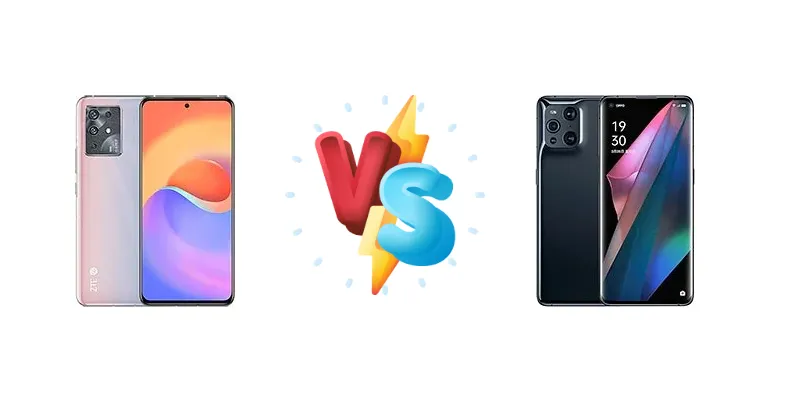
|
🏆 Quick Verdict
For most users, the Oppo Find X3 Pro is the superior choice. Its Snapdragon 888 chipset provides significantly more processing power, translating to smoother multitasking and gaming. While the ZTE S30 Pro offers respectable performance, the X3 Pro’s faster charging and potentially superior camera experience justify the price difference.
| PHONES | ||
|---|---|---|
| Phone Names | ZTE S30 Pro | Oppo Find X3 Pro |
| Network | ||
|---|---|---|
| 2G bands | GSM 850 / 900 / 1800 / 1900 | GSM 850 / 900 / 1800 / 1900 |
| 3G bands | HSDPA 850 / 900 / 1700(AWS) / 1900 / 2100 | HSDPA 800 / 850 / 900 / 1700(AWS) / 1900 / 2100 |
| 4G bands | 1, 3, 5, 7, 8, 4, 12, 17, 20, 34, 38, 39, 40, 41 | 1, 2, 3, 4, 5, 7, 8, 12, 13, 17, 18, 19, 20, 25, 26, 28, 32, 34, 38, 39, 40, 41, 42, 66 - International |
| 5G bands | 1, 3, 28, 41, 78 SA/NSA | 1, 3, 5, 7, 8, 20, 28, 38, 40, 41, 77, 78, 79 SA/NSA - International |
| Speed | HSPA, LTE, 5G | HSPA, LTE, 5G |
| Technology | GSM / CDMA / HSPA / LTE / 5G | GSM / CDMA / HSPA / CDMA2000 / LTE / 5G |
| CDMA 800 | 1, 2, 3, 5, 7, 8, 12, 20, 28, 38, 40, 41, 66, 77, 78, 79 SA/NSA - China | |
| Launch | ||
|---|---|---|
| Announced | 2021, March 31 | 2021, March 11 |
| Status | Available. Released 2021, April 03 | Available. Released 2021, March 19 |
| Body | ||
|---|---|---|
| Build | - | Glass front (Gorilla Glass 5), glass back (Gorilla Glass 5), aluminum frame |
| Dimensions | 163.5 x 75.2 x 7.8 mm (6.44 x 2.96 x 0.31 in) | 163.6 x 74 x 8.3 mm (6.44 x 2.91 x 0.33 in) |
| SIM | Nano-SIM + Nano-SIM | Nano-SIM + eSIM |
| Weight | 183 g (6.46 oz) | 193 g (6.81 oz) |
| - | IP68 dust/water resistant (up to 1.5m for 30 min) | |
| Display | ||
|---|---|---|
| Protection | - | Corning Gorilla Glass 5 |
| Resolution | 1080 x 2400 pixels, 20:9 ratio (~395 ppi density) | 1440 x 3216 pixels, 20:9 ratio (~525 ppi density) |
| Size | 6.67 inches, 107.4 cm2 (~87.4% screen-to-body ratio) | 6.7 inches, 108.4 cm2 (~89.6% screen-to-body ratio) |
| Type | AMOLED, 144Hz, HDR10+, 800 nits (HBM) | LTPO AMOLED, 1B colors, 120Hz, HDR10+, BT.2020, 500 nits (typ), 1300 nits (peak) |
| Platform | ||
|---|---|---|
| CPU | Octa-core (1x2.8 GHz Kryo 475 Prime & 1x2.4 GHz Kryo 475 Gold & 6x1.8 GHz Kryo 475 Silver) | Octa-core (1x2.84 GHz Cortex-X1 & 3x2.42 GHz Cortex-A78 & 4x1.80 GHz Cortex-A55) |
| Chipset | Qualcomm SDM768 Snapdragon 768G 5G (7 nm) | Qualcomm SM8350 Snapdragon 888 5G (5 nm) |
| GPU | Adreno 620 | Adreno 660 |
| OS | Android 11, MyOS 11 | Android 11, upgradable to Android 14, ColorOS 14 |
| Memory | ||
|---|---|---|
| Card slot | microSDXC (uses shared SIM slot) | No |
| Internal | 256GB 8GB RAM | 256GB 8GB RAM, 256GB 12GB RAM, 512GB 16GB RAM |
| - | UFS 3.1 | |
| Main Camera | ||
|---|---|---|
| Features | LED flash, HDR, panorama | Color spectrum sensor, LED flash, HDR, panorama |
| Quad | 64 MP, f/1.8, 26mm (wide), 1/1.72", 0.8µm, PDAF 8 MP, f/2.4, 120˚, 16mm (ultrawide) 2 MP (macro) Auxiliary lens | 50 MP, f/1.8, 26mm (wide), 1/1.56", 1.0µm, multi-directional PDAF, OIS 13 MP, f/2.4, 52mm (telephoto), 1/3.4", 1.0µm, 2x optical zoom, PDAF 50 MP, f/2.2, 16mm, 110˚ (ultrawide), 1/1.56", 1.0µm, multi-directional PDAF 3 MP, f/3.0, (microscope), AF, ring flash, 60x magnification |
| Single | 44 MP | - |
| Video | 4K@30/60fps, 1080p@30fps, gyro-EIS | 4K@30/60fps, 1080p@30/60/240fps; gyro-EIS; HDR, 10‑bit video |
| Selfie camera | ||
|---|---|---|
| Features | HDR | Panorama |
| Single | 44 MP | 32 MP, f/2.4, 26mm (wide), 1/2.8", 0.8µm |
| Video | 4K@30fps, 1080p@30fps | 1080p@30fps |
| Sound | ||
|---|---|---|
| 3.5mm jack | No | No |
| 35mm jack | No | No |
| Loudspeaker | Yes | Yes, with stereo speakers |
| Comms | ||
|---|---|---|
| Bluetooth | 5.1, A2DP, LE | 5.2, A2DP, LE, aptX HD |
| NFC | No | Yes |
| Positioning | GPS, BDS | GPS (L1+L5), GLONASS (L1), BDS (B1I+B1c+B2a), GALILEO (E1+E5a), QZSS (L1+L5) |
| Radio | No | No |
| USB | USB Type-C 2.0 | USB Type-C 3.1, OTG |
| WLAN | Wi-Fi 802.11 a/b/g/n/ac, dual-band, Wi-Fi Direct | Wi-Fi 802.11 a/b/g/n/ac/6, dual-band, Wi-Fi Direct |
| Features | ||
|---|---|---|
| Sensors | Fingerprint (under display, optical), accelerometer, gyro, proximity, compass | Fingerprint (under display, optical), accelerometer, gyro, proximity, compass |
| Battery | ||
|---|---|---|
| Charging | 55W wired | 65W wired, PD, 40% in 10 min 30W wireless, 100% in 80 min 10W reverse wireless |
| Type | Li-Ion 4200 mAh | Li-Po 4500 mAh |
| Misc | ||
|---|---|---|
| Colors | Black, Pink/Blue | Gloss Black, Blue, White, Cosmic Mocha, Mars Edition, Photographer Edition |
| Models | A2122H | CPH2173, PEEM00, OPG03 |
| Price | About 390 EUR | About 200 EUR |
| Tests | ||
|---|---|---|
| Battery life | - | Endurance rating 81h |
| Camera | - | Photo / Video |
| Display | - | Contrast ratio: Infinite (nominal) |
| Loudspeaker | - | -25.4 LUFS (Very good) |
| Performance | - | AnTuTu: 656467 (v8) GeekBench: 3316 (v5.1) GFXBench: 33fps (ES 3.1 onscreen) |
ZTE S30 Pro
- Faster Snapdragon 768G processor for smooth daily use.
- Competitive 55W wired charging.
- Potentially more affordable price point.
- Less powerful chipset compared to the Snapdragon 888.
- Limited display details suggest a potentially inferior panel.
Oppo Find X3 Pro
- Flagship Snapdragon 888 processor for top-tier performance.
- Brighter display for better outdoor visibility.
- 65W wired, 30W wireless, and 10W reverse wireless charging.
- Potentially superior camera system with advanced ISP.
- Higher price compared to the ZTE S30 Pro.
- May run hotter under sustained load than more efficient chips.
Display Comparison
The Oppo Find X3 Pro boasts a brighter display, reaching a measured 774 nits, compared to an unspecified brightness for the ZTE S30 Pro. While both likely utilize OLED panels, the X3 Pro’s higher peak brightness ensures better visibility in direct sunlight. The X3 Pro’s infinite contrast ratio (nominal) is typical for OLEDs, providing deep blacks and vibrant colors. The S30 Pro’s display specs are less detailed, suggesting a potentially less advanced panel, though color accuracy remains unknown for both devices.
Camera Comparison
Both phones feature photo and video capabilities, but detailed camera specs are limited. The Oppo Find X3 Pro likely benefits from a more advanced image signal processor (ISP) within the Snapdragon 888, enabling superior image processing and low-light performance. Without sensor size information, it’s difficult to definitively assess image quality, but Oppo’s history suggests a focus on computational photography and color science. The ZTE S30 Pro’s camera system is likely more modest, prioritizing value over cutting-edge features. The absence of details regarding OIS or lens apertures on either device makes a precise comparison challenging.
Performance
The core difference lies in the chipsets. The Oppo Find X3 Pro is powered by the Snapdragon 888 (5nm), featuring a Cortex-X1 prime core clocked at 2.84 GHz, while the ZTE S30 Pro utilizes the Snapdragon 768G (7nm). The 5nm process node of the 888 offers superior power efficiency and thermal performance compared to the 7nm 768G. This translates to sustained performance under heavy loads, crucial for gaming and video editing. The X3 Pro’s CPU architecture – Cortex-X1, A78, and A55 – is a generation ahead of the 768G’s Kryo 475 cores, resulting in noticeable performance gains. While both support 5G, the 888’s integrated modem is generally faster and more efficient.
Battery Life
Both devices achieve an endurance rating of 81 hours, suggesting similar real-world battery life despite differing internal capacities (not specified for the S30 Pro). However, the charging speeds are significantly different. The Oppo Find X3 Pro supports 65W wired charging, achieving 40% charge in just 10 minutes, alongside 30W wireless and 10W reverse wireless charging. The ZTE S30 Pro offers 55W wired charging, which is still fast, but slower than the X3 Pro. The addition of wireless charging on the X3 Pro provides added convenience.
Buying Guide
Buy the ZTE S30 Pro if you prioritize value and a clean software experience, and don't require the absolute highest performance for demanding tasks. It's ideal for everyday users who want a 5G-capable phone with fast charging without breaking the bank. Buy the Oppo Find X3 Pro if you demand top-tier performance for gaming and content creation, appreciate a brighter display, and value the convenience of both fast wired and wireless charging.