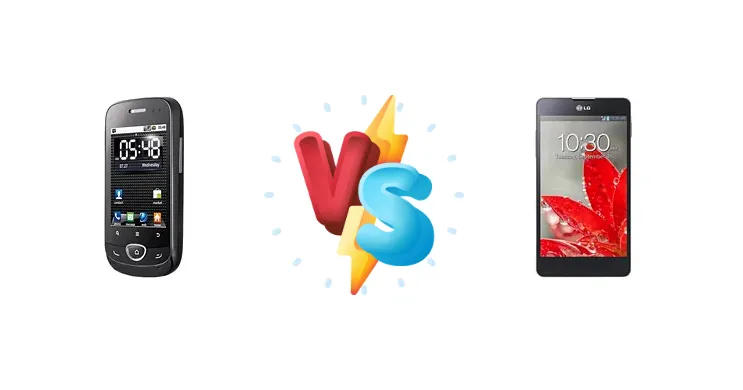
Remember the early days of smartphones? The ZTE Racer II and LG Optimus G represent a snapshot of that era. Both were budget-friendly options offering a taste of the mobile revolution. But which one holds up better today? Let's dive into a detailed comparison.
🏆 Quick Verdict
The LG Optimus G decisively wins this comparison. Its significantly faster processor, superior display, and longer battery life make it a far more capable device than the ZTE Racer II, despite both being older models. The Racer II's charm lies in its compact size and simplicity.
| Network |
|---|
| 2G bands | GSM 900 / 1800 / 1900 | GSM 850 / 900 / 1800 / 1900 - E975, E973, E971 |
| 3G bands | HSDPA 900 / 2100 | HSDPA 900 / 2100 - E975 |
| 4G bands | - | 1, 3, 7, 8, 20 - E975 (market dependent) |
| Speed | HSPA 3.6/0.384 Mbps | HSPA 42.2/5.76 Mbps, LTE Cat3 100/50 Mbps |
| Technology | GSM / HSPA | GSM / HSPA / LTE |
| | - | HSDPA 900 / 1700 / 2100 |
| Launch |
|---|
| Announced | 2011, August. Released 2011, September | 2012, August. Released 2012, November |
| Status | Discontinued | Discontinued |
| Body |
|---|
| Dimensions | 104 x 55.4 x 13.5 mm (4.09 x 2.18 x 0.53 in) | 131.9 x 68.9 x 8.5 mm (5.19 x 2.71 x 0.33 in) |
| SIM | Mini-SIM | Micro-SIM |
| Weight | 100 g (3.53 oz) | 145 g (5.11 oz) |
| | - | Optical trackpad |
| Display |
|---|
| Protection | - | Corning Gorilla Glass 2 |
| Resolution | 240 x 320 pixels, 4:3 ratio (~143 ppi density) | 768 x 1280 pixels, 5:3 ratio (~318 ppi density) |
| Size | 2.8 inches, 24.3 cm2 (~42.1% screen-to-body ratio) | 4.7 inches, 62.9 cm2 (~69.2% screen-to-body ratio) |
| Type | TFT, 256K colors | True HD-IPS + LCD |
| Platform |
|---|
| CPU | 500 MHz ARM 11 | Quad-core 1.5 GHz Krait |
| Chipset | - | Qualcomm APQ8064 Snapdragon S4 Pro |
| GPU | - | Adreno 320 |
| OS | Android 2.2 (Froyo) | Android 4.1.2 (Jelly Bean), upgradаble to 4.4.2 (KitKat) |
| Memory |
|---|
| Card slot | microSDHC (dedicated slot) | No |
| Internal | 256MB 512MB RAM | 32GB (25GB user available), 2GB RAM |
| Main Camera |
|---|
| Features | - | LED flash, HDR |
| Single | 3.15 MP | 13 MP/8 MP, market dependent, AF |
| Video | Yes | 1080p@30fps |
| Selfie camera |
|---|
| Single | - | 1.3 MP |
| | No | No |
| Sound |
|---|
| 3.5mm jack | Yes | Yes |
| 35mm jack | Yes | Yes |
| Loudspeaker | Yes | Yes |
| | - | Dedicated music keys |
| Comms |
|---|
| Bluetooth | 2.1, A2DP, EDR | 4.0, A2DP |
| NFC | Optional | Yes |
| Positioning | GPS, A-GPS | GPS, A-GPS, GLONASS |
| Radio | Stereo FM radio, RDS | Stereo FM radio, RDS |
| USB | microUSB | microUSB 2.0 (MHL TV-out), OTG |
| WLAN | Wi-Fi 802.11 b/g | Wi-Fi 802.11 a/b/g/n, dual-band, Wi-Fi Direct, DLNA, hotspot |
| Features |
|---|
| Browser | - | HTML |
| Sensors | Accelerometer, proximity, compass | Accelerometer, gyro, proximity, compass |
| | MP4/H.264 player
MP3/WAV/eAAC+ player
Organizer
Document viewer
Voice memo
Predictive text input | BlackBerry maps
Document editor (Word, Excel, PowerPoint, PDF)
MP3/WMA/WAV/eAAC+ player
MP4/H.264/WMV player
Organizer
Voice memo/dial
|
| Battery |
|---|
| Music play | - | Up to 30 h |
| Stand-by | Up to 166 h | Up to 456 h (2G) / Up to 411 h (3G) |
| Talk time | Up to 4 h 35 min | Up to 15 h (2G) / Up to 13 h (3G) |
| Type | Removable Li-Ion 1100 mAh battery | Non-removable Li-Po 2100 mAh battery |
| Misc |
|---|
| Colors | Black | Black, White |
| Models | - | E973, E971, E975, F180L, F180K, F180S |
| Price | About 200 EUR | About 160 EUR |
| SAR | - | 0.58 W/kg (head) 1.08 W/kg (body) |
| SAR EU | - | 0.43 W/kg (head) 0.40 W/kg (body) |
| Tests |
|---|
| Audio quality | - |
Noise -89.9dB / Crosstalk -87.1dB |
| Camera | - |
Photo |
| Loudspeaker | - |
Voice 66dB / Noise 66dB / Ring 71dB |
ZTE Racer II
- Extremely compact
- Simple and easy to use
- Lightweight
- Very slow performance
- Low-resolution display
- Poor camera quality
- Short battery life
- Limited app support
LG Optimus G E975
- Faster processor
- Better display
- Improved camera
- Longer battery life (originally)
- More app compatibility
- Older technology
- Battery degradation likely
- May lack modern software updates
- Larger than Racer II
Display Comparison
The LG Optimus G boasts a significantly superior display. Its contrast ratio (1438:1 nominal, 1.753:1 sunlight) is exceptional for its time, offering vibrant colors and excellent visibility even in bright conditions. The ZTE Racer II's display is a basic, lower-resolution screen, adequate for its intended purpose but lacking in detail and brightness.
Camera Comparison
While both phones have cameras, the LG Optimus G's camera is expected to be noticeably better, offering higher resolution photos and video. The ZTE Racer II's camera is basic and produces lower-quality images. Specific camera specs are missing for both, but the Optimus G's hardware was generally considered superior at the time.
Performance
The LG Optimus G's Qualcomm APQ8064 Snapdragon S4 Pro chipset with a 1.5 GHz Quad-core Krait processor utterly dominates the ZTE Racer II's 500 MHz ARM 11. The Optimus G offers vastly improved speed and responsiveness for apps, browsing, and multitasking. The Racer II feels sluggish by comparison.
Battery Life
The LG Optimus G's endurance rating of 45h suggests a significantly larger battery and better power efficiency than the ZTE Racer II. While both batteries are old and likely degraded, the Optimus G started with a considerable advantage.
Buying Guide
The ZTE Racer II is for those seeking a tiny, ultra-basic phone for calls and texts, or for collectors of retro devices. The LG Optimus G is for anyone wanting a more functional smartphone experience from that era, with better performance and features, even if it's showing its age.
Frequently Asked Questions
❓ Are spare parts readily available for either of these phones?
Finding spare parts for both phones will be challenging due to their age. Expect limited availability and potentially higher prices.
❓ Can I use these phones with a modern 4G/5G network?
Neither phone supports modern 4G or 5G networks. They are limited to older 2G/3G technologies, so coverage may be limited.