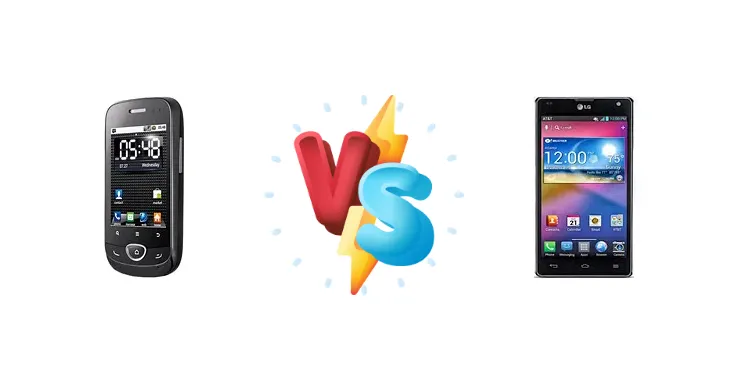
Remember the early days of smartphones? The ZTE Racer II and LG Optimus G represent a snapshot of that era, offering affordable options with varying degrees of success. This comparison dives deep into their specs, performance, and overall value to determine which phone remains the better choice today (or for nostalgic collectors).
🏆 Quick Verdict
The LG Optimus G utterly dominates the ZTE Racer II. Its significantly faster processor, superior display, and better camera make it the clear winner. While the Racer II was a budget champion in its time, the Optimus G offers a vastly improved experience.
| Network |
|---|
| 2G bands | GSM 900 / 1800 / 1900 | GSM 850 / 900 / 1800 / 1900 |
| 3G bands | HSDPA 900 / 2100 | HSDPA 850 / 1900 / 2100 |
| 4G bands | - | 4, 17 |
| Speed | HSPA 3.6/0.384 Mbps | HSPA 21.1/5.76 Mbps, LTE Cat3 100/50 Mbps |
| Technology | GSM / HSPA | GSM / HSPA / LTE |
| Launch |
|---|
| Announced | 2011, August. Released 2011, September | 2012, September. Released 2012, November |
| Status | Discontinued | Discontinued |
| Body |
|---|
| Dimensions | 104 x 55.4 x 13.5 mm (4.09 x 2.18 x 0.53 in) | 130.8 x 71.6 x 8.4 mm (5.15 x 2.82 x 0.33 in) |
| SIM | Mini-SIM | Micro-SIM |
| Weight | 100 g (3.53 oz) | 147.1 g (5.19 oz) |
| Display |
|---|
| Protection | - | Corning Gorilla Glass 2 |
| Resolution | 240 x 320 pixels, 4:3 ratio (~143 ppi density) | 768 x 1280 pixels, 5:3 ratio (~318 ppi density) |
| Size | 2.8 inches, 24.3 cm2 (~42.1% screen-to-body ratio) | 4.7 inches, 62.9 cm2 (~67.1% screen-to-body ratio) |
| Type | TFT, 256K colors | True HD-IPS + LCD |
| | - | LG Optimus UI v3.0 |
| Platform |
|---|
| CPU | 500 MHz ARM 11 | Quad-core 1.5 GHz Krait |
| Chipset | - | Qualcomm APQ8064 Snapdragon S4 Pro |
| GPU | - | Adreno 320 |
| OS | Android 2.2 (Froyo) | Android 4.0 (Ice Cream Sandwich), upgradable to 4.1.2 (Jelly Bean) |
| Memory |
|---|
| Card slot | microSDHC (dedicated slot) | microSDXC (dedicated slot), 16 GB included |
| Internal | 256MB 512MB RAM | 16GB 2GB RAM |
| Main Camera |
|---|
| Features | - | LED flash |
| Single | 3.15 MP | 8 MP, AF |
| Video | Yes | 1080p@30fps |
| Selfie camera |
|---|
| Single | - | 1.3 MP |
| | No | - |
| Sound |
|---|
| 3.5mm jack | Yes | Yes |
| 35mm jack | Yes | Yes |
| Loudspeaker | Yes | Yes |
| Comms |
|---|
| Bluetooth | 2.1, A2DP, EDR | 4.0, A2DP, LE |
| NFC | Optional | Yes |
| Positioning | GPS, A-GPS | GPS, S-GPS, GLONASS |
| Radio | Stereo FM radio, RDS | No |
| USB | microUSB | microUSB 2.0 (MHL TV-out), OTG |
| WLAN | Wi-Fi 802.11 b/g | Wi-Fi 802.11 a/b/g/n, dual-band, Wi-Fi Direct, DLNA, hotspot |
| Features |
|---|
| Sensors | Accelerometer, proximity, compass | Accelerometer, gyro, proximity, compass |
| | MP4/H.264 player
MP3/WAV/eAAC+ player
Organizer
Document viewer
Voice memo
Predictive text input | MP4/H.264/WMV/DviX player
MP3/WMA/WAV/FLAC/eAAC+ player
Photo viewer/editor
Document viewer/editor |
| Battery |
|---|
| Stand-by | Up to 166 h | Up to 324 h |
| Talk time | Up to 4 h 35 min | Up to 10 h |
| Type | Removable Li-Ion 1100 mAh battery | Li-Po 2100 mAh, non-removable |
| Misc |
|---|
| Colors | Black | Black |
| Price | About 200 EUR | About 250 EUR |
| SAR | - | 0.67 W/kg (head) 1.22 W/kg (body) |
| Tests |
|---|
| Audio quality | - |
Noise -82.5dB / Crosstalk -81.6dB |
| Display | - |
Contrast ratio: 1438:1 (nominal) / 1.753:1 (sunlight) |
ZTE Racer II
- Extremely affordable (when new)
- Compact size
- Early Android experience
- Very slow performance
- Low-resolution display
- Basic camera
- Limited storage
- Poor battery life
LG Optimus G E970
- Significantly faster performance
- Better display quality
- Improved camera
- More storage options
- Better battery life (relative to Racer II)
- Aging hardware
- Limited software updates (historical)
- May be difficult to find in good condition
Display Comparison
The LG Optimus G boasts a significantly superior display. Its IPS LCD panel offers vibrant colors, wider viewing angles, and a much higher resolution than the Racer II's smaller, lower-resolution screen. The contrast ratios, while similar nominally, are likely better realized on the Optimus G due to its panel technology. Sunlight readability is also improved on the Optimus G.
Camera Comparison
The LG Optimus G's camera, while not exceptional by today's standards, was considerably better than the Racer II's. It likely offered better image quality, more features, and faster focusing. Details are scarce on the Racer II's camera, but it was likely a basic, low-resolution sensor.
Performance
This is where the Optimus G truly shines. The Qualcomm Snapdragon S4 Pro with its quad-core 1.5 GHz Krait processor is leagues ahead of the Racer II's single-core 500 MHz ARM 11. Expect noticeably faster app loading, smoother multitasking, and a generally more responsive user experience on the Optimus G. The Racer II will feel sluggish by modern standards.
Battery Life
While specific battery capacities are difficult to confirm definitively for the Racer II, the LG Optimus G generally offered better battery life due to its more efficient processor and larger battery capacity (around 2150 mAh vs. likely under 1500 mAh for the Racer II). However, both phones will struggle to provide a full day's use by today's standards.
Buying Guide
Who should buy the ZTE Racer II? Primarily collectors interested in early Android devices or those seeking a very basic, ultra-budget phone. The LG Optimus G is for those wanting a more capable and enjoyable experience from a phone of this era, offering a better balance of features and performance.
Frequently Asked Questions
❓ Are spare parts readily available for these phones?
Spare parts for both phones are increasingly difficult to find, especially for the ZTE Racer II. Expect limited availability and potentially high prices.
❓ Can I still use these phones with a modern SIM card?
Potentially. Both phones support 2G and likely 3G networks. However, compatibility with newer 4G/5G networks is unlikely. Check with your carrier for compatibility.