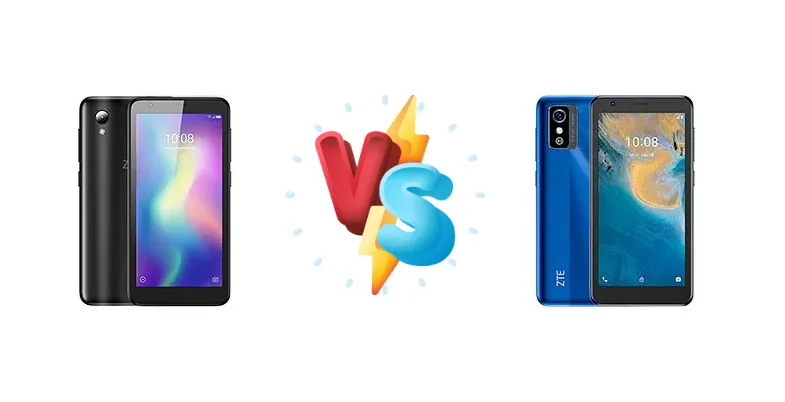
Looking for an affordable smartphone that won't break the bank? The ZTE Quest 5 and ZTE Blade L9 are both contenders in the budget market, but which one offers the best bang for your buck? We'll break down their specs, performance, and features to help you decide.
🏆 Quick Verdict
The ZTE Quest 5 edges out the Blade L9 thanks to its slightly more powerful chipset and CPU. While both are budget devices, the Quest 5 offers a bit more performance for everyday tasks and potentially smoother multitasking. Both offer basic functionality at a low price point.
| Network |
|---|
| 2G bands | GSM 850 / 1900 | GSM 850 / 900 / 1800 / 1900 |
| 3G bands | HSDPA 850 / 900 / 1900 / 2100 | HSDPA 900 / 2100 |
| 4G bands | 2, 4, 5, 12, 13, 25, 26, 41 | - |
| Speed | HSPA, LTE Cat4 150/50 Mbps | HSPA |
| Technology | GSM / CDMA / HSPA / LTE | GSM / HSPA |
| | CDMA 800 / 1900 | - |
| Launch |
|---|
| Announced | 2020, August. Released 2020, August | 2021, October 10 |
| Status | Discontinued | Available. Released 2021, October 10 |
| Body |
|---|
| Dimensions | 137 x 68 x 10.6 mm (5.39 x 2.68 x 0.42 in) | 137.5 x 67.5 x 10 mm (5.41 x 2.66 x 0.39 in) |
| SIM | Nano-SIM | Nano-SIM + Nano-SIM |
| Weight | 143 g (5.04 oz) | 143 g (5.04 oz) |
| Display |
|---|
| Resolution | 480 x 960 pixels, 18:9 ratio (~215 ppi density) | 480 x 960 pixels, 18:9 ratio (~215 ppi density) |
| Size | 5.0 inches, 64.5 cm2 (~69.3% screen-to-body ratio) | 5.0 inches, 64.5 cm2 (~69.5% screen-to-body ratio) |
| Type | IPS LCD | TFT LCD |
| Platform |
|---|
| CPU | Quad-core 1.5 GHz Cortex-A53 | Quad-core 1.3 GHz Cortex-A7 |
| Chipset | Mediatek MT6739 (28 nm) | Unisoc SC7731e |
| GPU | PowerVR GE8100 | Mali-400 MP2 |
| OS | Android 10 (Go Edition) | Android 11 (Go edition) |
| Memory |
|---|
| Card slot | microSDHC (dedicated slot) | microSDXC |
| Internal | 16GB 1GB RAM | 32GB 1GB RAM |
| | eMMC 5.1 | eMMC 5.1 |
| Main Camera |
|---|
| Features | - | LED flash, HDR |
| Single | 5 MP | 5 MP (up-scaled to 8 MP) |
| Video | - | 720p@30fps |
| Selfie camera |
|---|
| Single | 2 MP | 2 MP (up-scaled to 5 MP) |
| Sound |
|---|
| 3.5mm jack | Yes | Yes |
| 35mm jack | Yes | Yes |
| Loudspeaker | Yes | Yes |
| Comms |
|---|
| Bluetooth | 4.2, A2DP | 4.2, A2DP |
| NFC | No | No |
| Positioning | GPS | GPS, GLONASS |
| Radio | No | FM radio |
| USB | microUSB 2.0 | microUSB 2.0 |
| WLAN | Wi-Fi 802.11 b/g/n | Wi-Fi 802.11 b/g/n |
| Features |
|---|
| Sensors | Accelerometer, proximity | Accelerometer |
| Battery |
|---|
| Type | Li-Ion 2000 mAh, removable | Li-Ion 2000 mAh |
| Misc |
|---|
| Colors | Black | Black, Blue |
| Price | About 80 EUR | About 70 EUR |
ZTE Quest 5
- Slightly more powerful chipset
- Potentially better battery life
- More modern design (likely)
- Limited storage
- Basic camera quality
- May be slightly more expensive
ZTE Blade L9
- Very affordable
- Compact size
- Basic functionality
- Less powerful chipset
- Lower performance
- Basic camera quality
Display Comparison
Both phones likely feature basic LCD displays, probably around 5-6 inches in size with standard resolutions (likely HD+). Expect decent viewing angles but limited brightness and color accuracy. The Quest 5 *might* have a slightly better panel, but differences will be minimal.
Camera Comparison
Camera specs are likely similar – expect basic 8-13MP rear cameras and 5MP front cameras on both. Image quality will be adequate in good lighting conditions, but low-light performance will be poor. Don't expect exceptional photo capabilities from either device.
Performance
The Quest 5's Mediatek MT6739 with a 1.5 GHz Cortex-A53 CPU holds a slight advantage over the Blade L9's Unisoc SC7731e and 1.3 GHz Cortex-A7. This translates to marginally faster app loading times and smoother navigation. However, neither phone is a powerhouse and demanding games will struggle.
Battery Life
Battery capacity is likely in the 3000-3500mAh range for both. Battery life will depend heavily on usage, but expect a full day of moderate use. The Quest 5's slightly more efficient chipset *could* provide marginally better battery life.
Buying Guide
The ZTE Quest 5 is ideal for users prioritizing a little extra performance for basic apps and light gaming. The ZTE Blade L9 is a good choice for those seeking the absolute lowest price and primarily need a phone for calls, texts, and essential apps.
Frequently Asked Questions
❓ What operating system do these phones use?
Both phones likely run a customized version of Android Go, optimized for lower-powered hardware. Expect a streamlined experience with fewer pre-installed apps.
❓ How much storage do these phones offer?
Typically, these budget phones offer 16GB or 32GB of internal storage, expandable via microSD card. It's recommended to use a microSD card for storing photos, videos, and apps.