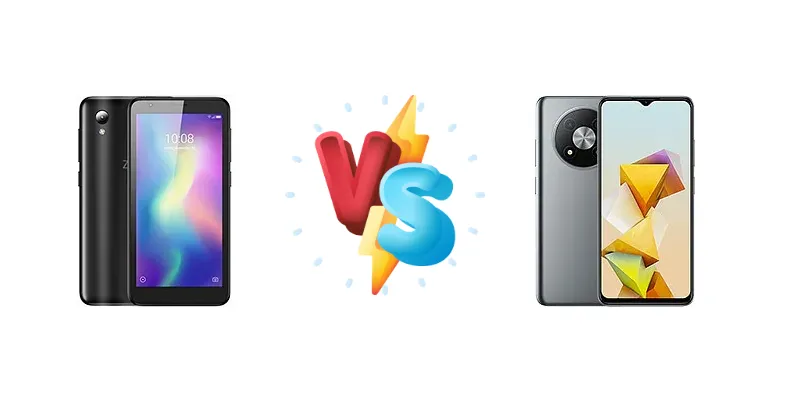
ZTE offers two compelling options in the sub-$200 5G smartphone space: the older ZTE Quest 5 and the newer ZTE Blade A73 5G. While both aim to deliver affordable 5G connectivity, they differ significantly under the hood. This comparison dissects those differences, focusing on how the chipset choices impact real-world performance and value.
🏆 Quick Verdict
For most users, the ZTE Blade A73 5G is the superior choice. Its Unisoc T760 chipset, built on a modern 6nm process, delivers a substantial performance uplift over the Quest 5’s aging Mediatek MT6739. This translates to smoother multitasking, faster app loading, and a more responsive user experience, justifying the potential price difference.
| Network |
|---|
| 2G bands | GSM 850 / 1900 | GSM 850 / 900 / 1800 / 1900 |
| 3G bands | HSDPA 850 / 900 / 1900 / 2100 | HSDPA 850 / 900 / 1900 / 2100 |
| 4G bands | 2, 4, 5, 12, 13, 25, 26, 41 | 1, 2, 3, 4, 5, 7, 8, 20, 28, 38, 40, 41 |
| 5G bands | - | 1, 3, 7, 8, 20, 28, 38, 40, 41, 77, 78 SA/NSA |
| Speed | HSPA, LTE Cat4 150/50 Mbps | HSPA, LTE, 5G |
| Technology | GSM / CDMA / HSPA / LTE | GSM / HSPA / LTE / 5G |
| | CDMA 800 / 1900 | - |
| Launch |
|---|
| Announced | 2020, August. Released 2020, August | 2023, August 10 |
| Status | Discontinued | Available. Released 2023, September |
| Body |
|---|
| Dimensions | 137 x 68 x 10.6 mm (5.39 x 2.68 x 0.42 in) | 163.5 x 75.2 x 8.5 mm (6.44 x 2.96 x 0.33 in) |
| SIM | Nano-SIM | Nano-SIM + Nano-SIM |
| Weight | 143 g (5.04 oz) | 197 g (6.95 oz) |
| Display |
|---|
| Resolution | 480 x 960 pixels, 18:9 ratio (~215 ppi density) | 720 x 1600 pixels, 20:9 ratio (~269 ppi density) |
| Size | 5.0 inches, 64.5 cm2 (~69.3% screen-to-body ratio) | 6.52 inches, 102.6 cm2 (~83.5% screen-to-body ratio) |
| Type | IPS LCD | IPS LCD, 90Hz |
| Platform |
|---|
| CPU | Quad-core 1.5 GHz Cortex-A53 | Octa-core (1x2.2 GHz Cortex-A76 & 3x Cortex-A76 & 4x Cortex-A55) |
| Chipset | Mediatek MT6739 (28 nm) | Unisoc T760 (6 nm) |
| GPU | PowerVR GE8100 | Mali-G57 |
| OS | Android 10 (Go Edition) | Android 13 |
| Memory |
|---|
| Card slot | microSDHC (dedicated slot) | No |
| Internal | 16GB 1GB RAM | 128GB 4GB RAM |
| | eMMC 5.1 | - |
| Main Camera |
|---|
| Dual | - | 50 MP (13 MP in Asia), (wide), AF
Auxiliary lens |
| Features | - | LED flash |
| Single | 5 MP | - |
| Video | - | 1080p@30fps |
| Selfie camera |
|---|
| Single | 2 MP | 5 MP |
| Video | - | 1080p@30fps |
| Sound |
|---|
| 3.5mm jack | Yes | - |
| 35mm jack | Yes | Yes |
| Loudspeaker | Yes | Yes |
| Comms |
|---|
| Bluetooth | 4.2, A2DP | 5.2, A2DP, LE |
| NFC | No | Yes (market/region dependent) |
| Positioning | GPS | GPS |
| Radio | No | FM radio |
| USB | microUSB 2.0 | USB Type-C 2.0, OTG |
| WLAN | Wi-Fi 802.11 b/g/n | Wi-Fi 802.11 a/b/g/n/ac, dual-band |
| Features |
|---|
| Sensors | Accelerometer, proximity | Accelerometer, proximity |
| Battery |
|---|
| Type | Li-Ion 2000 mAh, removable | Li-Ion 5000 mAh |
| Misc |
|---|
| Colors | Black | Gray, Blue |
| Price | About 80 EUR | About 120 EUR |
| SAR EU | - | 1.42 W/kg (head) 1.69 W/kg (body) |
ZTE Quest 5
- Lowest possible price point
- Functional for basic smartphone tasks
- May have slightly larger battery capacity (speculative)
- Outdated Mediatek MT6739 chipset
- Poor performance for multitasking and gaming
- Less efficient 28nm process
ZTE Blade A73 5G
- Modern Unisoc T760 chipset
- Significantly improved performance
- More efficient 6nm process for better battery life
- Potentially higher price than the Quest 5
- Camera quality may still be limited by budget sensors
- Display specifications are unknown
Display Comparison
Neither ZTE provides detailed display specifications in the provided data. However, given the market segment, both likely utilize LCD panels. The key difference will be in color calibration and brightness. The A73 5G, being newer, *may* benefit from improved panel technology, but without specific nit ratings, it's speculative. Bezels are likely comparable, reflecting cost-saving measures in this price range.
Camera Comparison
Without sensor details, a direct camera comparison is difficult. However, it’s reasonable to assume both phones feature basic camera setups geared towards casual photography. The A73 5G’s newer image signal processor (ISP) within the Unisoc T760 likely offers improved image processing capabilities, resulting in better dynamic range and noise reduction compared to the Quest 5. The presence of a more modern chipset suggests potentially better low-light performance, even with similar sensor sizes. We can expect both phones to include a standard main camera and potentially a depth or macro sensor, but image quality will heavily depend on software optimization.
Performance
The performance gap is the most significant differentiator. The ZTE Blade A73 5G’s Unisoc T760, fabricated on a 6nm process, is a substantial upgrade over the Quest 5’s 28nm Mediatek MT6739. The T760’s octa-core configuration – featuring a high-performance Cortex-A76 core alongside additional A76 and A55 cores – provides a considerable advantage in multi-threaded tasks and overall responsiveness. The Quest 5’s quad-core Cortex-A53 is simply outmatched. This means the A73 5G will handle multitasking, app loading, and even light gaming far more efficiently, with less lag and stuttering. The 6nm process also contributes to better thermal efficiency, potentially reducing throttling during sustained workloads.
Battery Life
Battery capacity isn’t specified for either device. However, the Unisoc T760’s 6nm process efficiency gives the Blade A73 5G a potential advantage in battery life. A more efficient chipset consumes less power for the same tasks, translating to longer usage times. While the Quest 5 might have a slightly larger battery, the A73 5G’s superior power efficiency is likely to offset any capacity difference. Charging wattage is also unknown, but faster charging is a common feature in newer devices like the A73 5G.
Buying Guide
Buy the ZTE Quest 5 if you absolutely need the lowest possible price and your smartphone usage is limited to basic tasks like calls, texts, and light web browsing. It’s a functional device for minimalists. Buy the ZTE Blade A73 5G if you prioritize a smoother, more capable experience, especially if you enjoy occasional gaming, streaming, or running multiple apps simultaneously. The A73 5G offers a significantly better return on investment for anyone beyond the most basic smartphone needs.
Frequently Asked Questions
❓ Will the ZTE Blade A73 5G handle popular games like PUBG Mobile or Call of Duty Mobile?
While the Unisoc T760 isn't a gaming powerhouse, it's significantly more capable than the MT6739 in the Quest 5. You'll likely be able to play PUBG Mobile and Call of Duty Mobile at medium settings with reasonable frame rates. However, don't expect a flagship-level gaming experience; some stuttering and frame drops are possible during intense scenes.
❓ Is the 5G connectivity on the ZTE Blade A73 5G actually useful, or is it just a marketing gimmick?
The usefulness of 5G depends on your location and carrier coverage. If you live in an area with robust 5G infrastructure, you'll experience significantly faster download and upload speeds compared to 4G LTE. This is particularly beneficial for streaming high-resolution video, downloading large files, and online gaming. However, if 5G coverage is limited, the benefit will be minimal.
❓ How much storage does each phone have, and is it expandable?
Storage capacity isn't specified in the provided data. However, budget smartphones typically offer 32GB or 64GB of internal storage. It's highly likely that both phones feature a microSD card slot for expandable storage, allowing you to add more space for photos, videos, and apps. Check the product listing for specific storage options.