
ZTE Quest 5 vs Google Pixel 7a: A Deep Dive into Value and Performance
| Phones Images | |||||
|---|---|---|---|---|---|
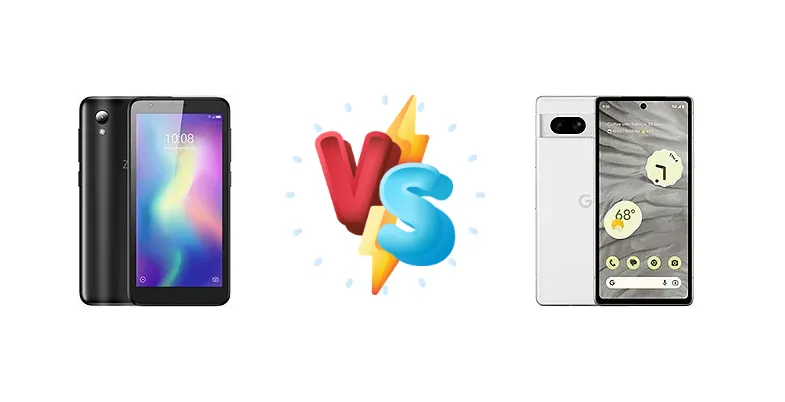
|
🏆 Quick Verdict
For the average user prioritizing camera quality, smooth performance, and software support, the Google Pixel 7a is the clear winner. Its Tensor G2 chipset and optimized software experience significantly outperform the ZTE Quest 5's aging Mediatek MT6739. However, the Quest 5 remains a viable option for those on an extremely tight budget who need basic smartphone functionality.
| PHONES | ||
|---|---|---|
| Phone Names | ZTE Quest 5 | Google Pixel 7a |
| Network | ||
|---|---|---|
| 2G bands | GSM 850 / 1900 | GSM 850 / 900 / 1800 / 1900 |
| 3G bands | HSDPA 850 / 900 / 1900 / 2100 | HSDPA 800 / 850 / 900 / 1700(AWS) / 1900 / 2100 |
| 4G bands | 2, 4, 5, 12, 13, 25, 26, 41 | 1, 2, 3, 4, 5, 7, 8, 12, 13, 14, 17, 20, 25, 26, 28, 29, 30, 38, 40, 41, 48, 66, 71 - GWKK3, G0DZQ |
| 5G bands | - | 1, 2, 3, 5, 7, 8, 12, 14, 20, 25, 28, 30, 38, 41, 48, 66, 71, 77, 78 SA/NSA/Sub6 - GWKK3 |
| Speed | HSPA, LTE Cat4 150/50 Mbps | HSPA, LTE, 5G |
| Technology | GSM / CDMA / HSPA / LTE | GSM / HSPA / LTE / 5G |
| CDMA 800 / 1900 | 1, 2, 3, 5, 7, 8, 12, 20, 25, 28, 38, 40, 41, 66, 75, 76, 77, 78, 79 SA/NSA/Sub6 - GHL1X, G82U8 | |
| Launch | ||
|---|---|---|
| Announced | 2020, August. Released 2020, August | 2023, May 10 |
| Status | Discontinued | Available. Released 2023, May 10 |
| Body | ||
|---|---|---|
| Build | - | Glass front (Gorilla Glass 3), aluminum frame, plastic back |
| Dimensions | 137 x 68 x 10.6 mm (5.39 x 2.68 x 0.42 in) | 152 x 72.9 x 9 mm (5.98 x 2.87 x 0.35 in) |
| SIM | Nano-SIM | Nano-SIM + eSIM |
| Weight | 143 g (5.04 oz) | 193.5 g (6.84 oz) |
| - | IP67 dust/water resistant (up to 1m for 30 min) | |
| Display | ||
|---|---|---|
| Protection | - | Corning Gorilla Glass 3 |
| Resolution | 480 x 960 pixels, 18:9 ratio (~215 ppi density) | 1080 x 2400 pixels, 20:9 ratio (~429 ppi density) |
| Size | 5.0 inches, 64.5 cm2 (~69.3% screen-to-body ratio) | 6.1 inches, 90.7 cm2 (~81.8% screen-to-body ratio) |
| Type | IPS LCD | OLED, HDR, 90Hz |
| - | Always-on display | |
| Platform | ||
|---|---|---|
| CPU | Quad-core 1.5 GHz Cortex-A53 | Octa-core (2x2.85 GHz Cortex-X1 & 2x2.35 GHz Cortex-A78 & 4x1.80 GHz Cortex-A55) |
| Chipset | Mediatek MT6739 (28 nm) | Google Tensor G2 (5 nm) |
| GPU | PowerVR GE8100 | Mali-G710 MP7 |
| OS | Android 10 (Go Edition) | Android 13, upgradable to Android 15, up to 5 major Android upgrades |
| Memory | ||
|---|---|---|
| Card slot | microSDHC (dedicated slot) | No |
| Internal | 16GB 1GB RAM | 128GB 8GB RAM |
| eMMC 5.1 | UFS 3.1 | |
| Main Camera | ||
|---|---|---|
| Dual | - | 64 MP, f/1.9, 26mm (wide), 1/1.73", 0.8µm, dual pixel PDAF, OIS 13 MP, f/2.2, 120˚ (ultrawide), 1.12µm |
| Features | - | Dual-LED flash, Pixel Shift, Auto-HDR, panorama |
| Single | 5 MP | - |
| Video | - | 4K@30/60fps, 1080p@30/60/120/240fps, OIS |
| Selfie camera | ||
|---|---|---|
| Features | - | HDR, panorama |
| Single | 2 MP | 13 MP, f/2.2, 20mm (ultrawide), 1.12µm |
| Video | - | 4K@30fps, 1080p@30fps |
| Sound | ||
|---|---|---|
| 3.5mm jack | Yes | No |
| 35mm jack | Yes | No |
| Loudspeaker | Yes | Yes, with stereo speakers |
| Comms | ||
|---|---|---|
| Bluetooth | 4.2, A2DP | 5.3, A2DP, LE |
| NFC | No | Yes |
| Positioning | GPS | GPS, GLONASS, GALILEO, BDS, QZSS, NavIC |
| Radio | No | No |
| USB | microUSB 2.0 | USB Type-C 3.2 |
| WLAN | Wi-Fi 802.11 b/g/n | Wi-Fi 802.11 a/b/g/n/ac/6e, tri-band |
| Features | ||
|---|---|---|
| Sensors | Accelerometer, proximity | Fingerprint (under display, optical), accelerometer, gyro, proximity, compass, barometer |
| Battery | ||
|---|---|---|
| Charging | - | 18W wired, PD3.0 7.5W wireless |
| Type | Li-Ion 2000 mAh, removable | Li-Po 4385 mAh |
| Misc | ||
|---|---|---|
| Colors | Black | Charcoal, Snow, Sea, Coral |
| Models | - | GWKK3, GHL1X, G0DZQ, G82U8 |
| Price | About 80 EUR | € 179.90 / $ 150.00 / £ 170.00 / ₹ 25,980 |
ZTE Quest 5
- Extremely affordable price point
- Functional for basic smartphone tasks
- Lightweight and portable
- Outdated processor and limited performance
- Inferior camera quality
- Limited software support and updates
Google Pixel 7a
- Powerful Google Tensor G2 chipset
- Excellent camera with advanced features
- Guaranteed software updates and support
- Higher price compared to the ZTE Quest 5
- Charging speed is moderate (18W)
- May be overkill for basic users
Display Comparison
The Pixel 7a boasts a significantly brighter display, reaching a measured 1070 nits, compared to the Quest 5's likely lower (and unspecified) peak brightness. This translates to better visibility outdoors in direct sunlight. While the Quest 5's display resolution is not specified, it's reasonable to assume it's lower than the Pixel 7a's, resulting in less sharpness. The Pixel 7a's OLED panel also offers superior contrast and color accuracy, enhancing the viewing experience for videos and photos.
Camera Comparison
The Pixel 7a's camera system is a major differentiator. While specific sensor details are not provided, Google's computational photography prowess, powered by the Tensor G2, elevates image quality significantly. The Pixel 7a excels in low-light photography and offers features like Magic Eraser and Photo Unblur. The ZTE Quest 5's camera capabilities are likely limited by its older chipset and less sophisticated image processing. The absence of details suggests a focus on basic functionality rather than advanced features. It's safe to assume the Pixel 7a will deliver far superior photo and video quality.
Performance
The performance gap between these two devices is substantial. The ZTE Quest 5's Mediatek MT6739, built on a 28nm process, features a quad-core Cortex-A53 CPU. This is a relatively old architecture designed for basic tasks. In contrast, the Pixel 7a's Google Tensor G2, fabricated on a 5nm process, utilizes an octa-core configuration with high-performance Cortex-X1 and Cortex-A78 cores. The 5nm process node provides significantly improved power efficiency and transistor density, resulting in much faster processing speeds and better thermal management. The Tensor G2's architecture is also optimized for machine learning tasks, enhancing features like Google Assistant and image processing.
Battery Life
The Pixel 7a has an endurance rating of 76 hours, indicating excellent battery life. It supports 18W wired charging with PD3.0 and 7.5W wireless charging, offering convenient charging options. The ZTE Quest 5's battery capacity is not specified, but given its lower-power chipset, it likely has a smaller battery. However, the efficiency gains of the Tensor G2 and optimized software on the Pixel 7a likely offset any capacity difference, resulting in longer real-world usage.
Buying Guide
Buy the ZTE Quest 5 if you need a functional smartphone for essential tasks like calls, texts, and light browsing, and your budget is under $150. It's a good choice for first-time smartphone users or as a backup device. Buy the Google Pixel 7a if you prioritize a high-quality camera, responsive performance for everyday tasks and gaming, and guaranteed software updates for years to come. It's ideal for users who rely on their phone for photography, social media, and productivity.