
ZTE nubia Z80 Ultra vs Xiaomi 14T Pro: A Deep Dive into Flagship Performance
| Phones Images | |||||
|---|---|---|---|---|---|
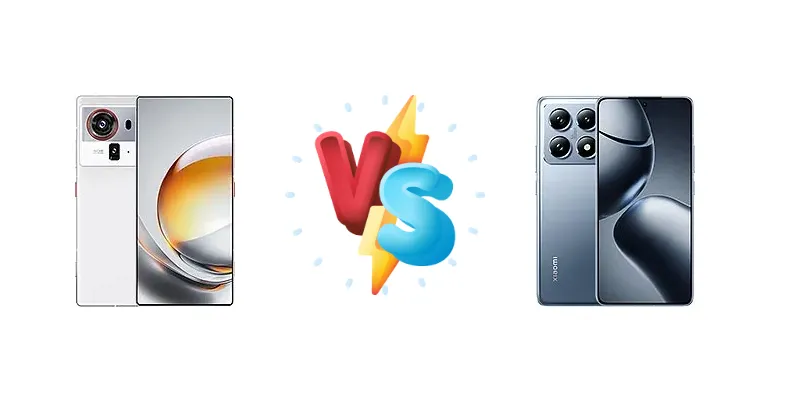
|
🏆 Quick Verdict
For the average user prioritizing longevity and a superior viewing experience, the ZTE nubia Z80 Ultra emerges as the winner. Its significantly longer battery life (20:13h vs 12:32h) and brighter display (1723 nits) outweigh the Xiaomi 14T Pro’s faster charging, making it ideal for power users and content consumers.
| PHONES | ||
|---|---|---|
| Phone Names | ZTE nubia Z80 Ultra | Xiaomi 14T Pro |
| Network | ||
|---|---|---|
| 2G bands | GSM 850 / 900 / 1800 / 1900 | GSM 850 / 900 / 1800 / 1900 |
| 3G bands | HSDPA 800 / 850 / 900 / 1700(AWS) / 1900 / 2100 | HSDPA 800 / 850 / 900 / 1700(AWS) / 1900 / 2100 |
| 4G bands | LTE | 1, 2, 3, 4, 5, 7, 8, 12, 13, 17, 18, 19, 20, 25, 26, 28, 32, 38, 39, 40, 41, 42, 48, 66 |
| 5G bands | 1, 2, 3, 5, 7, 8, 12, 20, 26, 28, 38, 40, 41, 66, 71, 77, 78, 80, 81, 83, 84, 89 SA/NSA | 1, 2, 3, 5, 7, 8, 12, 20, 25, 26, 28, 38, 40, 41, 48, 66, 75, 77, 78 SA/NSA |
| Speed | HSPA, LTE, 5G | HSPA, LTE, 5G |
| Technology | GSM / CDMA / HSPA / CDMA2000 / LTE / 5G | GSM / HSPA / LTE / 5G |
| Launch | ||
|---|---|---|
| Announced | 2025, October 22 | 2024, September 26 |
| Status | Available. Released 2025, October 22 | Available. Released 2024, September 26 |
| Body | ||
|---|---|---|
| Build | Glass front, aluminum frame, glass back | Glass front (Gorilla Glass 5), aluminum frame, glass back (Panda X) |
| Dimensions | 164.5 x 77.2 x 8.6 mm (6.48 x 3.04 x 0.34 in) | 160.4 x 75.1 x 8.4 mm (6.31 x 2.96 x 0.33 in) |
| SIM | Nano-SIM + Nano-SIM | · Nano-SIM + eSIM· eSIM + eSIM· Nano-SIM + Nano-SIM |
| Weight | 227 g (8.01 oz) | 209 g (7.37 oz) |
| Display | ||
|---|---|---|
| Protection | Unspecified | Corning Gorilla Glass 5 |
| Resolution | 1216 x 2688 pixels (~431 ppi density) | 1220 x 2712 pixels, 20:9 ratio (~446 ppi density) |
| Size | 6.85 inches, 113.7 cm2 (~89.5% screen-to-body ratio) | 6.67 inches, 107.4 cm2 (~89.1% screen-to-body ratio) |
| Type | AMOLED, 1B colors, 144Hz, 2592Hz PWM, HDR10, 2000 nits (peak) | AMOLED, 68B colors, 144Hz, 3840Hz PWM, Dolby Vision, HDR10+, 1600 nits (HBM), 4000 nits (peak) |
| Platform | ||
|---|---|---|
| CPU | Octa-core (2x4.6 GHz Oryon V3 Phoenix L + 6x3.62 GHz Oryon V3 Phoenix M) | Octa-core (1x3.4 GHz Cortex-X4 & 3x2.85 GHz Cortex-X4 & 4x2.0 GHz Cortex-A720) |
| Chipset | Qualcomm SM8850-AC Snapdragon 8 Elite Gen 5 (3 nm) | Mediatek Dimensity 9300+ (4 nm) |
| GPU | Adreno 840 | Immortalis-G720 MC12 |
| OS | Android 16, Nebula AIOS 2 | Android 14, HyperOS |
| Memory | ||
|---|---|---|
| Card slot | No | No |
| Internal | 256GB 12GB RAM, 512GB 12GB RAM, 512GB 16GB RAM, 1TB 16GB RAM | 256GB 12GB RAM, 512GB 12GB RAM, 512GB 16GB RAM, 1TB 12GB RAM |
| Main Camera | ||
|---|---|---|
| Features | Laser AF, color spectrum sensor, Ring-LED, dual-tone flash, panorama, DSG HDR | Leica lens, Ultra HDR, LED flash, HDR, panorama |
| Triple | 50 MP, f/1.7, 35mm (standard), 1/1.3", 1.2µm, PDAF, OIS 64 MP, f/2.5, 70mm (periscope telephoto), 1/2.0", 0.7µm, multi-directional PDAF (15cm - ∞), OIS, 2.7x optical zoom (vs. 26mm cam) 50 MP, f/1.8, 18mm (ultrawide), 1/1.55", PDAF | 50 MP, f/1.6, 23mm (wide), 1/1.31", 1.2µm, PDAF, OIS 50 MP, f/2.0, 60mm (telephoto), 1/2.88", 0.61µm, PDAF, 2.6x optical zoom 12 MP, f/2.2, 15mm (ultrawide), 1/3.06", 1.12µm |
| Video | 8K@30fps, 4K@30/60/120fps, 1080p@30/60fps, gyro-EIS, HDR10, 10‑bit video | 8K@24/30fps, 4K@24/30/60fps, 1080p@30/60/120/240/960fps, gyro-EIS, 10-bit Rec. 2020, HDR10+ |
| Selfie camera | ||
|---|---|---|
| Features | HDR | HDR |
| Single | 16 MP, f/2.0, 24mm (wide), 1/2.8", 1.12µm, under display | 32 MP, f/2.0, 25mm (wide), 1/3.44", 0.64µm |
| Video | 1080p@30fps | 4K@30fps, 1080p@30/60fps, HDR10+ |
| Sound | ||
|---|---|---|
| 35mm jack | No | No |
| Loudspeaker | Yes, with stereo speakers | Yes, with stereo speakers |
| Comms | ||
|---|---|---|
| Bluetooth | 6.0, A2DP, LE, aptX HD, aptX Adaptive, aptX Lossless / 5.4 (China) | 5.4, A2DP, LE, LHDC |
| Infrared port | Yes | Yes |
| NFC | Yes | Yes (market/region dependent) |
| Positioning | GPS (L1+L2+L5), GLONASS (G1+G5), BDS (B1I+B1C+B2a+B2b), GALILEO (E1+E5a), QZSS (L1+L5) | GPS (L1+L5), BDS (B1I+B1C+B2a+B2b), GALILEO (E1+E5a+E5b), QZSS (L1+L5), NavIC (L5), GLONASS |
| Radio | No | No |
| USB | USB Type-C 3.2, OTG | USB Type-C 2.0, OTG |
| WLAN | Wi-Fi 802.11 a/b/g/n/ac/6e/7, dual-band, Wi-Fi Direct | Wi-Fi 802.11 a/b/g/n/ac/6e/7, dual-band, Wi-Fi Direct |
| Features | ||
|---|---|---|
| Sensors | Fingerprint (under display, ultrasonic), accelerometer, gyro, proximity, compass | Fingerprint (under display, optical), accelerometer, gyro, proximity, compass |
| Battery | ||
|---|---|---|
| Charging | 80W wired, PD3.0, QC4 (International) 90W wired, PD3.0, QC4 (China) 80W wireless | 120W wired, PD3.0, QC4, 100% in 19 min 50W wireless, 100% in 45 min |
| Type | Si/C Li-Ion 7200 mAh | Li-Po 5000 mAh |
| Misc | ||
|---|---|---|
| Colors | Black, White, Starry Night Blue, Luo Tian Yi Red | Titan Gray, Titan Blue, Titan Black |
| Models | NX741J | 2407FPN8EG |
| Price | About 650 EUR | $ 550.00 / £ 498.00 / € 539.99 |
| SAR EU | - | 0.99 W/kg (head) 1.00 W/kg (body) |
ZTE nubia Z80 Ultra
- Exceptional battery life (20:13h active use)
- Significantly brighter display (1723 nits)
- Potentially superior sustained performance with Snapdragon 8 Elite Gen 5
- Charging speed is slower than Xiaomi 14T Pro
- Brand recognition is lower than Xiaomi
Xiaomi 14T Pro
- Blazing-fast 120W wired charging (19 minutes to 100%)
- Competitive performance with Dimensity 9300+
- Wider brand recognition and support
- Significantly shorter battery life (12:32h active use)
- Dimmer display (1228 nits)
Display Comparison
The nubia Z80 Ultra’s display is a clear standout, achieving a measured peak brightness of 1723 nits, significantly surpassing the Xiaomi 14T Pro’s 1228 nits. This translates to superior readability under direct sunlight. While both likely employ AMOLED panels, the nubia’s higher brightness suggests a more advanced panel generation or more aggressive power delivery. Details regarding refresh rate and panel technology (LTPO) are missing, but the brightness difference is a key differentiator for outdoor users.
Camera Comparison
Without detailed camera specifications, a direct comparison is limited. However, the focus should be on sensor size and image processing. Larger sensors generally capture more light, resulting in better low-light performance. The absence of information regarding sensor sizes necessitates relying on brand reputation; nubia often prioritizes camera capabilities, while Xiaomi balances camera performance with other features. Lens apertures and OIS (Optical Image Stabilization) are also crucial factors, but remain unknown without further data.
Performance
The chipset battle pits Qualcomm’s Snapdragon 8 Elite Gen 5 (3nm) against MediaTek’s Dimensity 9300+ (4nm). The Snapdragon 8 Elite Gen 5, with its Oryon V3 Phoenix cores (2x4.6GHz + 6x3.62GHz), is architecturally designed for sustained performance, leveraging the efficiency of the 3nm process. The Dimensity 9300+ utilizes a different core configuration (1x3.4 GHz Cortex-X4, 3x2.85 GHz Cortex-X4, 4x2.0 GHz Cortex-A720) and a 4nm node. While the Dimensity 9300+ is a powerful chip, the Snapdragon 8 Elite Gen 5’s architecture and process node likely provide a thermal advantage, reducing throttling during prolonged intensive tasks. Both devices utilize Octa-core CPUs, but the Snapdragon’s core arrangement appears geared towards maximizing peak and sustained performance.
Battery Life
The nubia Z80 Ultra’s active use battery score of 20:13h is a substantial improvement over the Xiaomi 14T Pro’s 12:32h. This difference is likely attributable to the more efficient Snapdragon 8 Elite Gen 5 chipset and potentially a larger battery capacity (unspecified). While the Xiaomi 14T Pro compensates with incredibly fast 120W wired charging (0-100% in 19 minutes) and 50W wireless charging (0-100% in 45 minutes), the nubia Z80 Ultra offers 80W wired (International) / 90W (China) and 80W wireless charging. The nubia’s longer battery life reduces the reliance on frequent charging, making it more convenient for users who are often away from power outlets.
Buying Guide
Buy the ZTE nubia Z80 Ultra if you need exceptional battery life for all-day use, a brighter screen for outdoor visibility, and sustained performance during extended gaming sessions. Buy the Xiaomi 14T Pro if you prioritize the absolute fastest charging speeds, frequently top up your phone, and value a more mainstream brand ecosystem.