
ZTE nubia Z80 Ultra vs Xiaomi 13T Pro: A Deep Dive into Flagship Performance
| Phones Images | |||||
|---|---|---|---|---|---|
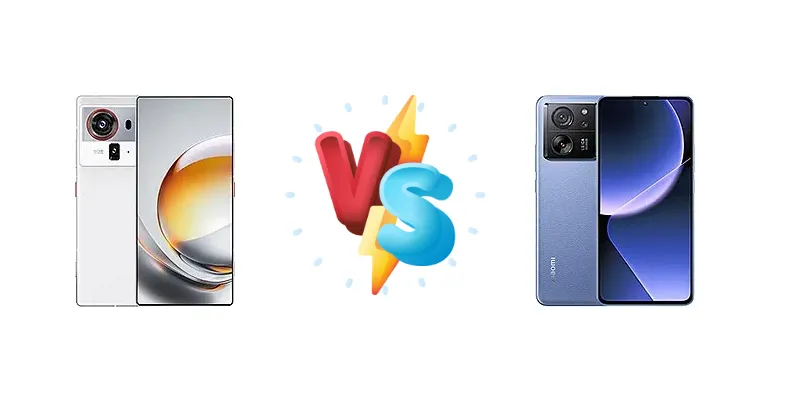
|
🏆 Quick Verdict
For users prioritizing sustained performance and exceptional battery life, the ZTE nubia Z80 Ultra is the clear winner. Its Snapdragon 8 Elite Gen 5 and 20:13h active use score significantly outperform the Xiaomi 13T Pro. However, the 13T Pro’s 120W charging is a compelling advantage for those who value speed over longevity.
| PHONES | ||
|---|---|---|
| Phone Names | ZTE nubia Z80 Ultra | Xiaomi 13T Pro |
| Network | ||
|---|---|---|
| 2G bands | GSM 850 / 900 / 1800 / 1900 | GSM 850 / 900 / 1800 / 1900 |
| 3G bands | HSDPA 800 / 850 / 900 / 1700(AWS) / 1900 / 2100 | HSDPA 800 / 850 / 900 / 1700(AWS) / 1900 / 2100 |
| 4G bands | LTE | 1, 2, 3, 4, 5, 7, 8, 12, 13, 17, 18, 19, 20, 25, 26, 28, 32, 38, 39, 40, 41, 42, 48, 66 |
| 5G bands | 1, 2, 3, 5, 7, 8, 12, 20, 26, 28, 38, 40, 41, 66, 71, 77, 78, 80, 81, 83, 84, 89 SA/NSA | 1, 3, 5, 7, 8, 20, 28, 38, 40, 41, 66, 75, 77, 78 SA/NSA |
| Speed | HSPA, LTE, 5G | HSPA, LTE, 5G |
| Technology | GSM / CDMA / HSPA / CDMA2000 / LTE / 5G | GSM / HSPA / LTE / 5G |
| Launch | ||
|---|---|---|
| Announced | 2025, October 22 | 2023, September 26 |
| Status | Available. Released 2025, October 22 | Available. Released 2023, September 26 |
| Body | ||
|---|---|---|
| Build | Glass front, aluminum frame, glass back | Glass front (Gorilla Glass 5), glass back or silicone polymer back, plastic frame |
| Dimensions | 164.5 x 77.2 x 8.6 mm (6.48 x 3.04 x 0.34 in) | 162.2 x 75.7 x 8.5 mm (6.39 x 2.98 x 0.33 in) |
| SIM | Nano-SIM + Nano-SIM | · Nano-SIM + eSIM· Nano-SIM + Nano-SIM |
| Weight | 227 g (8.01 oz) | 200 g or 206 g (7.05 oz) |
| Display | ||
|---|---|---|
| Protection | Unspecified | Corning Gorilla Glass 5 |
| Resolution | 1216 x 2688 pixels (~431 ppi density) | 1220 x 2712 pixels, 20:9 ratio (~446 ppi density) |
| Size | 6.85 inches, 113.7 cm2 (~89.5% screen-to-body ratio) | 6.67 inches, 107.4 cm2 (~87.5% screen-to-body ratio) |
| Type | AMOLED, 1B colors, 144Hz, 2592Hz PWM, HDR10, 2000 nits (peak) | AMOLED, 68B colors, 144Hz, Dolby Vision, HDR10+, 1200 nits (HBM), 2600 nits (peak) |
| Platform | ||
|---|---|---|
| CPU | Octa-core (2x4.6 GHz Oryon V3 Phoenix L + 6x3.62 GHz Oryon V3 Phoenix M) | Octa-core (1x3.35 GHz Cortex-X3 & 3x3.0 GHz Cortex-A715 & 4x2.0 GHz Cortex-A510) |
| Chipset | Qualcomm SM8850-AC Snapdragon 8 Elite Gen 5 (3 nm) | Mediatek Dimensity 9200+ (4 nm) |
| GPU | Adreno 840 | Immortalis-G715 MC11 |
| OS | Android 16, Nebula AIOS 2 | Android 13, up to 4 major Android upgrades, HyperOS |
| Memory | ||
|---|---|---|
| Card slot | No | No |
| Internal | 256GB 12GB RAM, 512GB 12GB RAM, 512GB 16GB RAM, 1TB 16GB RAM | 256GB 12GB RAM, 512GB 12GB RAM, 1TB 16GB RAM |
| Main Camera | ||
|---|---|---|
| Features | Laser AF, color spectrum sensor, Ring-LED, dual-tone flash, panorama, DSG HDR | Leica lens, color spectrum sensor, LED flash, HDR, panorama |
| Triple | 50 MP, f/1.7, 35mm (standard), 1/1.3", 1.2µm, PDAF, OIS 64 MP, f/2.5, 70mm (periscope telephoto), 1/2.0", 0.7µm, multi-directional PDAF (15cm - ∞), OIS, 2.7x optical zoom (vs. 26mm cam) 50 MP, f/1.8, 18mm (ultrawide), 1/1.55", PDAF | 50 MP, f/1.9, 24mm (wide), 1/1.28", 1.22µm, PDAF, OIS 50 MP, f/1.9, 50mm (telephoto), 1/2.88", 0.61µm, PDAF, 2x optical zoom 12 MP, f/2.2, 15mm (ultrawide), 1/3.06", 1.12µm |
| Video | 8K@30fps, 4K@30/60/120fps, 1080p@30/60fps, gyro-EIS, HDR10, 10‑bit video | 8K@24fps, 4K@24/30/60fps, 4K/1080p@30fps HDR10+, 1080p@30/60/120/240fps; 10-bit LOG, gyro-EIS |
| Selfie camera | ||
|---|---|---|
| Features | HDR | HDR |
| Single | 16 MP, f/2.0, 24mm (wide), 1/2.8", 1.12µm, under display | 20 MP, f/2.2, (wide), 0.8µm |
| Video | 1080p@30fps | 1080p@30fps, HDR10+ |
| Sound | ||
|---|---|---|
| 35mm jack | No | No |
| Loudspeaker | Yes, with stereo speakers | Yes, with stereo speakers |
| Comms | ||
|---|---|---|
| Bluetooth | 6.0, A2DP, LE, aptX HD, aptX Adaptive, aptX Lossless / 5.4 (China) | 5.4, A2DP, LE |
| Infrared port | Yes | Yes |
| NFC | Yes | Yes |
| Positioning | GPS (L1+L2+L5), GLONASS (G1+G5), BDS (B1I+B1C+B2a+B2b), GALILEO (E1+E5a), QZSS (L1+L5) | GPS (L1+L5), GLONASS (G1), GALILEO (E1+E5a), NavIC (L5), BDS |
| Radio | No | No |
| USB | USB Type-C 3.2, OTG | USB Type-C 2.0, OTG |
| WLAN | Wi-Fi 802.11 a/b/g/n/ac/6e/7, dual-band, Wi-Fi Direct | Wi-Fi 802.11 a/b/g/n/ac/6e/7, dual/tri-band (market/region dependent), Wi-Fi Direct |
| Features | ||
|---|---|---|
| Sensors | Fingerprint (under display, ultrasonic), accelerometer, gyro, proximity, compass | Fingerprint (under display, optical), accelerometer, gyro, proximity, compass |
| Battery | ||
|---|---|---|
| Charging | 80W wired, PD3.0, QC4 (International) 90W wired, PD3.0, QC4 (China) 80W wireless | 120W wired, PD3.0, QC4, 100% in 19 min |
| Type | Si/C Li-Ion 7200 mAh | Li-Po 5000 mAh |
| Misc | ||
|---|---|---|
| Colors | Black, White, Starry Night Blue, Luo Tian Yi Red | Alpine Blue, Meadow Green, Black |
| Models | NX741J | 23078PND5G |
| Price | About 650 EUR | $ 370.00 / £ 482.55 / € 301.99 |
| SAR EU | - | 1.00 W/kg (head) 0.99 W/kg (body) |
ZTE nubia Z80 Ultra
- Exceptional battery life (20:13h active use)
- Cutting-edge Snapdragon 8 Elite Gen 5 processor
- Brighter display (1723 nits)
- 80W wireless charging
- Charging speed slower than Xiaomi 13T Pro (80W/90W wired)
- Camera details are limited in provided data
Xiaomi 13T Pro
- Ultra-fast 120W wired charging (0-100% in 19 minutes)
- Competitive Dimensity 9200+ processor
- Potentially lower price point
- Strong camera marketing
- Significantly shorter battery life (11:50h active use)
- Less efficient chipset (4nm vs 3nm)
- 2MP macro camera likely offers limited value
Display Comparison
The nubia Z80 Ultra boasts a brighter display, reaching a measured 1723 nits compared to the Xiaomi 13T Pro’s 1094 nits. This translates to superior visibility in direct sunlight. While both likely utilize AMOLED panels, the nubia’s higher peak brightness and potentially superior color calibration (though not specified) give it an edge. The absence of refresh rate data for both devices makes a direct comparison difficult, but the nubia’s focus on high performance suggests a variable refresh rate panel for smoother visuals. Bezels are not specified, but the nubia’s design language often prioritizes maximizing screen real estate.
Camera Comparison
Detailed camera specs are missing, but the focus should be on the main sensors. The Xiaomi 13T Pro is marketed with a strong camera focus, but without sensor size or aperture information, it’s difficult to assess its low-light performance. The nubia Z80 Ultra’s camera capabilities are less emphasized in the provided data, but its overall flagship positioning suggests a competitive sensor. The presence of a 2MP macro camera on the Xiaomi 13T Pro is likely a marketing feature with limited practical value. Image processing styles will also differ, with Xiaomi often favoring vibrant, saturated colors, while nubia may lean towards a more natural look.
Performance
The core difference lies in the chipsets. The ZTE nubia Z80 Ultra is powered by the Qualcomm SM8850-AC Snapdragon 8 Elite Gen 5 (3nm), featuring an octa-core configuration with Oryon V3 Phoenix cores clocked up to 4.6 GHz. This architecture, built on a 3nm process, promises significant performance and efficiency gains over the Xiaomi 13T Pro’s Mediatek Dimensity 9200+ (4nm). The Dimensity 9200+ utilizes a more traditional core arrangement (1x Cortex-X3, 3x Cortex-A715, 4x Cortex-A510). While capable, the 4nm process and different core design will likely result in lower sustained performance and higher power consumption under heavy load compared to the Snapdragon 8 Elite Gen 5. The nubia’s LPDDR5x RAM (assumed, based on flagship positioning) further enhances memory bandwidth, contributing to smoother multitasking and faster app loading.
Battery Life
The ZTE nubia Z80 Ultra delivers a remarkable 20:13h of active use, significantly exceeding the Xiaomi 13T Pro’s 11:50h. This difference is substantial and highlights the efficiency of the Snapdragon 8 Elite Gen 5 and potentially a larger battery capacity (not specified). While the Xiaomi 13T Pro compensates with incredibly fast 120W wired charging (0-100% in 19 minutes), the nubia Z80 Ultra offers 80W wired (International) / 90W (China) and even 80W wireless charging, providing flexibility. The Xiaomi’s faster wired charging is ideal for quick top-ups, but the nubia’s superior battery life reduces the need for frequent charging.
Buying Guide
Buy the ZTE nubia Z80 Ultra if you need a phone capable of handling demanding tasks like gaming and video editing for extended periods without significant throttling, and if battery life is paramount. Buy the Xiaomi 13T Pro if you prefer a faster charging experience and a potentially lower price point, and your usage doesn't consistently push the phone to its thermal limits.