
ZTE nubia Z80 Ultra vs. Samsung Galaxy S23 FE: A Deep Dive into Performance and Value
| Phones Images | |||||
|---|---|---|---|---|---|
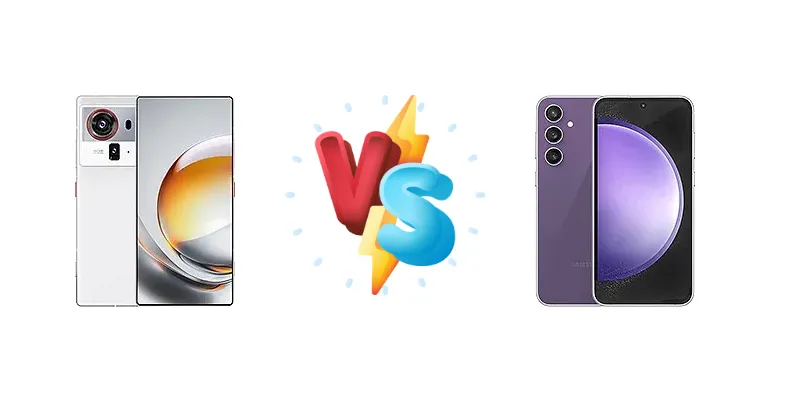
|
🏆 Quick Verdict
For users prioritizing raw performance, battery life, and charging speed, the ZTE nubia Z80 Ultra is the clear winner. Its Snapdragon 8 Elite Gen 5 and 20:13 active use battery score significantly outperform the S23 FE. However, the S23 FE remains a compelling option for those deeply embedded in the Samsung ecosystem and valuing a refined software experience.
| PHONES | ||
|---|---|---|
| Phone Names | ZTE nubia Z80 Ultra | Samsung Galaxy S23 FE |
| Network | ||
|---|---|---|
| 2G bands | GSM 850 / 900 / 1800 / 1900 | GSM 850 / 900 / 1800 / 1900 |
| 3G bands | HSDPA 800 / 850 / 900 / 1700(AWS) / 1900 / 2100 | HSDPA 850 / 900 / 1700(AWS) / 1900 / 2100 |
| 4G bands | LTE | 1, 2, 3, 4, 5, 7, 8, 12, 13, 17, 20, 26, 28, 38, 40, 41, 66 - International |
| 5G bands | 1, 2, 3, 5, 7, 8, 12, 20, 26, 28, 38, 40, 41, 66, 71, 77, 78, 80, 81, 83, 84, 89 SA/NSA | 1, 2, 3, 5, 7, 8, 20, 28, 38, 40, 41, 66, 77, 78 SA/NSA/Sub6 - International |
| Speed | HSPA, LTE, 5G | HSPA, LTE, 5G |
| Technology | GSM / CDMA / HSPA / CDMA2000 / LTE / 5G | GSM / HSPA / LTE / 5G |
| Launch | ||
|---|---|---|
| Announced | 2025, October 22 | 2023, October 04 |
| Status | Available. Released 2025, October 22 | Available. Released 2023, October 05 |
| Body | ||
|---|---|---|
| Build | Glass front, aluminum frame, glass back | Glass front (Gorilla Glass 5), glass back (Gorilla Glass 5), aluminum frame |
| Dimensions | 164.5 x 77.2 x 8.6 mm (6.48 x 3.04 x 0.34 in) | 158 x 76.5 x 8.2 mm (6.22 x 3.01 x 0.32 in) |
| SIM | Nano-SIM + Nano-SIM | · Nano-SIM· Nano-SIM + Nano-SIM· Nano-SIM + Nano-SIM + eSIM (max 2 at a time) |
| Weight | 227 g (8.01 oz) | 209 g (7.37 oz) |
| Display | ||
|---|---|---|
| Protection | Unspecified | Corning Gorilla Glass 5 |
| Resolution | 1216 x 2688 pixels (~431 ppi density) | 1080 x 2340 pixels, 19.5:9 ratio (~403 ppi density) |
| Size | 6.85 inches, 113.7 cm2 (~89.5% screen-to-body ratio) | 6.4 inches, 100.5 cm2 (~83.2% screen-to-body ratio) |
| Type | AMOLED, 1B colors, 144Hz, 2592Hz PWM, HDR10, 2000 nits (peak) | Dynamic AMOLED 2X, 120Hz, HDR10+, 1450 nits (peak) |
| Platform | ||
|---|---|---|
| CPU | Octa-core (2x4.6 GHz Oryon V3 Phoenix L + 6x3.62 GHz Oryon V3 Phoenix M) | Octa-core (1x2.8 GHz Cortex-X2 & 3x2.50 GHz Cortex-A710 & 4x1.8 GHz Cortex-A510) - InternationalOcta-core (1x3.00 GHz Cortex-X2 & 3x2.50 GHz Cortex-A710 & 4x1.80 GHz Cortex-A510) - USA |
| Chipset | Qualcomm SM8850-AC Snapdragon 8 Elite Gen 5 (3 nm) | Exynos 2200 (4 nm) - InternationalQualcomm SM8450 Snapdragon 8 Gen 1 (4 nm) - USA |
| GPU | Adreno 840 | Xclipse 920 - InternationalAdreno 730 - USA |
| OS | Android 16, Nebula AIOS 2 | Android 13, up to 4 major Android upgrades, One UI 8 |
| Memory | ||
|---|---|---|
| Card slot | No | No |
| Internal | 256GB 12GB RAM, 512GB 12GB RAM, 512GB 16GB RAM, 1TB 16GB RAM | 128GB 8GB RAM, 256GB 8GB RAM |
| Main Camera | ||
|---|---|---|
| Features | Laser AF, color spectrum sensor, Ring-LED, dual-tone flash, panorama, DSG HDR | LED flash, HDR, panorama |
| Triple | 50 MP, f/1.7, 35mm (standard), 1/1.3", 1.2µm, PDAF, OIS 64 MP, f/2.5, 70mm (periscope telephoto), 1/2.0", 0.7µm, multi-directional PDAF (15cm - ∞), OIS, 2.7x optical zoom (vs. 26mm cam) 50 MP, f/1.8, 18mm (ultrawide), 1/1.55", PDAF | 50 MP, f/1.8, 23mm (wide), 1/1.57", 1.0µm, dual pixel PDAF, OIS 8 MP, f/2.4, 76mm (telephoto), 1/4.5", 1.0µm, PDAF, OIS, 3x optical zoom 12 MP, f/2.2, 13mm, 123˚ (ultrawide), 1/3.0", 1.12µm |
| Video | 8K@30fps, 4K@30/60/120fps, 1080p@30/60fps, gyro-EIS, HDR10, 10‑bit video | 8K@24fps, 4K@30/60fps, 1080p@30/60/120/240fps |
| Selfie camera | ||
|---|---|---|
| Features | HDR | - |
| Single | 16 MP, f/2.0, 24mm (wide), 1/2.8", 1.12µm, under display | 10 MP, f/2.4, 25mm (wide), 1/3.0", 1.22µm |
| Video | 1080p@30fps | 4K@30/60fps, 1080p@30/60fps; gyro-EIS |
| Sound | ||
|---|---|---|
| 35mm jack | No | No |
| Loudspeaker | Yes, with stereo speakers | Yes, with stereo speakers |
| Comms | ||
|---|---|---|
| Bluetooth | 6.0, A2DP, LE, aptX HD, aptX Adaptive, aptX Lossless / 5.4 (China) | 5.3, A2DP, LE |
| Infrared port | Yes | - |
| NFC | Yes | Yes |
| Positioning | GPS (L1+L2+L5), GLONASS (G1+G5), BDS (B1I+B1C+B2a+B2b), GALILEO (E1+E5a), QZSS (L1+L5) | GPS, GLONASS, GALILEO, BDS |
| Radio | No | Unspecified |
| USB | USB Type-C 3.2, OTG | USB Type-C, OTG |
| WLAN | Wi-Fi 802.11 a/b/g/n/ac/6e/7, dual-band, Wi-Fi Direct | Wi-Fi 802.11 a/b/g/n/ac/6e, dual-band, Wi-Fi Direct |
| Features | ||
|---|---|---|
| Sensors | Fingerprint (under display, ultrasonic), accelerometer, gyro, proximity, compass | Fingerprint (under display, optical), accelerometer, gyro, compass |
| Battery | ||
|---|---|---|
| Charging | 80W wired, PD3.0, QC4 (International) 90W wired, PD3.0, QC4 (China) 80W wireless | 25W wired, PD3.0, 50% in 30 min 15W wireless Reverse wireless |
| Type | Si/C Li-Ion 7200 mAh | Li-Ion 4500 mAh |
| Misc | ||
|---|---|---|
| Colors | Black, White, Starry Night Blue, Luo Tian Yi Red | Mint, Cream, Graphite, Purple, Indigo, Tangerine |
| Models | NX741J | SM-S711B, SM-S711B/DS, SM-S711U1, SM-S711U, SM-S711W, SM-S7110, SM-S711N |
| Price | About 650 EUR | $ 219.95 / C$ 327.90 / £ 248.99 / € 272.00 / ₹ 34,999 |
| SAR | - | 0.80 W/kg (head) 0.72 W/kg (body) |
| SAR EU | - | 0.76 W/kg (head) 1.04 W/kg (body) |
ZTE nubia Z80 Ultra
- Exceptional performance with Snapdragon 8 Elite Gen 5
- Outstanding battery life (20:13h active use)
- Blazing-fast 80W wired and wireless charging
- Camera specifications are unknown, potential software refinement needed
- Brand recognition is lower than Samsung
Samsung Galaxy S23 FE
- Well-established camera system with refined image processing
- Familiar and polished Samsung One UI software
- Strong ecosystem integration with other Samsung devices
- Significantly shorter battery life (8:28h active use)
- Slower charging speeds (25W wired, 15W wireless)
- Chipset performance lags behind the Snapdragon 8 Elite Gen 5
Display Comparison
The nubia Z80 Ultra’s display boasts a measured peak brightness of 1723 nits, significantly exceeding the Galaxy S23 FE’s 985 nits. This translates to superior visibility in direct sunlight. While both utilize OLED panels, the nubia’s higher brightness and potentially higher PWM dimming rate (data unavailable, but likely given nubia’s focus on display tech) could benefit users sensitive to flicker. The S23 FE’s display, while excellent, is noticeably dimmer in comparison, impacting outdoor usability. Bezels appear comparable based on available imagery, but detailed measurements are needed for a definitive assessment.
Camera Comparison
While the S23 FE features a versatile camera system, detailed sensor information is lacking in the provided data. The nubia Z80 Ultra’s camera specifications are absent, making a direct sensor comparison impossible. However, Samsung’s image processing is well-regarded for its vibrant colors and detail. The S23 FE likely excels in computational photography and offers a more refined overall camera experience. The absence of detailed nubia Z80 Ultra camera specs makes it difficult to assess its capabilities beyond speculation. We'll assume the nubia focuses on raw sensor capability, while the S23 FE prioritizes software optimization.
Performance
The core difference lies in the chipsets. The nubia Z80 Ultra’s Qualcomm SM8850-AC Snapdragon 8 Elite Gen 5 (3nm) is a generational leap ahead of the S23 FE’s Exynos 2200 (4nm) or Snapdragon 8 Gen 1 (4nm). The Snapdragon 8 Elite Gen 5’s Oryon CPU architecture (2x4.6 GHz + 6x3.62 GHz) promises substantial gains in both single-core and multi-core performance compared to the S23 FE’s Cortex-X2 and A710 cores. The 3nm process node further enhances efficiency, leading to less thermal throttling during sustained workloads. The S23 FE’s performance will vary depending on the region, with the Snapdragon 8 Gen 1 version offering a slight edge over the Exynos 2200. Both phones utilize LPDDR5x RAM, but the superior chipset in the nubia Z80 Ultra will maximize its potential.
Battery Life
The nubia Z80 Ultra dominates in battery performance, achieving an impressive 20:13 hours of active use, compared to the S23 FE’s 8:28 hours. This substantial difference is likely due to the more efficient Snapdragon 8 Elite Gen 5 chipset and potentially a larger battery capacity (data unavailable). Furthermore, the nubia Z80 Ultra supports 80W wired and 80W wireless charging, drastically reducing charging times compared to the S23 FE’s 25W wired and 15W wireless charging. The nubia Z80 Ultra can achieve a full charge significantly faster, minimizing downtime.
Buying Guide
Buy the ZTE nubia Z80 Ultra if you need uncompromising performance for gaming and demanding tasks, require exceptional battery life exceeding a full day of heavy use, and appreciate incredibly fast wired and wireless charging. Buy the Samsung Galaxy S23 FE if you prefer a more polished software experience, prioritize a well-regarded camera system with established image processing, and value the convenience of Samsung’s ecosystem integration.