
ZTE nubia Z80 Ultra vs. Oppo Find X6 Pro: A Deep Dive into Flagship Android Power
| Phones Images | |||||
|---|---|---|---|---|---|
|
🏆 Quick Verdict
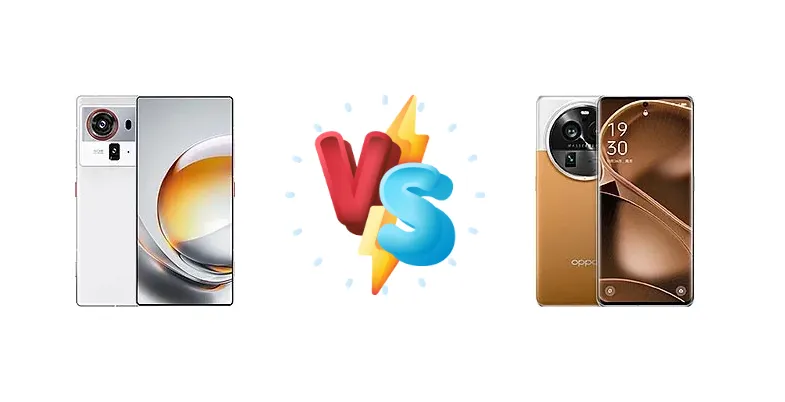
For users prioritizing raw power and the fastest charging available, the ZTE nubia Z80 Ultra is the clear winner. Its Snapdragon 8 Elite Gen 5 and 80W wireless charging are unmatched. However, the Oppo Find X6 Pro offers a more refined and potentially more efficient experience with its Snapdragon 8 Gen 2 and excellent camera capabilities.
| PHONES | ||
|---|---|---|
| Phone Names | ZTE nubia Z80 Ultra | Oppo Find X6 Pro |
| Network | ||
|---|---|---|
| 2G bands | GSM 850 / 900 / 1800 / 1900 | GSM 850 / 900 / 1800 / 1900 |
| 3G bands | HSDPA 800 / 850 / 900 / 1700(AWS) / 1900 / 2100 | HSDPA 800 / 850 / 900 / 1700(AWS) / 1900 / 2100 |
| 4G bands | LTE | 1, 2, 3, 4, 5, 7, 8, 12, 17, 18, 19, 20, 26, 28, 34, 38, 39, 40, 41, 66 |
| 5G bands | 1, 2, 3, 5, 7, 8, 12, 20, 26, 28, 38, 40, 41, 66, 71, 77, 78, 80, 81, 83, 84, 89 SA/NSA | 1, 3, 5, 7, 8, 20, 28, 38, 40, 41, 66, 77, 78, 79 SA/NSA |
| Speed | HSPA, LTE, 5G | HSPA, LTE, 5G |
| Technology | GSM / CDMA / HSPA / CDMA2000 / LTE / 5G | GSM / CDMA / HSPA / CDMA2000 / LTE / 5G |
| - | CDMA2000 1x | |
| Launch | ||
|---|---|---|
| Announced | 2025, October 22 | 2023, March 21 |
| Status | Available. Released 2025, October 22 | Available. Released 2023, March 24 |
| Body | ||
|---|---|---|
| Build | Glass front, aluminum frame, glass back | Glass front (Gorilla Glass Victus 2), glass back (Gorilla Glass 5) or eco leather back, aluminum frame |
| Dimensions | 164.5 x 77.2 x 8.6 mm (6.48 x 3.04 x 0.34 in) | 164.8 x 76.2 x 9.1 mm or 9.5 mm |
| SIM | Nano-SIM + Nano-SIM | Nano-SIM + Nano-SIM |
| Weight | 227 g (8.01 oz) | 216 g or 218 g (7.62 oz) |
| - | IP68 dust/water resistant (up to 1.5m for 30 min) | |
| Display | ||
|---|---|---|
| Protection | Unspecified | Corning Gorilla Glass Victus 2 |
| Resolution | 1216 x 2688 pixels (~431 ppi density) | 1440 x 3168 pixels (~510 ppi density) |
| Size | 6.85 inches, 113.7 cm2 (~89.5% screen-to-body ratio) | 6.82 inches, 113.0 cm2 (~90.0% screen-to-body ratio) |
| Type | AMOLED, 1B colors, 144Hz, 2592Hz PWM, HDR10, 2000 nits (peak) | LTPO3 AMOLED, 1B colors, 120Hz, Dolby Vision, HDR10+, 800 nits (typ), 1500 nits (HBM), 2500 nits (peak) |
| Platform | ||
|---|---|---|
| CPU | Octa-core (2x4.6 GHz Oryon V3 Phoenix L + 6x3.62 GHz Oryon V3 Phoenix M) | Octa-core (1x3.2 GHz Cortex-X3 & 2x2.8 GHz Cortex-A715 & 2x2.8 GHz Cortex-A710 & 3x2.0 GHz Cortex-A510) |
| Chipset | Qualcomm SM8850-AC Snapdragon 8 Elite Gen 5 (3 nm) | Qualcomm SM8550-AB Snapdragon 8 Gen 2 (4 nm) |
| GPU | Adreno 840 | Adreno 740 |
| OS | Android 16, Nebula AIOS 2 | Android 13, up to 4 major Android upgrades, ColorOS 14 |
| Memory | ||
|---|---|---|
| Card slot | No | No |
| Internal | 256GB 12GB RAM, 512GB 12GB RAM, 512GB 16GB RAM, 1TB 16GB RAM | 256GB 12GB RAM, 256GB 16GB RAM, 512GB 16GB RAM |
| - | UFS 4.0 | |
| Main Camera | ||
|---|---|---|
| Features | Laser AF, color spectrum sensor, Ring-LED, dual-tone flash, panorama, DSG HDR | Laser AF, color spectrum sensor, Hasselblad Color Calibration, LED flash, HDR, panorama |
| Triple | 50 MP, f/1.7, 35mm (standard), 1/1.3", 1.2µm, PDAF, OIS 64 MP, f/2.5, 70mm (periscope telephoto), 1/2.0", 0.7µm, multi-directional PDAF (15cm - ∞), OIS, 2.7x optical zoom (vs. 26mm cam) 50 MP, f/1.8, 18mm (ultrawide), 1/1.55", PDAF | 50 MP, f/1.8, 23mm (wide), 1.0"-type, 1.6µm, dual pixel PDAF, OIS 50 MP, f/2.6, 65mm (periscope telephoto), 1/1.56", 1.0µm, 2.8x optical zoom, multi-directional PDAF, OIS 50 MP, f/2.2, 15mm, 110˚ (ultrawide), 1/1.56", 1.0µm, multi-directional PDAF |
| Video | 8K@30fps, 4K@30/60/120fps, 1080p@30/60fps, gyro-EIS, HDR10, 10‑bit video | 4K@30/60fps, 1080p@30/60/240fps; gyro-EIS; HDR, 10‑bit video, Dolby Vision |
| Selfie camera | ||
|---|---|---|
| Features | HDR | Panorama |
| Single | 16 MP, f/2.0, 24mm (wide), 1/2.8", 1.12µm, under display | 32 MP, f/2.4, 21mm (wide), 1/2.74", 0.8µm, PDAF |
| Video | 1080p@30fps | 4K@30fps, gyro-EIS |
| Sound | ||
|---|---|---|
| 3.5mm jack | - | No |
| 35mm jack | No | No |
| Loudspeaker | Yes, with stereo speakers | Yes, with stereo speakers |
| Comms | ||
|---|---|---|
| Bluetooth | 6.0, A2DP, LE, aptX HD, aptX Adaptive, aptX Lossless / 5.4 (China) | 5.3, A2DP, LE, aptX HD |
| Infrared port | Yes | Yes |
| NFC | Yes | Yes |
| Positioning | GPS (L1+L2+L5), GLONASS (G1+G5), BDS (B1I+B1C+B2a+B2b), GALILEO (E1+E5a), QZSS (L1+L5) | GPS (L1+L5), GLONASS (G1), BDS (B1I+B1c+B2a), GALILEO (E1+E5a), QZSS (L1+L5) |
| Radio | No | No |
| USB | USB Type-C 3.2, OTG | USB Type-C 3.1, OTG |
| WLAN | Wi-Fi 802.11 a/b/g/n/ac/6e/7, dual-band, Wi-Fi Direct | Wi-Fi 802.11 a/b/g/n/ac/6e/7, tri-band, Wi-Fi Direct |
| Features | ||
|---|---|---|
| Sensors | Fingerprint (under display, ultrasonic), accelerometer, gyro, proximity, compass | Fingerprint (under display, optical), accelerometer, gyro, proximity, compass |
| Battery | ||
|---|---|---|
| Charging | 80W wired, PD3.0, QC4 (International) 90W wired, PD3.0, QC4 (China) 80W wireless | 100W wired, PD, 45% in 10 min, 100% in 30 min 50W wireless, 50% in 22 min, 100% in 51 min 10W reverse wireless |
| Type | Si/C Li-Ion 7200 mAh | Li-Po 5000 mAh |
| Misc | ||
|---|---|---|
| Colors | Black, White, Starry Night Blue, Luo Tian Yi Red | Black, Green, Brown |
| Models | NX741J | PGEM110, PGEM10 |
| Price | About 650 EUR | About 820 EUR |
| Tests | ||
|---|---|---|
| Battery life | - | Endurance rating 114h |
| Camera | - | Photo / Video |
| Display | - | Contrast ratio: Infinite (nominal) |
| Loudspeaker | - | -25.1 LUFS (Very good) |
| Performance | - | AnTuTu: 1294797 (v9) GeekBench: 4791 (v5.1), 5226 (v6) GFXBench: 60fps (ES 3.1 onscreen) |
ZTE nubia Z80 Ultra
- Unmatched processing power with Snapdragon 8 Elite Gen 5
- Industry-leading 80W wireless charging
- Exceptionally bright display (1723 nits)
- Potential for thermal throttling under sustained load
- Camera performance details are currently limited
Oppo Find X6 Pro
- Excellent camera system with a focus on image quality
- Efficient Snapdragon 8 Gen 2 processor
- Fast 100W wired charging and 50W wireless charging
- Lower peak display brightness compared to nubia Z80 Ultra
- Less powerful processor than the nubia Z80 Ultra
Display Comparison
The nubia Z80 Ultra boasts a significantly brighter display, reaching a measured 1723 nits compared to the Oppo Find X6 Pro’s 1318 nits. This translates to superior visibility in direct sunlight. While both displays feature an infinite contrast ratio (nominal), the higher peak brightness of the nubia Z80 Ultra provides a more vibrant and impactful visual experience. Details regarding panel technology (LTPO) and refresh rates are missing, but both are expected to offer smooth scrolling and adaptive refresh rates typical of flagship devices.
Camera Comparison
Both phones are advertised as having strong camera systems, but specific details are limited. The Oppo Find X6 Pro is explicitly noted for its Photo/Video capabilities, suggesting a strong emphasis on image quality. Without sensor size or aperture information, it’s difficult to make a definitive comparison. However, the Oppo Find X6 Pro’s reputation suggests a focus on natural color reproduction and dynamic range. The nubia Z80 Ultra’s camera performance remains largely unknown without further specifications. We can assume both will offer a range of shooting modes and features common to flagship smartphones.
Performance
The core difference lies in the chipsets. The nubia Z80 Ultra utilizes the Qualcomm SM8850-AC Snapdragon 8 Elite Gen 5 (3nm), featuring a unique octa-core configuration with Oryon V3 Phoenix L and M cores clocked up to 4.6 GHz. This contrasts with the Oppo Find X6 Pro’s Snapdragon 8 Gen 2 (4nm), which employs a more conventional Cortex-X3, A715, A710, and A510 core arrangement. The 3nm process of the Snapdragon 8 Elite Gen 5 *should* offer improved power efficiency, but the higher clock speeds and aggressive core design may lead to increased thermal output. The nubia Z80 Ultra is likely to excel in sustained workloads, but the Oppo Find X6 Pro’s 4nm process may provide better thermal management during extended gaming sessions.
Battery Life
The nubia Z80 Ultra delivers a compelling battery and charging package. Its active use score of 20:13h suggests excellent endurance. The charging speeds are particularly impressive: 80W wired (International) / 90W (China), 80W wireless, and support for PD3.0 and QC4. The Oppo Find X6 Pro offers 100W wired charging (0-100% in 30 minutes) and 50W wireless charging (0-100% in 51 minutes), alongside 10W reverse wireless charging. While the Oppo charges slightly faster wired, the nubia Z80 Ultra’s 80W wireless charging is a significant advantage. The Oppo’s endurance rating of 114h is a useful metric, but real-world usage will vary.
Buying Guide
Buy the ZTE nubia Z80 Ultra if you demand the absolute best in processing power for demanding games and applications, and if minimizing charging times is paramount. You'll benefit from the Snapdragon 8 Elite Gen 5's Oryon cores and the convenience of 80W wireless charging. Buy the Oppo Find X6 Pro if you prioritize a well-rounded flagship experience with a focus on camera quality, efficient performance, and a potentially more stable software experience. Its Snapdragon 8 Gen 2 provides excellent performance without the potential thermal concerns of a newer, more aggressive chip.