
ZTE nubia Z80 Ultra vs. Google Pixel 8 Pro: A Deep Dive into Performance, Camera, and Battery Life
| Phones Images | |||||
|---|---|---|---|---|---|
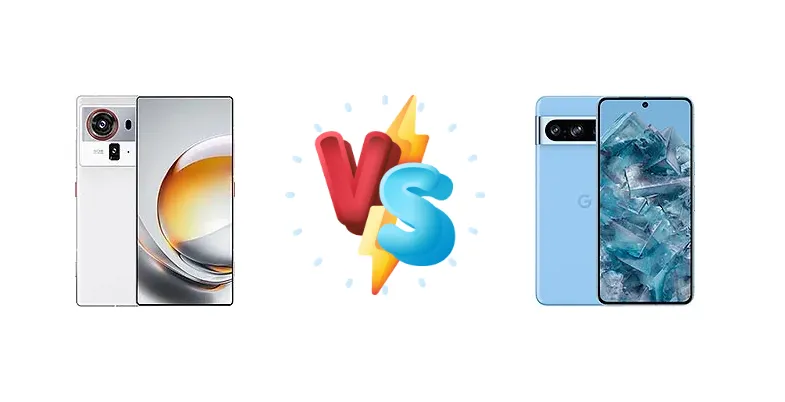
|
🏆 Quick Verdict
For users prioritizing peak performance, gaming, and incredibly fast charging, the ZTE nubia Z80 Ultra is the clear winner. Its Snapdragon 8 Elite Gen 5 and 80W wireless charging are unmatched. However, the Google Pixel 8 Pro excels in camera versatility and AI-powered features, making it the better choice for photography enthusiasts and those deeply invested in the Google ecosystem.
| PHONES | ||
|---|---|---|
| Phone Names | ZTE nubia Z80 Ultra | Google Pixel 8 Pro |
| Network | ||
|---|---|---|
| 2G bands | GSM 850 / 900 / 1800 / 1900 | GSM 850 / 900 / 1800 / 1900 |
| 3G bands | HSDPA 800 / 850 / 900 / 1700(AWS) / 1900 / 2100 | HSDPA 800 / 850 / 900 / 1700(AWS) / 1900 / 2100 |
| 4G bands | LTE | 1, 2, 3, 4, 5, 7, 8, 12, 13, 14, 17, 18, 19, 20, 25, 26, 28, 29, 30, 38, 39, 40, 41, 46, 48, 66, 71 - G1MNW |
| 5G bands | 1, 2, 3, 5, 7, 8, 12, 20, 26, 28, 38, 40, 41, 66, 71, 77, 78, 80, 81, 83, 84, 89 SA/NSA | 1, 2, 3, 5, 7, 8, 12, 20, 25, 26, 28, 29, 30, 38, 40, 41, 48, 66, 70, 71, 77, 78, 257, 258, 260, 261 SA/NSA/Sub6/mmWave - G1MNW |
| Speed | HSPA, LTE, 5G | HSPA, LTE, 5G |
| Technology | GSM / CDMA / HSPA / CDMA2000 / LTE / 5G | GSM / HSPA / LTE / 5G |
| Launch | ||
|---|---|---|
| Announced | 2025, October 22 | 2023, October 04 |
| Status | Available. Released 2025, October 22 | Available. Released 2023, October 12 |
| Body | ||
|---|---|---|
| Build | Glass front, aluminum frame, glass back | Glass front (Gorilla Glass Victus 2), glass back (Gorilla Glass Victus 2), aluminum frame |
| Dimensions | 164.5 x 77.2 x 8.6 mm (6.48 x 3.04 x 0.34 in) | 162.6 x 76.5 x 8.8 mm (6.40 x 3.01 x 0.35 in) |
| SIM | Nano-SIM + Nano-SIM | Nano-SIM + eSIM |
| Weight | 227 g (8.01 oz) | 213 g (7.51 oz) |
| Display | ||
|---|---|---|
| Protection | Unspecified | Corning Gorilla Glass Victus 2 |
| Resolution | 1216 x 2688 pixels (~431 ppi density) | 1344 x 2992 pixels, 20:9 ratio (~489 ppi density) |
| Size | 6.85 inches, 113.7 cm2 (~89.5% screen-to-body ratio) | 6.7 inches, 108.7 cm2 (~87.4% screen-to-body ratio) |
| Type | AMOLED, 1B colors, 144Hz, 2592Hz PWM, HDR10, 2000 nits (peak) | LTPO OLED, 120Hz, HDR10+, 1600 nits (HBM), 2400 nits (peak) |
| Platform | ||
|---|---|---|
| CPU | Octa-core (2x4.6 GHz Oryon V3 Phoenix L + 6x3.62 GHz Oryon V3 Phoenix M) | Nona-core (1x3.0 GHz Cortex-X3 & 4x2.45 GHz Cortex-A715 & 4x2.15 GHz Cortex-A510) |
| Chipset | Qualcomm SM8850-AC Snapdragon 8 Elite Gen 5 (3 nm) | Google Tensor G3 (4 nm) |
| GPU | Adreno 840 | Immortalis-G715s MC10 |
| OS | Android 16, Nebula AIOS 2 | Android 14, upgradable to Android 16, up to 7 major Android upgrades |
| Memory | ||
|---|---|---|
| Card slot | No | No |
| Internal | 256GB 12GB RAM, 512GB 12GB RAM, 512GB 16GB RAM, 1TB 16GB RAM | 128GB 12GB RAM, 256GB 12GB RAM, 512GB 12GB RAM, 1TB 12GB RAM |
| Main Camera | ||
|---|---|---|
| Features | Laser AF, color spectrum sensor, Ring-LED, dual-tone flash, panorama, DSG HDR | Multi-zone Laser AF, Dual-LED flash, Pixel Shift, Ultra-HDR, panorama, Best Take, Zoom Enhance |
| Triple | 50 MP, f/1.7, 35mm (standard), 1/1.3", 1.2µm, PDAF, OIS 64 MP, f/2.5, 70mm (periscope telephoto), 1/2.0", 0.7µm, multi-directional PDAF (15cm - ∞), OIS, 2.7x optical zoom (vs. 26mm cam) 50 MP, f/1.8, 18mm (ultrawide), 1/1.55", PDAF | 50 MP, f/1.7, 25mm (wide), 1/1.31", 1.2µm, dual pixel PDAF, OIS 48 MP, f/2.8, 113mm (periscope telephoto), 1/2.55", 0.7µm, dual pixel PDAF, OIS, 5x optical zoom 48 MP, f/2.0, 126˚ (ultrawide), 1/2.0", 0.8µm, dual pixel PDAF |
| Video | 8K@30fps, 4K@30/60/120fps, 1080p@30/60fps, gyro-EIS, HDR10, 10‑bit video | 4K@30/60fps, 1080p@24/30/60/120/240fps; gyro-EIS, OIS, 10-bit HDR |
| Selfie camera | ||
|---|---|---|
| Features | HDR | HDR, panorama |
| Single | 16 MP, f/2.0, 24mm (wide), 1/2.8", 1.12µm, under display | 10.5 MP, f/2.2, 20mm (ultrawide), 1/3.1", 1.22µm, PDAF |
| Video | 1080p@30fps | 4K@24/30/60fps, 1080p@30/60fps |
| Sound | ||
|---|---|---|
| 35mm jack | No | No |
| Loudspeaker | Yes, with stereo speakers | Yes, with stereo speakers |
| Comms | ||
|---|---|---|
| Bluetooth | 6.0, A2DP, LE, aptX HD, aptX Adaptive, aptX Lossless / 5.4 (China) | 5.3, A2DP, LE, aptX HD |
| Infrared port | Yes | - |
| NFC | Yes | Yes |
| Positioning | GPS (L1+L2+L5), GLONASS (G1+G5), BDS (B1I+B1C+B2a+B2b), GALILEO (E1+E5a), QZSS (L1+L5) | GPS (L1+L5), GLONASS (G1), GALILEO (E1+E5a), QZSS (L1+L5) |
| Radio | No | No |
| USB | USB Type-C 3.2, OTG | USB Type-C 3.2 |
| WLAN | Wi-Fi 802.11 a/b/g/n/ac/6e/7, dual-band, Wi-Fi Direct | Wi-Fi 802.11 a/b/g/n/ac/6e/7, tri-band, Wi-Fi Direct |
| Features | ||
|---|---|---|
| Sensors | Fingerprint (under display, ultrasonic), accelerometer, gyro, proximity, compass | Fingerprint (under display, optical), accelerometer, gyro, proximity, compass, barometer, thermometer (skin temperature) |
| Battery | ||
|---|---|---|
| Charging | 80W wired, PD3.0, QC4 (International) 90W wired, PD3.0, QC4 (China) 80W wireless | 30W wired, PD3.0, PPS, 50% in 30 min 23W wireless Reverse wireless Bypass charging |
| Type | Si/C Li-Ion 7200 mAh | Li-Ion 5050 mAh |
| Misc | ||
|---|---|---|
| Colors | Black, White, Starry Night Blue, Luo Tian Yi Red | Obsidian, Porcelain, Bay, Mint |
| Models | NX741J | GC3VE, G1MNW |
| Price | About 650 EUR | € 362.00 / $ 289.97 / £ 329.95 / ₹ 54,999 |
ZTE nubia Z80 Ultra
- Unmatched charging speeds (80W wired, 80W wireless)
- Superior CPU and GPU performance with Snapdragon 8 Elite Gen 5
- Exceptional battery life (20:13h active use)
- Camera details are currently limited
- Software experience may not be as refined as the Pixel 8 Pro
Google Pixel 8 Pro
- Exceptional camera system with advanced computational photography
- Seamless software experience and AI-powered features
- Reverse wireless charging and bypass charging for battery health
- Slower charging speeds (30W wired, 23W wireless)
- Less powerful processor compared to Snapdragon 8 Elite Gen 5
- Shorter battery life (11:14h active use)
Display Comparison
Both devices feature excellent displays, but the nubia Z80 Ultra edges ahead with a measured peak brightness of 1723 nits compared to the Pixel 8 Pro’s 1600 nits. While both are easily viewable outdoors, the nubia’s higher peak brightness provides a slight advantage in direct sunlight. Details regarding panel technology (LTPO) and refresh rates are missing for the nubia, but assuming a flagship-level implementation, the experience should be comparable to the Pixel 8 Pro’s smooth 120Hz LTPO panel. Bezels appear similarly minimal on both devices, and color accuracy is expected to be excellent on both, though independent calibration data is needed for a definitive assessment.
Camera Comparison
The Pixel 8 Pro is renowned for its computational photography prowess, and while detailed sensor specifications for the nubia Z80 Ultra are absent, the Pixel 8 Pro’s camera system is a known quantity. Google’s image processing algorithms consistently deliver excellent dynamic range, accurate colors, and impressive low-light performance. The Pixel 8 Pro’s video capabilities are also top-tier. The nubia Z80 Ultra will likely rely more on hardware capabilities, but without specific details on sensor size, aperture, and OIS, it’s difficult to assess its photographic performance relative to the Pixel 8 Pro. The Pixel 8 Pro’s strength lies in its software-driven enhancements, offering features like Magic Eraser and Photo Unblur.
Performance
The performance gap is significant. The nubia Z80 Ultra’s Qualcomm SM8850-AC Snapdragon 8 Elite Gen 5 (3nm) is a powerhouse, featuring an octa-core CPU configuration with 2x4.6 GHz Oryon V3 Phoenix L cores and 6x3.62 GHz Oryon V3 Phoenix M cores. This contrasts sharply with the Pixel 8 Pro’s Google Tensor G3 (4nm) which employs a nona-core setup (1x3.0 GHz Cortex-X3, 4x2.45 GHz Cortex-A715, 4x2.15 GHz Cortex-A510). The Snapdragon 8 Elite Gen 5’s newer architecture and higher clock speeds translate to demonstrably faster CPU and GPU performance, particularly in sustained workloads. The 3nm process node also contributes to improved thermal efficiency, potentially mitigating throttling during extended gaming sessions. While the Tensor G3 excels in AI tasks, the nubia Z80 Ultra dominates in raw processing power.
Battery Life
The nubia Z80 Ultra boasts a significant advantage in charging speed. Its 80W wired (International) / 90W (China) charging, coupled with 80W wireless charging, drastically reduces recharge times compared to the Pixel 8 Pro’s 30W wired and 23W wireless charging. The Pixel 8 Pro’s battery life, as measured by active use, is 11:14h, while the nubia Z80 Ultra achieves an impressive 20:13h. This suggests a larger battery capacity and/or more efficient power management on the nubia’s side. The Pixel 8 Pro does offer reverse wireless charging and 'bypass charging' to reduce battery degradation, features absent from the nubia Z80 Ultra’s specifications.
Buying Guide
Buy the ZTE nubia Z80 Ultra if you need uncompromising performance for demanding tasks like gaming and video editing, and value the convenience of extremely fast wired and wireless charging. Buy the Google Pixel 8 Pro if you prefer a seamless software experience, prioritize computational photography and AI-driven features, and appreciate a more refined, polished user interface.