
ZTE nubia Z80 Ultra vs. Asus Zenfone 10: A Flagship Face-Off
| Phones Images | |||||
|---|---|---|---|---|---|
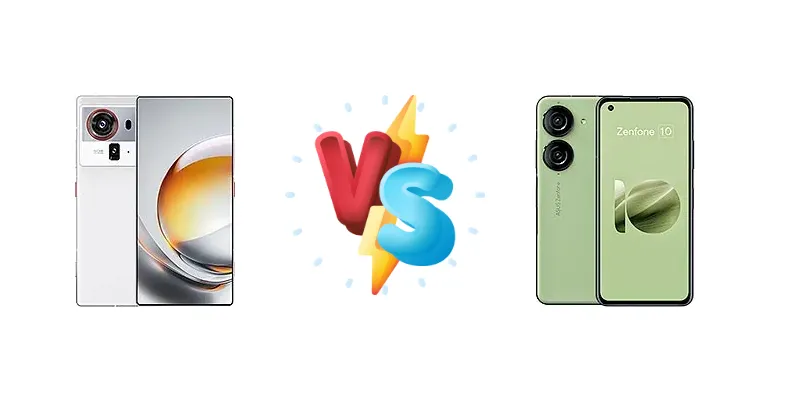
|
🏆 Quick Verdict
For users prioritizing raw power, display quality, and rapid charging, the ZTE nubia Z80 Ultra is the clear winner. However, the Asus Zenfone 10’s compact size and excellent usability make it the superior choice for those who value one-handed operation and portability.
| PHONES | ||
|---|---|---|
| Phone Names | ZTE nubia Z80 Ultra | Asus Zenfone 10 |
| Network | ||
|---|---|---|
| 2G bands | GSM 850 / 900 / 1800 / 1900 | GSM 850 / 900 / 1800 / 1900 |
| 3G bands | HSDPA 800 / 850 / 900 / 1700(AWS) / 1900 / 2100 | HSDPA 850 / 900 / 1700(AWS) / 1800 / 1900 / 2100 |
| 4G bands | LTE | 1, 2, 3, 4, 5, 7, 8, 12, 17, 18, 19, 20, 26, 28, 34, 38, 39, 40, 41, 42 |
| 5G bands | 1, 2, 3, 5, 7, 8, 12, 20, 26, 28, 38, 40, 41, 66, 71, 77, 78, 80, 81, 83, 84, 89 SA/NSA | 1, 2, 3, 5, 7, 8, 12, 20, 28, 38, 41, 77, 78 SA/NSA |
| Speed | HSPA, LTE, 5G | HSPA, LTE, 5G |
| Technology | GSM / CDMA / HSPA / CDMA2000 / LTE / 5G | GSM / HSPA / LTE / 5G |
| Launch | ||
|---|---|---|
| Announced | 2025, October 22 | 2023, June 29 |
| Status | Available. Released 2025, October 22 | Available. Released 2023, July 10 |
| Body | ||
|---|---|---|
| Build | Glass front, aluminum frame, glass back | Glass front, aluminum frame, plastic back |
| Dimensions | 164.5 x 77.2 x 8.6 mm (6.48 x 3.04 x 0.34 in) | 146.5 x 68.1 x 9.4 mm (5.77 x 2.68 x 0.37 in) |
| SIM | Nano-SIM + Nano-SIM | Nano-SIM + Nano-SIM |
| Weight | 227 g (8.01 oz) | 172 g (6.07 oz) |
| Display | ||
|---|---|---|
| Protection | Unspecified | Corning Gorilla Glass Victus |
| Resolution | 1216 x 2688 pixels (~431 ppi density) | 1080 x 2400 pixels, 20:9 ratio (~445 ppi density) |
| Size | 6.85 inches, 113.7 cm2 (~89.5% screen-to-body ratio) | 5.92 inches, 84.6 cm2 (~84.8% screen-to-body ratio) |
| Type | AMOLED, 1B colors, 144Hz, 2592Hz PWM, HDR10, 2000 nits (peak) | Super AMOLED, 144Hz, HDR10+, 800 nits (HBM), 1100 nits (peak) |
| Platform | ||
|---|---|---|
| CPU | Octa-core (2x4.6 GHz Oryon V3 Phoenix L + 6x3.62 GHz Oryon V3 Phoenix M) | Octa-core (1x3.2 GHz Cortex-X3 & 2x2.8 GHz Cortex-A715 & 2x2.8 GHz Cortex-A710 & 3x2.0 GHz Cortex-A510) |
| Chipset | Qualcomm SM8850-AC Snapdragon 8 Elite Gen 5 (3 nm) | Qualcomm SM8550-AB Snapdragon 8 Gen 2 (4 nm) |
| GPU | Adreno 840 | Adreno 740 |
| OS | Android 16, Nebula AIOS 2 | Android 13, up to 2 major Android upgrades |
| Memory | ||
|---|---|---|
| Card slot | No | No |
| Internal | 256GB 12GB RAM, 512GB 12GB RAM, 512GB 16GB RAM, 1TB 16GB RAM | 128GB 8GB RAM, 256GB 8GB RAM, 256GB 16GB RAM, 512GB 16GB RAM |
| Main Camera | ||
|---|---|---|
| Dual | - | 50 MP, f/1.9, 24mm (wide), 1/1.56", 1.0µm, multi-directional PDAF, gimbal OIS 13 MP, f/2.2, 120° (ultrawide), 1/3.06", 1.12µm |
| Features | Laser AF, color spectrum sensor, Ring-LED, dual-tone flash, panorama, DSG HDR | LED flash, HDR, panorama |
| Triple | 50 MP, f/1.7, 35mm (standard), 1/1.3", 1.2µm, PDAF, OIS 64 MP, f/2.5, 70mm (periscope telephoto), 1/2.0", 0.7µm, multi-directional PDAF (15cm - ∞), OIS, 2.7x optical zoom (vs. 26mm cam) 50 MP, f/1.8, 18mm (ultrawide), 1/1.55", PDAF | - |
| Video | 8K@30fps, 4K@30/60/120fps, 1080p@30/60fps, gyro-EIS, HDR10, 10‑bit video | 8K@24fps, 4K@30/60fps, 1080p@30/60fps; gyro-EIS, HDR |
| Selfie camera | ||
|---|---|---|
| Features | HDR | - |
| Single | 16 MP, f/2.0, 24mm (wide), 1/2.8", 1.12µm, under display | 32 MP, f/2.5, (wide), 1/3.2", 0.7µm |
| Video | 1080p@30fps | 1080p@30fps |
| Sound | ||
|---|---|---|
| 35mm jack | No | Yes |
| Loudspeaker | Yes, with stereo speakers | Yes, with stereo speakers |
| Comms | ||
|---|---|---|
| Bluetooth | 6.0, A2DP, LE, aptX HD, aptX Adaptive, aptX Lossless / 5.4 (China) | 5.3, A2DP, LE, aptX HD, aptX Adaptive, aptX Lossless |
| Infrared port | Yes | - |
| NFC | Yes | Yes |
| Positioning | GPS (L1+L2+L5), GLONASS (G1+G5), BDS (B1I+B1C+B2a+B2b), GALILEO (E1+E5a), QZSS (L1+L5) | GPS (L1+L5), GLONASS (L1), BDS (B1I+B2a), GALILEO (E1+E5a), QZSS (L1+L5), NavIC (L5) |
| Radio | No | No |
| USB | USB Type-C 3.2, OTG | USB Type-C 2.0, OTG |
| WLAN | Wi-Fi 802.11 a/b/g/n/ac/6e/7, dual-band, Wi-Fi Direct | Wi-Fi 802.11 a/b/g/n/ac/6e/7, tri-band, Wi-Fi Direct |
| Features | ||
|---|---|---|
| Sensors | Fingerprint (under display, ultrasonic), accelerometer, gyro, proximity, compass | Fingerprint (side-mounted), accelerometer, gyro, proximity, compass |
| Battery | ||
|---|---|---|
| Charging | 80W wired, PD3.0, QC4 (International) 90W wired, PD3.0, QC4 (China) 80W wireless | 30W wired, PD3.0, PPS, QC4 15W wireless 5W reverse wired |
| Type | Si/C Li-Ion 7200 mAh | Li-Po 4300 mAh |
| Misc | ||
|---|---|---|
| Colors | Black, White, Starry Night Blue, Luo Tian Yi Red | Starry Blue, Midnight Black, Aurora Green, Eclipse Red, Comet White |
| Models | NX741J | AI2302 |
| Price | About 650 EUR | About 2300 EUR |
ZTE nubia Z80 Ultra
- Unmatched processing power with Snapdragon 8 Elite Gen 5
- Significantly brighter and more immersive display
- Blazing-fast 80W/90W charging speeds
- Likely larger and less pocketable than the Zenfone 10
- Potential for higher thermal throttling under sustained load (needs testing)
Asus Zenfone 10
- Exceptionally compact and easy to use one-handed
- Refined software experience
- Good overall performance with Snapdragon 8 Gen 2
- Significantly dimmer display
- Slower charging speeds
Display Comparison
The nubia Z80 Ultra’s display significantly outshines the Zenfone 10, achieving a measured peak brightness of 1723 nits compared to the Zenfone 10’s 807 nits. This difference is crucial for outdoor legibility. While both likely utilize OLED panels, the nubia’s higher brightness and potentially larger size (spec not provided) will deliver a more immersive viewing experience. The Zenfone 10’s smaller display is a trade-off for its compact form factor, and while perfectly usable, it lacks the visual impact of the nubia.
Camera Comparison
While both phones feature capable camera systems, the nubia Z80 Ultra likely holds an edge due to its potential for larger sensors (spec not provided). The Zenfone 10’s camera is described as 'Photo / Video' but lacks specific sensor details. The nubia’s focus on high-end specs suggests a more sophisticated camera experience, potentially with better low-light performance and dynamic range. We'd need to see sample images to confirm, but the hardware hints at a stronger showing from the nubia.
Performance
The nubia Z80 Ultra’s Qualcomm SM8850-AC Snapdragon 8 Elite Gen 5 (3nm) represents a leap in mobile processing power over the Zenfone 10’s Snapdragon 8 Gen 2 (4nm). The 3nm process node allows for greater transistor density and improved power efficiency, potentially leading to sustained performance under heavy load. The nubia’s octa-core CPU configuration (2x4.6 GHz Oryon V3 Phoenix L + 6x3.62 GHz Oryon V3 Phoenix M) also suggests a focus on peak performance, while the Zenfone 10’s CPU (1x3.2 GHz Cortex-X3 & 2x2.8 GHz Cortex-A715 & 2x2.8 GHz Cortex-A710 & 3x2.0 GHz Cortex-A510) is optimized for a balance of performance and efficiency. The Zenfone 10 will be very capable, but the nubia has a clear architectural advantage.
Battery Life
The nubia Z80 Ultra’s active use score of 20:13h significantly surpasses the Zenfone 10’s 13:05h. This difference is likely attributable to a larger battery capacity (spec not provided) and the more efficient 3nm Snapdragon 8 Elite Gen 5. Furthermore, the nubia supports 80W wired charging (90W in China) and 80W wireless charging, drastically reducing recharge times compared to the Zenfone 10’s 30W wired, 15W wireless, and 5W reverse wired options. The Zenfone 10’s older endurance rating of 109h is less relevant than the nubia’s measured active use time.
Buying Guide
Buy the ZTE nubia Z80 Ultra if you need maximum performance for demanding tasks like gaming and video editing, a stunningly bright display for outdoor visibility, and incredibly fast charging speeds. Buy the Asus Zenfone 10 if you prefer a truly pocketable flagship experience, value ease of use with one hand, and appreciate a refined software experience in a smaller package.