
ZTE nubia Z70S Ultra vs. vivo X100 Pro: A Deep Dive into Flagship Performance
| Phones Images | |||||
|---|---|---|---|---|---|
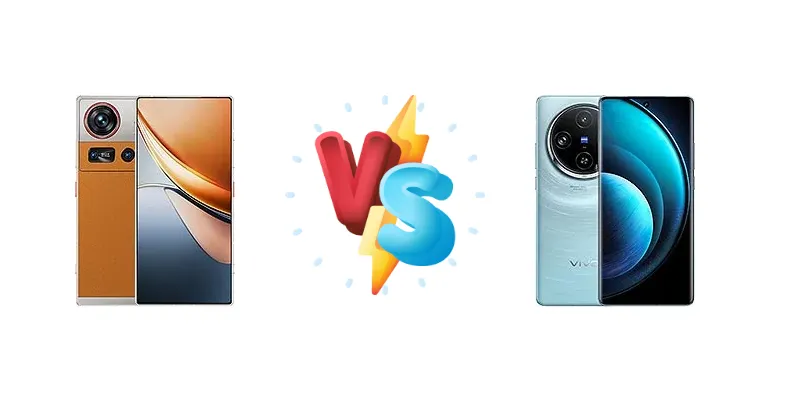
|
🏆 Quick Verdict
For users prioritizing sustained performance and a brighter display, the ZTE nubia Z70S Ultra emerges as the winner. Its Snapdragon 8 Elite chipset and 1395 nits peak brightness offer a noticeable edge in demanding tasks and outdoor visibility. However, the vivo X100 Pro’s superior battery life and faster charging are compelling advantages for power users.
| PHONES | ||
|---|---|---|
| Phone Names | ZTE nubia Z70S Ultra | vivo X100 Pro |
| Network | ||
|---|---|---|
| 2G bands | GSM 850 / 900 / 1800 / 1900 | GSM 850 / 900 / 1800 / 1900 |
| 3G bands | HSDPA 800 / 850 / 900 / 1700(AWS) / 1900 / 2100 | HSDPA 800 / 850 / 900 / 1700(AWS) / 1900 / 2100 |
| 4G bands | 1, 2, 3, 4, 5, 7, 8, 12, 17, 18, 19, 20, 25, 26, 28, 34, 38, 39, 40, 41, 42, 66 | 1, 2, 3, 4, 5, 7, 8, 12, 17, 18, 19, 20, 26, 28, 32, 38, 39, 40, 41, 42, 66 - International |
| 5G bands | 1, 2, 3, 5, 7, 8, 20, 25, 26, 28, 38, 40, 41, 66, 77, 78 SA/NSA | 1, 3, 5, 7, 8, 20, 28, 38, 40, 41, 66, 75, 77, 78, 79 SA/NSA - International |
| Speed | HSPA, LTE, 5G | HSPA, LTE, 5G |
| Technology | GSM / CDMA / HSPA / CDMA2000 / LTE / 5G | GSM / CDMA / HSPA / LTE / 5G |
| Launch | ||
|---|---|---|
| Announced | 2025, April 28 | 2023, November 13 |
| Status | Available. Released 2025, April 28 | Available. Released 2023, November 21 |
| Body | ||
|---|---|---|
| Build | Glass front (Gorilla Glass 7i), aluminum frame, glass back | Glass front, aluminum frame, glass back |
| Dimensions | 164.3 x 77.1 x 8.6 mm (6.47 x 3.04 x 0.34 in) | 164.1 x 75.3 x 8.9 mm or 9.1 mm |
| SIM | Nano-SIM + Nano-SIM | · Nano-SIM + eSIM· Nano-SIM + Nano-SIM |
| Weight | 228 g (8.04 oz) | 221 g or 225 g (7.80 oz) |
| Display | ||
|---|---|---|
| Protection | Corning Gorilla Glass 7i or Longxi glass (gen 2) | - |
| Resolution | 1216 x 2688 pixels (~431 ppi density) | 1260 x 2800 pixels, 20:9 ratio (~452 ppi density) |
| Size | 6.85 inches, 113.7 cm2 (~89.7% screen-to-body ratio) | 6.78 inches, 111.5 cm2 (~90.2% screen-to-body ratio) |
| Type | AMOLED, 1B colors, 144Hz, HDR10, 2000 nits (peak) | LTPO AMOLED, 1B colors, 120Hz, HDR10+, 3000 nits (peak) |
| Platform | ||
|---|---|---|
| CPU | Octa-core (2x4.32 GHz Oryon V2 Phoenix L + 6x3.53 GHz Oryon V2 Phoenix M) | Octa-core (1x3.25 GHz Cortex-X4 & 3x2.85 GHz Cortex-X4 & 4x2.0 GHz Cortex-A720) |
| Chipset | Qualcomm SM8750-AB Snapdragon 8 Elite (3 nm) | Mediatek Dimensity 9300 (4 nm) |
| GPU | Adreno 830 | Immortalis-G720 MC12 |
| OS | Android 15, Nebula AIOS 1.5 | Android 14, upgradable to Android 15, Funtouch 15 (International), OriginOS 4 (China) |
| Memory | ||
|---|---|---|
| Card slot | No | No |
| Internal | 256GB 12GB RAM, 512GB 16GB RAM, 1TB 16GB RAM, 1TB 24GB RAM | 256GB 12GB RAM, 256GB 16GB RAM, 512GB 16GB RAM, 1TB 16GB RAM |
| Main Camera | ||
|---|---|---|
| Features | Laser AF, color spectrum sensor, Ring-LED, dual-tone flash, panorama, HDR | Laser AF, color spectrum sensor, Zeiss optics, Zeiss T* lens coating, LED flash, panorama, HDR, 3D LUT import |
| Triple | 50 MP, f/1.7, 35mm (standard), 1/1.3", 1.2µm, PDAF, OIS 64 MP, f/2.5, 70mm (periscope telephoto), 1/2.0", 0.7µm, multi-directional PDAF (15cm - ∞), OIS, 2.7x optical zoom (vs. 26mm cam) 50 MP, f/2.0, 13mm, 122˚ (ultrawide), 1/2.88", 0.61µm, multi-directional PDAF | 50 MP, f/1.8, 23mm (wide), 1/0.98", 1.6µm, dual pixel PDAF, OIS 50 MP, f/2.5, 100mm (periscope telephoto), 1/2.51", 0.7µm, PDAF (18cm - ∞), OIS, 4.3x optical zoom 50 MP, f/2.0, 15mm, 119˚ (ultrawide), 1/2.76", 0.64µm, AF |
| Video | 8K@30fps, 4K@30/60/120fps, 1080p@30/60fps, gyro-EIS, HDR10, 10‑bit video | 8K@30fps, 4K@30/60fps, 1080p, gyro-EIS |
| Selfie camera | ||
|---|---|---|
| Features | HDR | HDR |
| Single | 16 MP, f/2.0, 24mm (wide), 1/2.8", 1.12µm, under display | 32 MP, f/2.0, 20mm (ultrawide) |
| Video | 1080p@30fps | 4K@30/60fps, 1080p@30/60fps |
| Sound | ||
|---|---|---|
| 35mm jack | No | No |
| Loudspeaker | Yes, with stereo speakers | Yes, with stereo speakers |
| Comms | ||
|---|---|---|
| Bluetooth | 5.4, A2DP, LE, aptX HD, aptX Adaptive, aptX Lossless | 5.4, A2DP, LE, aptX HD, LHDC |
| Infrared port | Yes | Yes |
| NFC | Yes | Yes |
| Positioning | GPS (L1+L2+L5), GLONASS (G1+G5), BDS (B1I+B1C+B2a+B2b), GALILEO (E1+E5a), QZSS (L1+L5) | GPS (L1+L5), GLONASS (L1), BDS (B1I+B1c+B2a+B2b), GALILEO (E1+E5a+E5b), QZSS (L1+L5), NavIC (L5) |
| Radio | No | No |
| USB | USB Type-C 3.2, OTG | USB Type-C 3.2, OTG |
| WLAN | Wi-Fi 802.11 a/b/g/n/ac/6e/7, dual-band, Wi-Fi Direct | Wi-Fi 802.11 a/b/g/n/ac/6/7, tri-band, Wi-Fi Direct |
| Features | ||
|---|---|---|
| Sensors | Fingerprint (under display, optical), accelerometer, gyro, proximity, compass | Fingerprint (under display, optical), accelerometer, gyro, proximity, compass |
| Battery | ||
|---|---|---|
| Charging | 80W wired, PD3.0, QC4 | 100W wired, 50% in 14 min 50W wireless Reverse wired |
| Type | Si/C Li-Ion 6600 mAh | Li-Ion 5400 mAh |
| Misc | ||
|---|---|---|
| Colors | Antique Brown, Classic Black | Startrail Blue, Asteroid Black, Sunset Orange, White |
| Models | NX737J | V2324A, V2309 |
| Price | £ 629.00 / € 729.00 | ₹ 59,999 |
| SAR EU | - | 0.99 W/kg (head) 1.19 W/kg (body) |
ZTE nubia Z70S Ultra
- Superior CPU performance with Snapdragon 8 Elite
- Brighter display for outdoor visibility
- Potentially better thermal management due to 3nm process
- Shorter battery life in active use
- Slower charging speeds (80W wired)
- Limited camera information
vivo X100 Pro
- Longer battery life for all-day use
- Faster 100W wired charging and 50W wireless charging
- Strong camera reputation (vivo X-series)
- Potentially lower peak CPU performance
- Slightly less bright display
- 4nm process may result in more heat under sustained load
Display Comparison
The vivo X100 Pro boasts a brighter display, reaching 1472 nits compared to the nubia Z70S Ultra’s 1395 nits. While both are excellent, the X100 Pro’s higher peak brightness translates to better readability under direct sunlight. Both likely employ LTPO technology for adaptive refresh rates, though this isn’t specified. The absence of detailed color accuracy data makes a direct comparison difficult, but both brands typically target DCI-P3 coverage for vibrant visuals. Bezels are assumed to be minimal on both devices, aligning with current flagship trends.
Camera Comparison
The context data only highlights the vivo X100 Pro’s camera capabilities generally as 'Photo / Video'. Without sensor size, aperture, or OIS details for either device, a detailed comparison is limited. However, vivo’s flagship X-series is renowned for its camera prowess, often featuring large sensors and advanced image processing algorithms. The nubia Z70S Ultra’s camera specs are entirely absent, making it difficult to assess its photographic capabilities. It’s safe to assume both phones will offer a versatile camera system, but the X100 Pro likely holds an advantage based on brand reputation and the available context.
Performance
The core of the difference lies in the chipsets. The ZTE nubia Z70S Ultra utilizes the Qualcomm Snapdragon 8 Elite (SM8750-AB) built on a 3nm process, featuring an octa-core CPU with Oryon V2 Phoenix cores clocked up to 4.32 GHz. This architecture is designed for peak performance. Conversely, the vivo X100 Pro employs the MediaTek Dimensity 9300 (4nm), with a different core configuration – 1x Cortex-X4 at 3.25 GHz, 3x Cortex-X4 at 2.85 GHz, and 4x Cortex-A720 at 2.0 GHz. While the Dimensity 9300’s core count is higher, the Snapdragon 8 Elite’s Oryon cores are known for their IPC (Instructions Per Clock) advantage. The 3nm process of the Snapdragon 8 Elite also suggests superior thermal efficiency, potentially leading to less throttling during sustained workloads. RAM specifications are not provided, but both are expected to utilize LPDDR5x for fast memory access.
Battery Life
The vivo X100 Pro demonstrates a clear advantage in battery life, achieving an active use score of 13:53h compared to the nubia Z70S Ultra’s 12:52h. This suggests better power efficiency from the Dimensity 9300 chipset. The X100 Pro also offers faster wired charging at 100W (50% in 14 minutes), alongside 50W wireless charging and reverse wired charging. The nubia Z70S Ultra is limited to 80W wired charging with PD3.0 and QC4 support. While the nubia’s battery capacity isn’t specified, the shorter runtime indicates it’s likely smaller or less efficiently utilized.
Buying Guide
Buy the ZTE nubia Z70S Ultra if you need uncompromising CPU and GPU performance for gaming or content creation, and value a display that remains easily visible in direct sunlight. Buy the vivo X100 Pro if you prioritize all-day battery life, rapid charging (including wireless), and a more balanced thermal profile for extended use.