
ZTE nubia Z70S Ultra vs. vivo iQOO 12 Pro: A Head-to-Head Flagship Showdown
| Phones Images | |||||
|---|---|---|---|---|---|
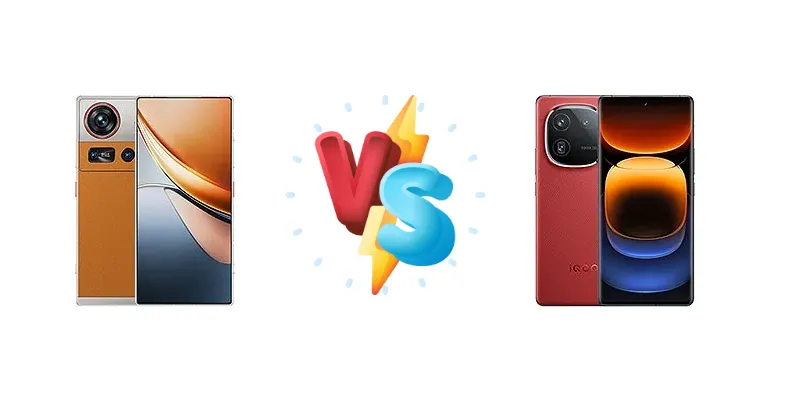
|
🏆 Quick Verdict
For the average user prioritizing all-around performance and faster charging, the vivo iQOO 12 Pro emerges as the winner. Its Snapdragon 8 Gen 3 offers excellent efficiency and gaming capabilities, complemented by 120W wired and 50W wireless charging. However, the nubia Z70S Ultra’s Snapdragon 8 Elite provides a performance edge for demanding tasks.
| PHONES | ||
|---|---|---|
| Phone Names | ZTE nubia Z70S Ultra | vivo iQOO 12 Pro |
| Network | ||
|---|---|---|
| 2G bands | GSM 850 / 900 / 1800 / 1900 | GSM 850 / 900 / 1800 / 1900 |
| 3G bands | HSDPA 800 / 850 / 900 / 1700(AWS) / 1900 / 2100 | HSDPA 800 / 850 / 900 / 1700(AWS) / 1900 / 2100 |
| 4G bands | 1, 2, 3, 4, 5, 7, 8, 12, 17, 18, 19, 20, 25, 26, 28, 34, 38, 39, 40, 41, 42, 66 | 1, 2, 3, 4, 5, 7, 8, 12, 17, 18, 19, 20, 25, 26, 28, 34, 38, 39, 40, 41, 42, 66 |
| 5G bands | 1, 2, 3, 5, 7, 8, 20, 25, 26, 28, 38, 40, 41, 66, 77, 78 SA/NSA | 1, 2, 3, 5, 7, 8, 12, 20, 25, 26, 28, 66, 38, 40, 41, 77, 78 SA/NSA |
| Speed | HSPA, LTE, 5G | HSPA, LTE, 5G |
| Technology | GSM / CDMA / HSPA / CDMA2000 / LTE / 5G | GSM / CDMA / HSPA / CDMA2000 / LTE / 5G |
| Launch | ||
|---|---|---|
| Announced | 2025, April 28 | 2023, November 07 |
| Status | Available. Released 2025, April 28 | Available. Released 2023, November 14 |
| Body | ||
|---|---|---|
| Build | Glass front (Gorilla Glass 7i), aluminum frame, glass back | - |
| Dimensions | 164.3 x 77.1 x 8.6 mm (6.47 x 3.04 x 0.34 in) | 164.6 x 75.4 x 8.6 mm or 8.8 mm |
| SIM | Nano-SIM + Nano-SIM | Nano-SIM + Nano-SIM |
| Weight | 228 g (8.04 oz) | 205 g or 210 g (7.23 oz) |
| Display | ||
|---|---|---|
| Protection | Corning Gorilla Glass 7i or Longxi glass (gen 2) | - |
| Resolution | 1216 x 2688 pixels (~431 ppi density) | 1440 x 3200 pixels, 20:9 ratio (~518 ppi density) |
| Size | 6.85 inches, 113.7 cm2 (~89.7% screen-to-body ratio) | 6.78 inches, 111.0 cm2 (~89.4% screen-to-body ratio) |
| Type | AMOLED, 1B colors, 144Hz, HDR10, 2000 nits (peak) | LTPO AMOLED, 1B colors, 144Hz, HDR10+, 1600 nits (HBM), 3000 nits (peak) |
| Platform | ||
|---|---|---|
| CPU | Octa-core (2x4.32 GHz Oryon V2 Phoenix L + 6x3.53 GHz Oryon V2 Phoenix M) | Octa-core (1x3.3 GHz Cortex-X4 & 3x3.2 GHz Cortex-A720 & 2x3.0 GHz Cortex-A720 & 2x2.3 GHz Cortex-A520) |
| Chipset | Qualcomm SM8750-AB Snapdragon 8 Elite (3 nm) | Qualcomm SM8650-AB Snapdragon 8 Gen 3 (4 nm) |
| GPU | Adreno 830 | Adreno 750 |
| OS | Android 15, Nebula AIOS 1.5 | Android 14, up to 2 major Android upgrades, Funtouch 14 (International), OriginOS 4 (China) |
| Memory | ||
|---|---|---|
| Card slot | No | No |
| Internal | 256GB 12GB RAM, 512GB 16GB RAM, 1TB 16GB RAM, 1TB 24GB RAM | 256GB 16GB RAM, 512GB 16GB RAM, 1TB 16GB RAM |
| Main Camera | ||
|---|---|---|
| Features | Laser AF, color spectrum sensor, Ring-LED, dual-tone flash, panorama, HDR | Color spectrum sensor, Dual-LED flash, HDR, panorama |
| Triple | 50 MP, f/1.7, 35mm (standard), 1/1.3", 1.2µm, PDAF, OIS 64 MP, f/2.5, 70mm (periscope telephoto), 1/2.0", 0.7µm, multi-directional PDAF (15cm - ∞), OIS, 2.7x optical zoom (vs. 26mm cam) 50 MP, f/2.0, 13mm, 122˚ (ultrawide), 1/2.88", 0.61µm, multi-directional PDAF | 50 MP, f/1.7, 23mm (wide), 1/1.3", 1.2µm, ulti-directional PDAF, OIS 64 MP, f/2.6, 70mm (periscope telephoto), 1/2.0", PDAF, OIS, 3x optical zoom 50 MP, f/2.0, 15mm, 119˚ (ultrawide), AF |
| Video | 8K@30fps, 4K@30/60/120fps, 1080p@30/60fps, gyro-EIS, HDR10, 10‑bit video | 8K@30fps, 4K@24/30/60fps, 1080p@30/60/120/240fps, gyro-EIS |
| Selfie camera | ||
|---|---|---|
| Features | HDR | HDR |
| Single | 16 MP, f/2.0, 24mm (wide), 1/2.8", 1.12µm, under display | 16 MP, f/2.5, (wide) |
| Video | 1080p@30fps | 1080p@30fps, gyro-EIS |
| Sound | ||
|---|---|---|
| 35mm jack | No | No |
| Loudspeaker | Yes, with stereo speakers | Yes, with stereo speakers |
| Comms | ||
|---|---|---|
| Bluetooth | 5.4, A2DP, LE, aptX HD, aptX Adaptive, aptX Lossless | 5.4, A2DP, LE, aptX HD, aptX Adaptive, aptX Lossless |
| Infrared port | Yes | Yes |
| NFC | Yes | Yes |
| Positioning | GPS (L1+L2+L5), GLONASS (G1+G5), BDS (B1I+B1C+B2a+B2b), GALILEO (E1+E5a), QZSS (L1+L5) | GPS (L1+L5), GLONASS (G1), BDS (B1I+B1c+B2a), GALILEO (E1+E5a), QZSS (L1+L5) |
| Radio | No | No |
| USB | USB Type-C 3.2, OTG | USB Type-C 2.0, OTG |
| WLAN | Wi-Fi 802.11 a/b/g/n/ac/6e/7, dual-band, Wi-Fi Direct | Wi-Fi 802.11 a/b/g/n/ac/6/7, tri-band, Wi-Fi Direct |
| Features | ||
|---|---|---|
| Sensors | Fingerprint (under display, optical), accelerometer, gyro, proximity, compass | Fingerprint (under display, ultrasonic), accelerometer, gyro, proximity, compass |
| Battery | ||
|---|---|---|
| Charging | 80W wired, PD3.0, QC4 | 120W wired 50W wireless 10W reverse wireless |
| Type | Si/C Li-Ion 6600 mAh | 5100 mAh |
| Misc | ||
|---|---|---|
| Colors | Antique Brown, Classic Black | Black, Red, White (BMW M branding) |
| Models | NX737J | V2329A |
| Price | £ 629.00 / € 729.00 | About 650 EUR |
ZTE nubia Z70S Ultra
- Potentially higher sustained CPU performance with Snapdragon 8 Elite
- High peak display brightness (1395 nits)
- Unique Oryon CPU architecture
- Slower charging speeds (80W wired)
- No wireless charging
- Less software optimization compared to Snapdragon 8 Gen 3
vivo iQOO 12 Pro
- Faster 120W wired charging
- 50W wireless charging and 10W reverse wireless charging
- Snapdragon 8 Gen 3 benefits from wider software optimization
- Potentially lower sustained CPU performance compared to Snapdragon 8 Elite
- Display brightness likely lower than nubia Z70S Ultra
- May prioritize gaming optimization over raw processing power
Display Comparison
The nubia Z70S Ultra boasts a measured peak brightness of 1395 nits, suggesting a vibrant and easily viewable display in direct sunlight. While the iQOO 12 Pro’s display specifications aren’t provided, iQOO typically employs high-quality AMOLED panels. The key difference lies in the chipset driving the display; the Snapdragon 8 Elite’s integrated display engine may offer slightly smoother rendering, but without detailed panel specs for the iQOO, it’s difficult to quantify. Both devices likely utilize high refresh rate panels, but the nubia’s brightness advantage is a clear win for outdoor visibility.
Camera Comparison
Without detailed camera specifications, a direct comparison is limited. However, both brands are known for delivering competitive camera systems. The nubia Z70S Ultra, given its flagship positioning, likely features a high-resolution main sensor with optical image stabilization (OIS). The iQOO 12 Pro is also expected to have a similar setup. The image processing style will likely differ – nubia often leans towards a more natural look, while iQOO tends to boost saturation and contrast. The absence of information on sensor sizes and lens apertures prevents a definitive judgment.
Performance
The core of this comparison is the chipset battle. The nubia Z70S Ultra features the Qualcomm SM8750-AB Snapdragon 8 Elite (3nm) with a unique octa-core configuration: 2x4.32 GHz Oryon V2 Phoenix L cores and 6x3.53 GHz Oryon V2 Phoenix M cores. This architecture is designed for sustained peak performance. The iQOO 12 Pro, conversely, utilizes the Snapdragon 8 Gen 3 (4nm) with a more conventional octa-core setup: 1x3.3 GHz Cortex-X4, 3x3.2 GHz Cortex-A720, 2x3.0 GHz Cortex-A720, and 2x2.3 GHz Cortex-A520. While the Gen 3’s Cortex-X4 core is powerful, the 8 Elite’s Oryon cores are specifically engineered for higher clock speeds and sustained performance. The 3nm process of the 8 Elite *should* offer better thermal efficiency, but real-world throttling will depend on each phone’s cooling solution. The iQOO 12 Pro benefits from the wider software optimization available for the Snapdragon 8 Gen 3.
Battery Life
The nubia Z70S Ultra achieves an active use battery score of 12:52h, a respectable result. The iQOO 12 Pro’s battery capacity is unknown, but its charging capabilities are a significant advantage. With 120W wired charging, the iQOO 12 Pro can likely achieve a full charge in under 30 minutes, significantly faster than the nubia’s 80W charging. Furthermore, the iQOO 12 Pro adds 50W wireless charging and 10W reverse wireless charging, features absent on the nubia. The Snapdragon 8 Gen 3’s 4nm process also contributes to better power efficiency, potentially offsetting any capacity difference.
Buying Guide
Buy the ZTE nubia Z70S Ultra if you absolutely need the highest possible CPU performance for tasks like video editing or emulation, and are willing to trade off some charging speed and potentially battery life for that power. Buy the vivo iQOO 12 Pro if you prioritize a balanced experience with excellent gaming performance, incredibly fast charging (both wired and wireless), and broader software support.