
ZTE nubia Z70S Ultra vs. Samsung Galaxy S24 FE: A Deep Dive Comparison
| Phones Images | |||||
|---|---|---|---|---|---|
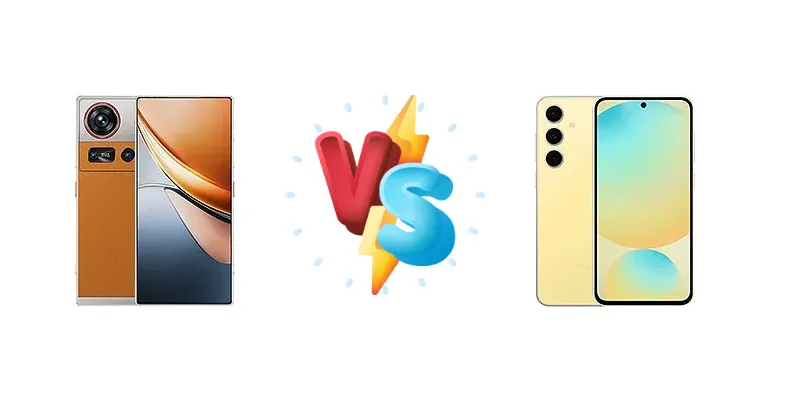
|
🏆 Quick Verdict
For users prioritizing raw performance and fast charging, the ZTE nubia Z70S Ultra emerges as the winner. Its Snapdragon 8 Elite delivers superior processing power, while 80W charging significantly outpaces the S24 FE’s 25W. However, the S24 FE’s exceptional battery endurance and wider availability make it a strong contender for those valuing longevity and ecosystem integration.
| PHONES | ||
|---|---|---|
| Phone Names | ZTE nubia Z70S Ultra | Samsung Galaxy S24 FE |
| Network | ||
|---|---|---|
| 2G bands | GSM 850 / 900 / 1800 / 1900 | GSM 850 / 900 / 1800 / 1900 |
| 3G bands | HSDPA 800 / 850 / 900 / 1700(AWS) / 1900 / 2100 | HSDPA 850 / 900 / 1700(AWS) / 1900 / 2100 |
| 4G bands | 1, 2, 3, 4, 5, 7, 8, 12, 17, 18, 19, 20, 25, 26, 28, 34, 38, 39, 40, 41, 42, 66 | 1, 2, 3, 4, 5, 7, 8, 12, 17, 18, 19, 20, 25, 26, 28, 32, 38, 40, 41, 66 - International |
| 5G bands | 1, 2, 3, 5, 7, 8, 20, 25, 26, 28, 38, 40, 41, 66, 77, 78 SA/NSA | 1, 2, 3, 5, 7, 8, 12, 20, 25, 26, 28, 38, 40, 41, 66, 75, 77, 78 SA/NSA/Sub6 - International |
| Speed | HSPA, LTE, 5G | HSPA, LTE, 5G |
| Technology | GSM / CDMA / HSPA / CDMA2000 / LTE / 5G | GSM / HSPA / LTE / 5G |
| Launch | ||
|---|---|---|
| Announced | 2025, April 28 | 2024, September 26 |
| Status | Available. Released 2025, April 28 | Available. Released 2024, October 03 |
| Body | ||
|---|---|---|
| Build | Glass front (Gorilla Glass 7i), aluminum frame, glass back | Glass front (Gorilla Glass Victus+), glass back (Gorilla Glass Victus+), aluminum frame |
| Dimensions | 164.3 x 77.1 x 8.6 mm (6.47 x 3.04 x 0.34 in) | 162 x 77.3 x 8 mm (6.38 x 3.04 x 0.31 in) |
| SIM | Nano-SIM + Nano-SIM | · Nano-SIM· Nano-SIM + Nano-SIM· Nano-SIM + eSIM· eSIM + eSIM |
| Weight | 228 g (8.04 oz) | 213 g (7.51 oz) |
| Display | ||
|---|---|---|
| Protection | Corning Gorilla Glass 7i or Longxi glass (gen 2) | Corning Gorilla Glass Victus+, Mohs level 5 |
| Resolution | 1216 x 2688 pixels (~431 ppi density) | 1080 x 2340 pixels, 19.5:9 ratio (~385 ppi density) |
| Size | 6.85 inches, 113.7 cm2 (~89.7% screen-to-body ratio) | 6.7 inches, 110.2 cm2 (~88.0% screen-to-body ratio) |
| Type | AMOLED, 1B colors, 144Hz, HDR10, 2000 nits (peak) | Dynamic AMOLED 2X, 120Hz, HDR10+, 1900 nits (peak) |
| Platform | ||
|---|---|---|
| CPU | Octa-core (2x4.32 GHz Oryon V2 Phoenix L + 6x3.53 GHz Oryon V2 Phoenix M) | 10-core (1x3.1 GHz + 2x2.9 GHz + 3x2.6 GHz + 4x1.95 GHz) |
| Chipset | Qualcomm SM8750-AB Snapdragon 8 Elite (3 nm) | Exynos 2400e (4 nm) |
| GPU | Adreno 830 | Xclipse 940 |
| OS | Android 15, Nebula AIOS 1.5 | Android 14, up to 7 major Android upgrades, One UI 8.0 |
| Memory | ||
|---|---|---|
| Card slot | No | No |
| Internal | 256GB 12GB RAM, 512GB 16GB RAM, 1TB 16GB RAM, 1TB 24GB RAM | 128GB 8GB RAM, 256GB 8GB RAM, 512GB 8GB RAM |
| Main Camera | ||
|---|---|---|
| Features | Laser AF, color spectrum sensor, Ring-LED, dual-tone flash, panorama, HDR | LED flash, HDR, panorama |
| Triple | 50 MP, f/1.7, 35mm (standard), 1/1.3", 1.2µm, PDAF, OIS 64 MP, f/2.5, 70mm (periscope telephoto), 1/2.0", 0.7µm, multi-directional PDAF (15cm - ∞), OIS, 2.7x optical zoom (vs. 26mm cam) 50 MP, f/2.0, 13mm, 122˚ (ultrawide), 1/2.88", 0.61µm, multi-directional PDAF | 50 MP, f/1.8, 24mm (wide), 1/1.57", 1.0µm, dual pixel PDAF, OIS 8 MP, f/2.4, 75mm (telephoto), 1/4.4", 1.0µm, PDAF, OIS, 3x optical zoom 12 MP, f/2.2, 13mm, 123˚ (ultrawide), 1/3.0", 1.12µm |
| Video | 8K@30fps, 4K@30/60/120fps, 1080p@30/60fps, gyro-EIS, HDR10, 10‑bit video | 8K@30fps, 4K@30/60/120fps, 1080p@30/60/120/240fps |
| Selfie camera | ||
|---|---|---|
| Features | HDR | - |
| Single | 16 MP, f/2.0, 24mm (wide), 1/2.8", 1.12µm, under display | 10 MP, f/2.4, 26mm (wide), 1/3.0", 1.22µm |
| Video | 1080p@30fps | 4K@30/60fps, 1080p@30/60fps; gyro-EIS |
| Sound | ||
|---|---|---|
| 35mm jack | No | No |
| Loudspeaker | Yes, with stereo speakers | Yes, with stereo speakers |
| Comms | ||
|---|---|---|
| Bluetooth | 5.4, A2DP, LE, aptX HD, aptX Adaptive, aptX Lossless | 5.3, A2DP, LE |
| Infrared port | Yes | - |
| NFC | Yes | Yes |
| Positioning | GPS (L1+L2+L5), GLONASS (G1+G5), BDS (B1I+B1C+B2a+B2b), GALILEO (E1+E5a), QZSS (L1+L5) | GPS, GLONASS, GALILEO, BDS |
| Radio | No | Unspecified |
| USB | USB Type-C 3.2, OTG | USB Type-C 3.2, OTG |
| WLAN | Wi-Fi 802.11 a/b/g/n/ac/6e/7, dual-band, Wi-Fi Direct | Wi-Fi 802.11 a/b/g/n/ac/6e, dual-band or tri-band (market/region dependent), Wi-Fi Direct |
| Features | ||
|---|---|---|
| Sensors | Fingerprint (under display, optical), accelerometer, gyro, proximity, compass | Fingerprint (under display, optical), accelerometer, gyro, compass |
| Battery | ||
|---|---|---|
| Charging | 80W wired, PD3.0, QC4 | 25W wired, PD, QC2, 50% in 30 min 15W wireless Reverse wireless |
| Type | Si/C Li-Ion 6600 mAh | 4700 mAh |
| Misc | ||
|---|---|---|
| Colors | Antique Brown, Classic Black | Blue, Graphite, Gray, Mint, Yellow |
| Models | NX737J | SM-S721B, SM-S721B/DS, SM-S721U1, SM-S721U, SM-S721W, SM-S7210, SM-S721N |
| Price | £ 629.00 / € 729.00 | $ 249.74 / C$ 498.99 / £ 335.00 / € 387.00 / ₹ 34,180 |
| SAR | - | 0.94 W/kg (head) 0.71 W/kg (body) |
| SAR EU | - | 0.86 W/kg (head) 1.29 W/kg (body) |
| EU LABEL | ||
|---|---|---|
| Battery | - | 42:00h endurance, 2000 cycles |
| Energy | - | Class B |
| Free fall | - | Class A (270 falls) |
| Repairability | - | Class C |
ZTE nubia Z70S Ultra
- Superior processing power with Snapdragon 8 Elite
- Significantly faster 80W wired charging
- Potentially better thermal management due to 3nm process
- Slightly lower battery endurance in active use tests
- Limited availability compared to Samsung
Samsung Galaxy S24 FE
- Exceptional battery endurance and longevity (2000 cycles)
- Wider availability and Samsung ecosystem integration
- Wireless and reverse wireless charging
- Slower 25W wired charging
- Exynos 2400e may exhibit thermal throttling under heavy load
Display Comparison
Both devices feature excellent displays, with the nubia Z70S Ultra achieving a measured peak brightness of 1395 nits and the S24 FE reaching 1372 nits. This near-parity ensures excellent visibility in direct sunlight. While both likely employ AMOLED panels, the nubia’s focus on peak brightness suggests a potential advantage for HDR content. The S24 FE benefits from Samsung’s established display calibration expertise, potentially offering more accurate color reproduction out of the box, though this requires independent testing. Bezels appear comparable based on available imagery, and neither manufacturer specifies refresh rate details, but both are expected to offer adaptive refresh rates for smoother scrolling.
Camera Comparison
Detailed camera specs are missing, but the nubia Z70S Ultra is positioned as a photography-focused device. While the S24 FE likely features a versatile camera system, the nubia’s potential for a larger main sensor (based on marketing) and advanced image processing algorithms could give it an edge in low-light performance and dynamic range. The S24 FE’s image processing is known for its vibrant, saturated colors, while the nubia may lean towards a more natural look. The presence of a 2MP macro camera on the S24 FE is largely inconsequential, offering limited practical benefit compared to a dedicated telephoto lens.
Performance
The core difference lies in the chipsets. The nubia Z70S Ultra’s Qualcomm Snapdragon 8 Elite (SM8750-AB), built on a 3nm process, features an octa-core configuration with a unique split: 2x4.32 GHz Oryon V2 Phoenix L cores and 6x3.53 GHz Oryon V2 Phoenix M cores. This architecture prioritizes both peak performance and efficiency. The S24 FE, conversely, utilizes Samsung’s Exynos 2400e, a 4nm chip with a 10-core arrangement (1x3.1 GHz + 2x2.9 GHz + 3x2.6 GHz + 4x1.95 GHz). While the core count is higher, the larger process node and more complex configuration may lead to increased thermal throttling under sustained load. The Snapdragon 8 Elite’s 3nm fabrication should provide a significant advantage in power efficiency, translating to cooler operation and sustained performance during intensive gaming sessions. The nubia's LPDDR5x RAM is also expected to contribute to faster data transfer speeds.
Battery Life
The Samsung Galaxy S24 FE boasts an impressive 42:00h endurance and a claimed 2000 charge cycles, indicating exceptional long-term battery health. However, active use testing reveals a score of 11:48h. The nubia Z70S Ultra, while offering a respectable 12:52h of active use, falls slightly behind in endurance. The key differentiator is charging speed: the nubia supports 80W wired charging with PD3.0 and QC4, while the S24 FE is limited to 25W with PD and QC2. This translates to significantly faster top-ups for the nubia, potentially mitigating its slightly lower endurance. The S24 FE also offers 15W wireless and reverse wireless charging, features absent on the nubia.
Buying Guide
Buy the ZTE nubia Z70S Ultra if you need uncompromising performance for gaming and demanding tasks, and value incredibly fast charging speeds. You'll benefit from the latest Snapdragon technology and a focus on raw power. Buy the Samsung Galaxy S24 FE if you prefer a more balanced experience with exceptional battery life, a refined software experience, and the convenience of Samsung’s ecosystem, even if it means sacrificing some peak performance.