
ZTE nubia Z70S Ultra vs. OnePlus 12R: A Head-to-Head Flagship Showdown
| Phones Images | |||||
|---|---|---|---|---|---|
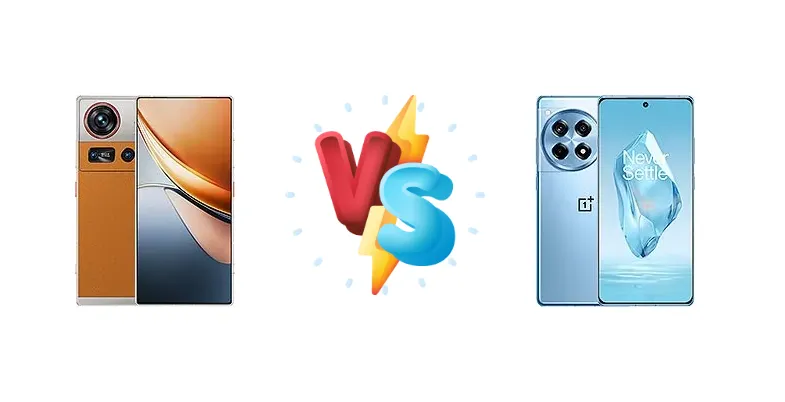
|
🏆 Quick Verdict
For the average user prioritizing all-day battery life and rapid charging, the OnePlus 12R emerges as the winner. Its 14:32h active use score and 100W charging significantly outperform the nubia Z70S Ultra, despite the latter’s more powerful chipset.
| PHONES | ||
|---|---|---|
| Phone Names | ZTE nubia Z70S Ultra | OnePlus 12R |
| Network | ||
|---|---|---|
| 2G bands | GSM 850 / 900 / 1800 / 1900 | GSM 850 / 900 / 1800 / 1900 |
| 3G bands | HSDPA 800 / 850 / 900 / 1700(AWS) / 1900 / 2100 | HSDPA 850 / 900 / 1700(AWS) / 1900 / 2100 |
| 4G bands | 1, 2, 3, 4, 5, 7, 8, 12, 17, 18, 19, 20, 25, 26, 28, 34, 38, 39, 40, 41, 42, 66 | 1, 2, 3, 4, 5, 7, 8, 12, 17, 18, 19, 20, 26, 28, 32, 38, 39, 40, 41, 66 |
| 5G bands | 1, 2, 3, 5, 7, 8, 20, 25, 26, 28, 38, 40, 41, 66, 77, 78 SA/NSA | 1, 2, 3, 5, 7, 8, 12, 20, 28, 38, 40, 41, 66, 77, 78 SA/NSA |
| Speed | HSPA, LTE, 5G | HSPA, LTE, 5G |
| Technology | GSM / CDMA / HSPA / CDMA2000 / LTE / 5G | GSM / CDMA / HSPA / LTE / 5G |
| Launch | ||
|---|---|---|
| Announced | 2025, April 28 | 2024, January 23 |
| Status | Available. Released 2025, April 28 | Available. Released 2024, February 06 |
| Body | ||
|---|---|---|
| Build | Glass front (Gorilla Glass 7i), aluminum frame, glass back | Glass front (Gorilla Glass Victus 2), aluminum frame, glass back |
| Dimensions | 164.3 x 77.1 x 8.6 mm (6.47 x 3.04 x 0.34 in) | 163.3 x 75.3 x 8.8 mm (6.43 x 2.96 x 0.35 in) |
| SIM | Nano-SIM + Nano-SIM | · Nano-SIM + Nano-SIM + eSIM (max 2 at a time)· Nano-SIM + Nano-SIM |
| Weight | 228 g (8.04 oz) | 207 g (7.30 oz) |
| Display | ||
|---|---|---|
| Protection | Corning Gorilla Glass 7i or Longxi glass (gen 2) | Corning Gorilla Glass Victus 2 |
| Resolution | 1216 x 2688 pixels (~431 ppi density) | 1264 x 2780 pixels (~450 ppi density) |
| Size | 6.85 inches, 113.7 cm2 (~89.7% screen-to-body ratio) | 6.78 inches, 111.7 cm2 (~90.9% screen-to-body ratio) |
| Type | AMOLED, 1B colors, 144Hz, HDR10, 2000 nits (peak) | LTPO4 AMOLED, 1B colors, 120Hz, HDR10+, Dolby Vision, 1600 nits (HBM), 4500 nits (peak) |
| Platform | ||
|---|---|---|
| CPU | Octa-core (2x4.32 GHz Oryon V2 Phoenix L + 6x3.53 GHz Oryon V2 Phoenix M) | Octa-core (1x3.2 GHz Cortex-X3 & 2x2.8 GHz Cortex-A715 & 2x2.8 GHz Cortex-A710 & 3x2.0 GHz Cortex-A510) |
| Chipset | Qualcomm SM8750-AB Snapdragon 8 Elite (3 nm) | Qualcomm SM8550-AB Snapdragon 8 Gen 2 (4 nm) |
| GPU | Adreno 830 | Adreno 740 |
| OS | Android 15, Nebula AIOS 1.5 | Android 14, up to 3 major Android upgrades, OxygenOS 15 |
| Memory | ||
|---|---|---|
| Card slot | No | No |
| Internal | 256GB 12GB RAM, 512GB 16GB RAM, 1TB 16GB RAM, 1TB 24GB RAM | 128GB 8GB RAM, 256GB 8GB RAM, 256GB 12GB RAM, 256GB 16GB RAM |
| Main Camera | ||
|---|---|---|
| Features | Laser AF, color spectrum sensor, Ring-LED, dual-tone flash, panorama, HDR | Laser AF, color spectrum sensor, LED flash, HDR, panorama |
| Triple | 50 MP, f/1.7, 35mm (standard), 1/1.3", 1.2µm, PDAF, OIS 64 MP, f/2.5, 70mm (periscope telephoto), 1/2.0", 0.7µm, multi-directional PDAF (15cm - ∞), OIS, 2.7x optical zoom (vs. 26mm cam) 50 MP, f/2.0, 13mm, 122˚ (ultrawide), 1/2.88", 0.61µm, multi-directional PDAF | 50 MP, f/1.8, 24mm (wide), 1/1.56", 1.0µm, multi-directional PDAF, OIS 8 MP, f/2.2, 16mm, 112˚ (ultrawide), 1/4.0", 1.12µm 2 MP (macro) |
| Video | 8K@30fps, 4K@30/60/120fps, 1080p@30/60fps, gyro-EIS, HDR10, 10‑bit video | 4K@30/60fps, 1080p@30/60/120/240fps, gyro-EIS, OIS |
| Selfie camera | ||
|---|---|---|
| Features | HDR | HDR, panorama |
| Single | 16 MP, f/2.0, 24mm (wide), 1/2.8", 1.12µm, under display | 16 MP, f/2.4, 26mm (wide), 1/3", 1.0µm |
| Video | 1080p@30fps | 1080p@30fps, gyro-EIS |
| Sound | ||
|---|---|---|
| 35mm jack | No | No |
| Loudspeaker | Yes, with stereo speakers | Yes, with stereo speakers |
| Comms | ||
|---|---|---|
| Bluetooth | 5.4, A2DP, LE, aptX HD, aptX Adaptive, aptX Lossless | 5.3, A2DP, LE, aptX HD |
| Infrared port | Yes | Yes |
| NFC | Yes | Yes |
| Positioning | GPS (L1+L2+L5), GLONASS (G1+G5), BDS (B1I+B1C+B2a+B2b), GALILEO (E1+E5a), QZSS (L1+L5) | GPS, GALILEO, GLONASS, BDS, QZSS |
| Radio | No | No |
| USB | USB Type-C 3.2, OTG | USB Type-C 2.0 |
| WLAN | Wi-Fi 802.11 a/b/g/n/ac/6e/7, dual-band, Wi-Fi Direct | Wi-Fi 802.11 a/b/g/n/ac/6/7, dual-band |
| Features | ||
|---|---|---|
| Sensors | Fingerprint (under display, optical), accelerometer, gyro, proximity, compass | Fingerprint (under display, optical), accelerometer, gyro, proximity, compass |
| Battery | ||
|---|---|---|
| Charging | 80W wired, PD3.0, QC4 | 100W wired, 100% in 26 min |
| Type | Si/C Li-Ion 6600 mAh | Li-Ion 5500 mAh |
| Misc | ||
|---|---|---|
| Colors | Antique Brown, Classic Black | Iron Gray, Cool Blue, Electric Violet, Sunset Dune |
| Models | NX737J | CPH2609, CPH2585, CPH2611 |
| Price | £ 629.00 / € 729.00 | € 410.84 / $ 399.95 / £ 649.00 |
| SAR | - | 1.19 W/kg (head) 0.82 W/kg (body) |
ZTE nubia Z70S Ultra
- Latest Snapdragon 8 Elite chipset for maximum performance
- Brighter display for better outdoor visibility
- Potentially superior camera system (based on brand positioning)
- Shorter battery life in active use
- Slower charging speed compared to the OnePlus 12R
- Potentially higher price point
OnePlus 12R
- Excellent battery life with 14:32h active use
- Ultra-fast 100W charging (0-100% in 26 minutes)
- Proven Snapdragon 8 Gen 2 performance
- Slightly dimmer display compared to the nubia Z70S Ultra
- May not match the nubia’s peak performance in demanding tasks
- Camera system may be less advanced
Display Comparison
The nubia Z70S Ultra boasts a brighter display, reaching a measured 1395 nits, compared to the OnePlus 12R’s 1181 nits. This translates to better visibility under direct sunlight. While both likely utilize high refresh rate panels (data not provided), the higher peak brightness of the nubia gives it an edge for HDR content consumption. The absence of LTPO information for either device makes it difficult to assess power efficiency gains from variable refresh rates, but both are expected to offer smooth scrolling and gaming experiences.
Camera Comparison
Without detailed camera specifications, a direct comparison is limited. However, the nubia Z70S Ultra’s positioning suggests a focus on imaging capabilities, potentially featuring a larger sensor or more advanced features. The OnePlus 12R, while capable, is likely to prioritize a more balanced camera system. The absence of information regarding OIS and lens apertures prevents a thorough assessment. It's reasonable to assume both phones will offer competent camera performance, but the nubia may have an edge in low-light scenarios or dynamic range.
Performance
The nubia Z70S Ultra’s Snapdragon 8 Elite (SM8750-AB) utilizes a 3nm process, featuring a unique octa-core configuration with Oryon V2 Phoenix cores clocked up to 4.32 GHz. This contrasts with the OnePlus 12R’s Snapdragon 8 Gen 2 (SM8550-AB) built on a 4nm node. The 3nm process of the 8 Elite *should* offer improved power efficiency and thermal headroom, allowing for sustained peak performance. However, the Snapdragon 8 Gen 2 is a highly optimized chip, and the real-world performance difference may be less dramatic than the architectural advantages suggest. The 12R’s Cortex-X3 prime core at 3.2 GHz is a strong performer, but the nubia’s Oryon cores are designed for even higher single-core speeds.
Battery Life
The OnePlus 12R’s 14:32h active use score significantly surpasses the nubia Z70S Ultra’s 12:52h. This difference is substantial and highlights the 12R’s superior battery endurance. While the nubia offers 80W wired charging with PD3.0 and QC4, the 12R’s 100W charging, capable of a full charge in just 26 minutes, provides a faster and more convenient charging experience. The 12R’s efficiency gains from the 4nm process clearly translate into real-world battery benefits.
Buying Guide
Buy the ZTE nubia Z70S Ultra if you absolutely need the latest Qualcomm silicon for maximum sustained performance in demanding tasks like video editing or high-end gaming, and are willing to trade some battery life for it. Buy the OnePlus 12R if you prioritize a longer-lasting battery, incredibly fast charging, and a more balanced overall experience without sacrificing flagship-level performance.